
Flexitank vs ISO tank
A flexitank carries liquid in a flexible bladder fitted inside a freight container. An ISO tank carries it in a reusable vessel mounted within an intermodal frame. Both can move bulk liquid through a container supply chain, but they have different cargo restrictions, filling requirements, handling arrangements, and costs after delivery.
For a compatible, non-dangerous liquid, compare both options against the actual shipment. A flexitank can suit a movement where a dry container and fitting service are readily available. An ISO tank can suit a product requiring an approved tank specification, particular transfer or temperature arrangements, or a reusable equipment cycle. Neither is automatically the cheaper choice.
Start with the product and the receiver's ability to unload it. Then establish the permitted quantity, complete route, and cost through discharge and equipment return. A favorable ocean rate has little value if the load cannot travel legally from the port or the receiver cannot accept it.
The main differences
The following comparison concerns containerized bulk liquids. DG means dangerous goods. Specialized gas tanks, refrigerated systems, and other equipment need their own specification review.
| Factor | Flexitank | ISO tank |
|---|---|---|
| Build | Bag in a dry box | Vessel in a frame |
| Cargo | Non-DG liquids | DG or non-DG; suitable tank |
| Volume | Often 24,000 L | Several sizes |
| Setup | Fit bag and supports | Check tank and cleanliness |
| Heat | Special bag/pad | Fitted system |
| After use | Remove bag; return box | Clean and return tank |
| Quote | Include fitting and removal | Include tank use and cleaning |
Cargo compatibility, approvals, and the permitted load need review for either system. Maersk's flexitank requirements specify a maximum of 24,000 L and 24,000 kg of cargo for the arrangements they cover. Eurotainer's standard liquid-tank range lists common capacities of 17,500, 21,000, 24,000, and 26,000 L. A carrier's acceptance conditions can be narrower than the equipment available from a supplier.
What the equipment descriptions mean
In a flexitank shipment, the bladder contains the liquid while the freight container and fitted supporting equipment form part of the system. The Container Owners Association's description includes the container, bladder, valves, fittings, and restraints. The bag is normally used for one transport cycle; the dry container remains reusable. See the guide to what a flexitank is for the components and fitting process.
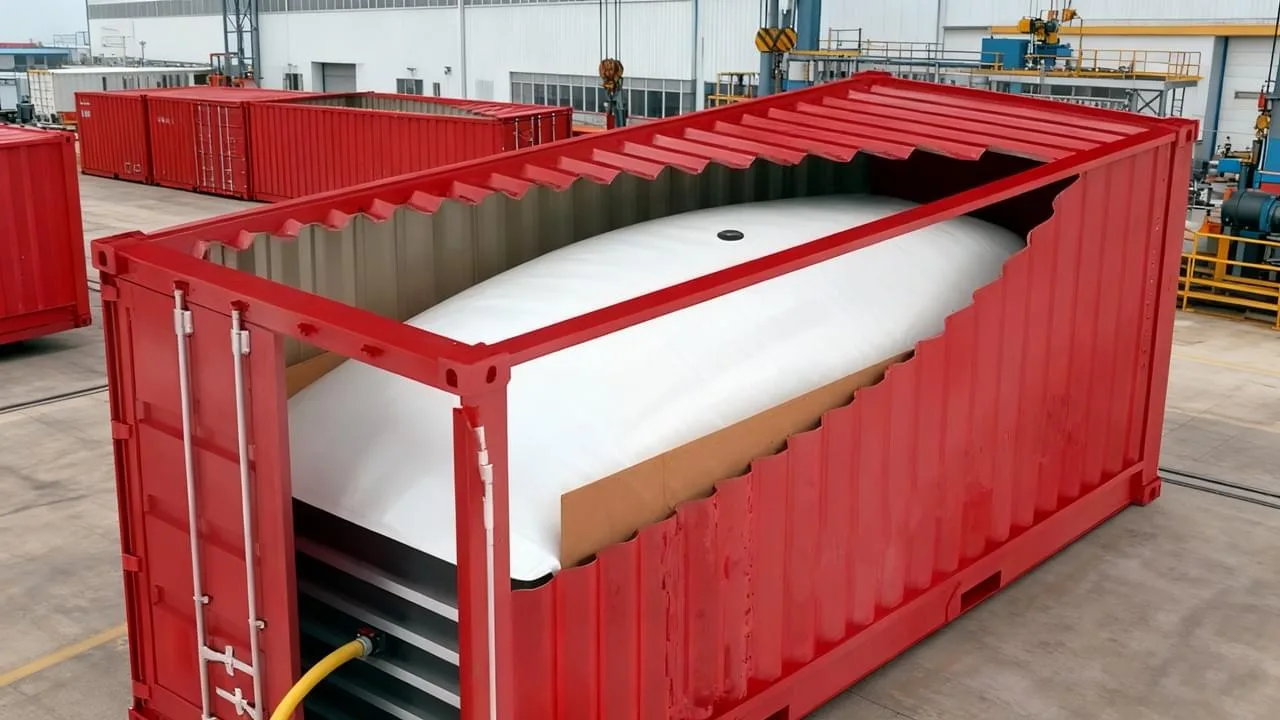
The cutaway exposes the bladder and supporting arrangement. A container used for transport keeps its roof and walls intact; the illustration is not an installation specification.
An ISO liquid tank is a separate cargo unit. Its vessel, frame, valves, seals, and any fitted heating or cooling equipment must suit the product. The tank travels on a chassis for the road leg and can be transferred between transport modes without emptying its contents. The guide to what an ISO tank is explains tank types, markings, and preparation.
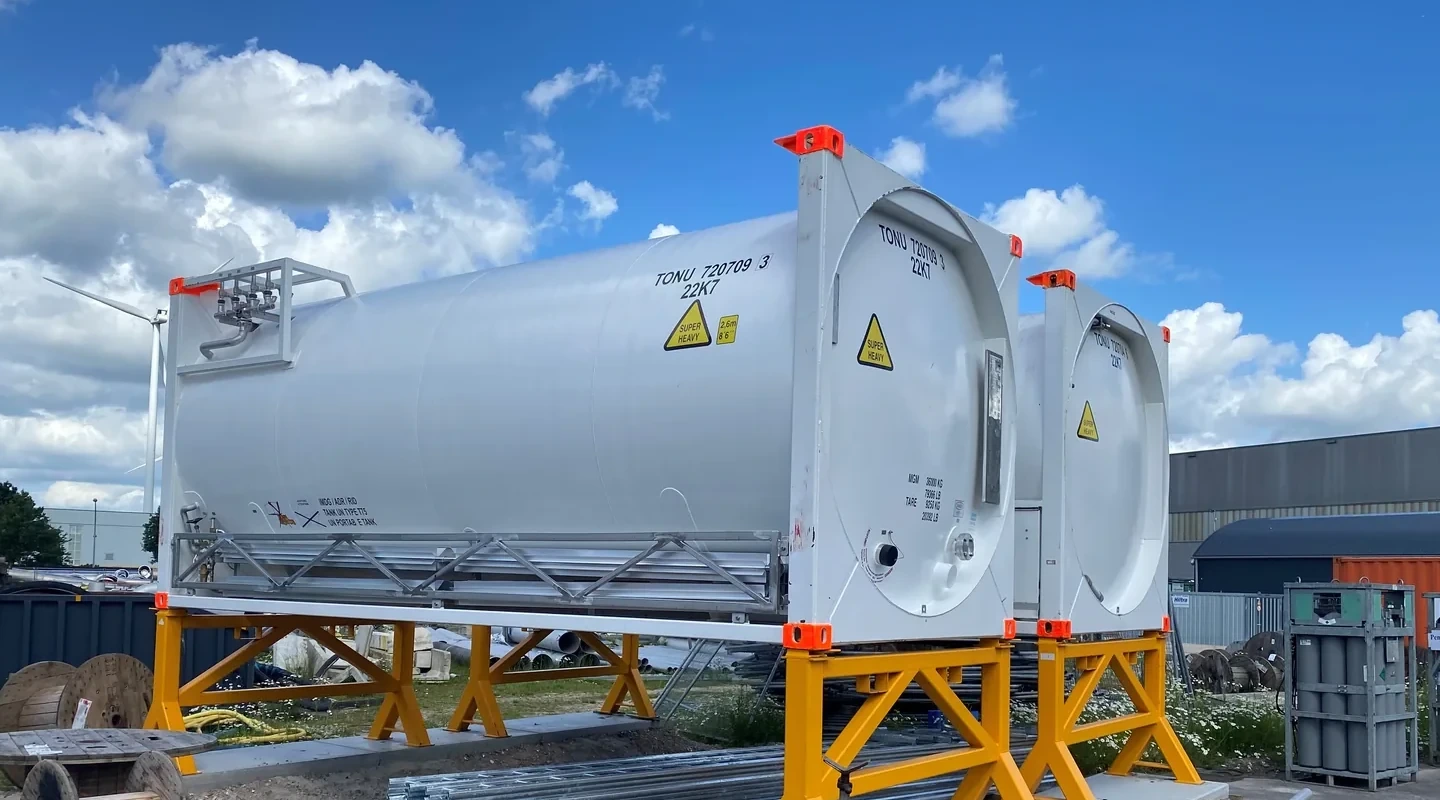
The ISO tank family also includes equipment for gases. The background photograph shows cryogenic tanks: Bofort identifies these 20-foot units as T75 tanks with vacuum insulation for refrigerated liquefied gases. Their construction and service differ from the conventional liquid tanks compared here. A flexitank is not an alternative for those gas cargoes.
Start with cargo suitability
A comparison is useful only if both systems can carry the product. Give the operator the exact commodity, grade or formulation, safety data sheet where applicable, density, viscosity, and expected temperatures. Broad descriptions such as “oil,” “chemical,” or “food product” leave important decisions unresolved.
Dangerous goods and material compatibility
Standard container flexitanks are intended for non-dangerous liquids. Maersk's requirements prohibit dangerous goods in flexitanks and require a review of the commodity and its compatibility with the bag. Classification needs to cover the complete route and relevant transport modes. The guide to what makes a shipment hazmat explains why a commercial product name is insufficient.
An ISO tank can be selected for many dangerous liquids, but “ISO tank” alone is not a cargo approval. The applicable tank instruction, materials, seals, pressure limits, outlets, and special provisions must be appropriate. For U.S. hazardous-material transport, 49 CFR 173.32 requires an authorized portable tank and prohibits loading a material that would damage the tank, react with it, or compromise containment.
Non-dangerous classification also does not establish compatibility. Ask the supplier to confirm the actual product against the specified bag or vessel, fittings, temperature range, and journey duration. Record the supplied model and operating limits with the booking.
Food quality, previous cargoes, and contamination
A new flexitank has no previous cargo inside that bladder. That is useful, but the loading hose, pump, valve, container condition, and receiving equipment still affect product quality. Avoid interpreting single use as a guarantee against all contamination.
For an ISO food shipment, agree the required tank specification, previous-cargo restrictions, cleaning standard, and acceptance documents before positioning the equipment. ITCO's food-grade cleaning guidance makes suitability dependent on the tank specification, previous cargoes, cleanliness, and shipper requirements. Stainless steel construction alone does not settle those questions.
Product protection can also influence flexitank selection. Oxygen-sensitive or odor-sensitive cargoes may need a particular barrier construction. TT Club discusses permeation and barrier selection, including the importance of matching materials to the cargo and transport conditions. Request the relevant food-contact and quality documentation for the actual equipment being supplied.
Capacity, payload, and filling limits
Capacity measures volume. Payload and road restrictions concern mass. Filling rules determine whether a proposed quantity is suitable for the selected system. Resolve all three before choosing a nominal tank size.
Convert the proposed volume to cargo mass
For planning, use the product's density at the relevant temperature:
Liquid volume in liters × density in kg/L = liquid mass in kg
For a proposed load of 24,000 L, these illustrative densities produce different liquid masses. They are not specifications for named products.
| Density | Liquid mass |
|---|---|
| 0.90 kg/L | 21,600 kg |
| 1.00 kg/L | 24,000 kg |
| 1.20 kg/L | 28,800 kg |
The last load exceeds the 24,000 kg cargo limit in the standard flexitank arrangement even though its volume is 24,000 L. At that illustrative density, 20,000 L would already weigh 24,000 kg. The supplier would need to select a system and filling quantity suited to the permitted load; a smaller liquid volume does not, by itself, establish an acceptable shipment.
For either option, keep these figures identifiable:
- Net product mass: The liquid itself.
- Packaging and equipment mass: The bag and fitting materials plus dry-container tare, or the ISO tank's actual tare, as applicable.
- Loaded unit gross mass: The container or tank together with everything carried in it.
- Complete vehicle and axle weights: The loaded unit, chassis, tractor, and other vehicle loads.
An ISO tank's data plate may permit a high loaded-unit mass, but that does not authorize the same quantity on every road. FHWA's Bridge Formula guidance explains why axle loads and spacing matter alongside gross vehicle weight. Use the actual equipment and route when checking whether a container is overweight.
For sea carriage, arrange the required Verified Gross Mass, or VGM. It concerns the loaded container, rather than liquid mass alone, and is distinct from the complete truck's scale weight. IMO's VGM guidance sets out the shipper's responsibility and the requirement before vessel loading.
Select a system that fits the quantity
The COA flexitank code of practice specifies filling within ±3% of nominal capacity. Follow the supplied manufacturer's instructions and carrier limits together. A 24,000 L bag filled with only 18,000 L is substantially outside that reference tolerance; it is not a routine solution to a smaller order or a weight restriction.
Liquid surge also affects ISO tank selection. Under the U.S. hazardous-material portable-tank provisions cited above, a qualifying tank or compartment larger than 7,500 L generally cannot be loaded above 20% but below 80% by volume. Specified viscosity and partition or surge-plate exceptions apply. ITCO's bulk-liquid guidance also recommends surge precautions for nonhazardous loads and allowance for thermal expansion.
For example, 18,000 L occupies about 69% of a 26,000 L tank. That should prompt a review of a smaller tank or an appropriate alternative design, rather than an assumption that any quantity below capacity is acceptable. Have the operator establish the permitted fill for the product, tank, temperatures, and route. A blanket instruction to fill every ISO tank to 95% is inadequate.
Special flexitanks with larger capacities or different container arrangements exist. Their availability does not override the shipping line's limits. Confirm the specific design and container combination before quoting its additional volume as a saving.
Loading, unloading, and temperature requirements
Both systems need a workable transfer plan. Before comparing transport prices, establish who supplies the pump, hoses, couplings, adapters, personnel, and receiving storage. A truck delivering a bulk-liquid container does not automatically include those services.
Prepare the receiving operation before dispatch
The receiver should confirm the following arrangements for the proposed delivery:
- Sufficient available storage capacity for the actual quantity.
- The required product temperature and an acceptable transfer rate.
- The outlet size, connection type, gasket material, and compatible hose.
- A suitable pump or another discharge method approved for the equipment and product.
- Access for the truck, safe working space, and the available unloading period.
- Personnel responsible for operating, monitoring, and ending the transfer.
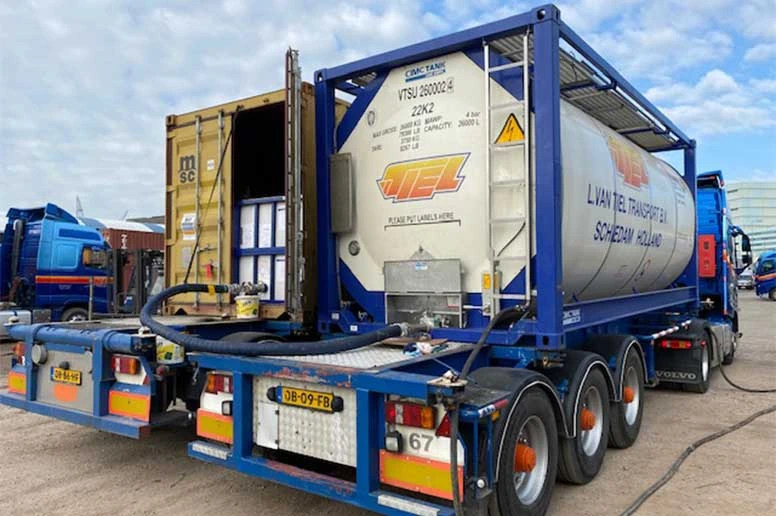
The framed tank is a separate cargo unit on its chassis. Hose access, coupling compatibility, and room to work need to be included in the site plan.
For a flexitank, the container needs inspection and preparation before the bladder and supporting system are fitted. The COA Flexitank Quality List is a useful supplier-review resource: check the relevant operator or manufacturer, design, manufacturing site, and audit information. A company name alone does not identify the supplied system.
Loading and discharge personnel should use that system's operating instructions. Cefic's flexitank guidance covers trained fitting personnel, hose support, monitored filling, leak checks, and controlled unloading. It also warns against introducing air or other gases into the bladder. Do not transfer pressure-discharge practices from an ISO tank to a flexitank.
For an ISO tank, confirm the vessel and fittings are prepared for the next cargo and that required inspections remain valid. U.S. IM and UN portable tanks have defined periodic and intermediate inspection requirements under 49 CFR 180.605. Inspection status, cleanliness, and suitability for a particular product are separate checks.
Distinguish discharge heating from temperature maintenance
A product that needs warming only before discharge has different requirements from one that must stay within a temperature band throughout transport.
Some flexitank designs can use heating pads or accommodate higher-temperature loading. For example, Hillebrand Gori's heat flexitank specifies loading and discharge temperatures up to 90°C for that design. This is a model-specific capability, not a limit that applies to every bag. Specialized refrigerated-container arrangements also exist and require approval for the supplied combination.
Suitably equipped ISO tanks offer different heating methods. Stolt explains steam and hot-water heating before unloading and electric heating on equipped tanks during transport. Insulation slows heat transfer; it does not establish active temperature control.
State the loading temperature, permissible product range, maximum contact temperature, expected conditions in transit, and required discharge condition. Confirm where heat will be supplied, how temperature will be monitored, and who pays for the time and service. A heating connection is useful only when the necessary equipment and facilities are available.
Compare the full shipment cost
Ask for comparable offers covering the same product, quantity, route, dates, and service responsibilities. A bag price, a tank rental figure, an ocean rate, and a drayage quote describe different portions of the job.
The initial equipment choice can change the costs that follow it. A flexitank may avoid positioning and returning a specialized reusable tank. An ISO tank may be competitively positioned within an operator's network and have a suitable next movement. ITCO advises shippers to obtain tank-operator quotes rather than assume flexitanks are cheaper.
Put both quotes on the same basis
For the flexitank offer, identify the bag, lining, restraints, container inspection, fitting, delivery for loading, and any supply-service charge. Include removal of the used system, residue handling, recycling or disposal, and the dry container's return conditions.
For the ISO tank offer, identify tank positioning, the tank-use period and free allowance, preparation and inspection, loaded transport, discharge support, cleaning, depot handling, and the agreed return location and condition. Establish when tank-use charges start and stop under that contract.
For both offers, review:
- Ocean, road, and any rail transport charges, including terminal and depot services.
- Chassis requirements, route weight support, permits where available and applicable, and driver qualifications.
- Pumping, hoses, adapters, transfer labor, heating, and sampling where required.
- Waiting, storage, additional trips, and equipment-use charges beyond the quoted allowances.
- Cargo insurance arrangements, relevant exclusions, and responsibility for spills or contamination.
- Expected recoverable quantity and the treatment of residual product.
Distinguish shipping-line container demurrage or detention from ISO tank-use charges. Each allowance and billing clock needs its own definition. Portmate's guide to what an all-in drayage quote means explains why a quoted total still depends on stated shipment conditions.
Compare cost per usable delivered unit
Use a consistent denominator:
Complete shipment cost ÷ usable delivered volume or mass
Consider two illustrative offers for the same compatible liquid. These U.S.-dollar totals are arithmetic examples, not market rates. Assume the operator has separately established suitable equipment and loading quantities for each option.
| Option | Cost | Volume |
|---|---|---|
| Flexitank shipment | $4,500 | 20,000 L |
| ISO tank shipment | $5,000 | 24,000 L |
The first offer costs $0.225/L. The second costs about $0.208/L despite its higher shipment total. That advantage is relevant only if the extra product is required, can be received, and can be transported within all limits. For a fixed order, compare the total number of shipments and the full cost of delivering that required quantity.
For equal usable quantities, compare the complete totals directly. Record assumptions about free time, cleaning, waste handling, heating, and return distance so a later charge does not invalidate the comparison.
Route acceptance, road transport, and returns
The equipment must be accepted throughout the movement. Resolve carrier approval and the destination plan before fitting a bag or positioning a tank.
Ocean and rail acceptance. Declare the flexitank system or tank container explicitly. Identify the operating carriers, transshipment arrangements, and inland legs. A flexitank's quality or impact-test evidence supports the review; it does not replace acceptance by the carriers that will handle the shipment. TT Club notes that some flexitank operators may not recommend rail because of the stresses involved. Include rail before or after the sea voyage in the initial request.
Road equipment and driver qualification. Give dispatch the containment type, rated capacity, cargo description, actual weight, and fill condition. For U.S. operations, the federal tank-vehicle definition can cover qualifying temporarily attached tanks carrying nonhazardous liquids. Have the provider confirm the required qualification for the actual arrangement. The tanker endorsement guide explains how tanker and hazmat qualifications differ.
Flexitank removal and dry-container return. Single use refers to the bladder. The used bag, lining, restraints, and residue still need an agreed destination, and the dry container must be cleared and returned. TT Club's disposal and return guidance describes separating materials and preparing the container for recirculation. Establish who does that work and whether it occurs at the receiver or a separate facility.
ISO cleaning and tank return. Obtain the operator's instructions for the receiving depot, timing, and return condition. A suitable cleaning facility must be available for the previous product; not every depot accepts every cargo. The EFTCO Cleaning Document records cleaning steps and is a supporting document, rather than a certificate establishing suitability for every next cargo.
An empty dirty ISO tank may retain hazardous residue or vapors. For U.S. hazardous-material movements, 49 CFR 173.29 generally requires residue-containing empty packaging to travel as it did with a greater quantity, subject to its exceptions. Do not assume discharge ends the applicable transport requirements.
Environmental tradeoffs
Compare the complete transport cycle and the actual treatment of materials. “Single use,” “reusable,” and “recyclable” each describe only part of the result.
Hillebrand Gori's flexitank assessment summary reports lower modeled carbon emissions than its ISO tank comparison under the study's route, equipment-life, and recovery assumptions. ITCO's position on flexibags emphasizes repeated tank use and the problems of recovering contaminated plastic. These industry sources support different conclusions and should not be treated as a universal ranking for every shipment.
For a useful comparison, request the assumptions behind any environmental claim:
- The amount of usable product delivered and the number of shipments required.
- Equipment manufacture and the service life allocated to each movement.
- Laden transport, empty positioning, depot travel, and available backhaul.
- Cleaning water, energy, chemicals, and residue treatment.
- Product loss and any replacement shipment.
- Documented reuse, recycling, incineration, or disposal at destination.
A flexitank recycling plan should identify the facility that will accept the used materials and the work needed to prepare them. An ISO tank comparison should account for cleaning and empty travel. Use the same calculation boundary and delivered quantity when comparing offers.
Which option fits the shipment
Use these scenarios to organize the decision. They illustrate the questions to resolve, rather than approve any named product or loading quantity.
A non-dangerous edible oil on a one-way ocean lane. A flexitank is a candidate when the product and bag are compatible, the carrier accepts the system, and both facilities can handle bulk transfer. Price the ISO alternative too. Local tank availability, cleaning, and the return plan can change the result.
A dangerous liquid chemical. A standard container flexitank is excluded. Review an appropriately approved ISO tank or another authorized transport system. Tank construction, permitted filling, cargo documentation, and residue return become part of the equipment decision.
A dense non-dangerous industrial liquid. Calculate mass before choosing capacity. The 24,000 L example at 1.20 kg/L produces 28,800 kg of liquid. Consider a smaller suitable flexitank or a properly specified ISO tank, then check the road route and filling requirements. A higher equipment rating cannot resolve an inland limit on its own.
A product that thickens in cold weather. Define the temperature required for unloading and whether temperature must be maintained in transit. Compare the actual flexitank heating design with the ISO tank's fitted systems and available depot services. Include heating time and receiver readiness in the price.
A recurring food-grade lane. Compare the flexitank supply-and-removal cycle with an ISO fleet's availability, preparation, cleanliness controls, and onward use. Regular volume gives the operator a clearer planning basis, but frequency alone does not establish which option costs less.
A small order or a receiver without bulk storage. Ask whether either bulk option fits the operation. Drums or IBC totes may be more practical when the receiver handles individual packages or cannot accept the proposed bulk quantity. Do not force a small order into an oversized tank to preserve a headline freight saving.
What to provide for comparable quotes
Send one consistent shipment brief to each provider. The reply should establish equipment suitability, the permitted load, included services, and the remaining responsibilities.
- Identify the product. Give the precise commodity and grade, transport classification, SDS where applicable, food-quality requirements, density, and viscosity.
- State quantity and temperature. Provide volume, net cargo weight, loading temperature, acceptable conditions in transit, and required discharge temperature. Identify a partial order or phased delivery requirement.
- Describe the complete route. Include origin and destination facilities, ports or terminals, dates, and every road, rail, or other planned leg.
- Request the actual equipment specification. Ask for the bag model and nominal capacity or the ISO tank specification, capacity, tare, and preparation requirements. Have the operator confirm the permitted filling quantity.
- Assign transfer responsibilities. Identify receiving storage, pump, hose, coupling, adapters, personnel, sampling, and heating. Give the appointment and unloading-time constraints.
- Define the end of the service. Establish bag removal and waste handling or tank cleaning and depot return, including locations, conditions, allowances, and chargeable time.
- Request an itemized total. Identify exclusions, conditional charges, weight assumptions, cargo coverage, and the events that would require repricing.
A practical inquiry might read:
Please compare a flexitank and an ISO liquid tank for 20,000 L of our specified non-dangerous liquid on the attached origin-to-destination route. The stated density is 1.00 kg/L, giving 20,000 kg of liquid; please account for any additional packaging or fitting weight. Our receiver has bulk storage and a pump. Please confirm compatibility, a suitable equipment capacity and filling quantity, carrier acceptance, road weight support, and the required transfer connections. Include equipment supply or use, fitting or preparation, transport, applicable heating, and removal or cleaning through the agreed equipment return. Identify free time and any services our facilities must supply.
The example provides a comparison basis, not an approved load. Add the product documents, actual addresses, dates, and temperature requirements before requesting an offer.
For Portmate drayage, state whether the move is a dry container fitted with a flexitank or an ISO tank container. The special-container guide explains why tank equipment needs manual service and pricing review. Request a lane weight-support check using the actual cargo and equipment details.
Portmate can provide flexitank supply and fitting on request. For that service, the shipper provides the pump; confirm the hose, coupling, other transfer equipment, and facility responsibilities before dispatch. Start with the drayage quote workflow and make those requirements explicit. If the cargo details are already in a booking or shipment file, upload the documents and add the handling and return instructions they do not contain.