
What is a flexitank
A flexitank is a large, flexible bladder installed inside a suitable shipping container to carry bulk liquid. It arrives empty and folded, is fitted inside the container, and expands as liquid is pumped into it. In container shipping, flexibag, flexi-bag, and flexible tank commonly refer to the same type of equipment.
The bag holds the liquid, while the container and the fitted restraint system support the shipment. The Container Owners Association's flexitank overview describes this as a complete system: container, bladder, valves, fittings, and restraints, designed for single-use transport of compatible, non-dangerous liquids.
For a shipper, the practical questions are whether the product is suitable, how much can be loaded, who fits the bag, and what equipment the loading and receiving facilities need. Portmate can provide the flexitank and fitting service on request, so the driver arrives at the shipper with the tank already installed in the container and ready for loading.
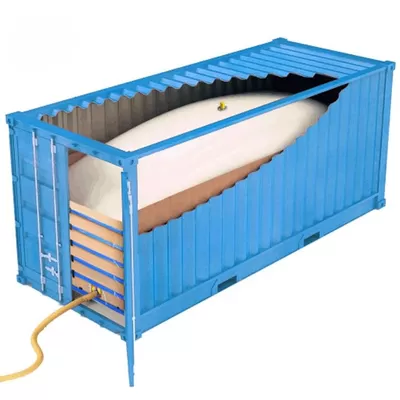
The cutaway shows the basic arrangement. In an actual shipment, the container roof and walls remain intact.
Flexitank and flexibag terminology
You will hear both names from shippers, forwarders, shipping lines, and trucking providers. In ordinary freight conversations, there is usually no difference: MSC explicitly identifies flexibag and flexitank as the same equipment.
Some technical documents make a narrower distinction. Cefic's flexitank guidance calls the bladder a flexibag and uses flexitank for the system. That terminology can help when discussing components, but it is not a universal rule for how suppliers use the words.
The useful distinction in a booking is the physical arrangement:
| Term | What to identify in the shipment request |
|---|---|
| Flexitank or flexibag | A flexible liquid bladder fitted inside a freight container |
| Flexitank system | The bag together with its container, valve, lining, and restraints |
| ISO tank container | A separate tank mounted in an intermodal frame |
| IBC tote | An individual intermediate bulk container; provide the number and rated capacity |
| Dry bulk liner or bulk bag | Packaging for a different cargo arrangement; describe the actual contents and equipment |
Instead of requesting only a “tank shipment,” specify 20-foot dry container with an installed flexitank, then give the commodity, liquid volume, and cargo weight. That removes an equipment ambiguity before anyone arranges the truck or prices the move.
What the flexitank system contains
The parts visible in a flexitank installation each have a different job. Understanding them also explains why buying a bag and arranging a container are only part of the preparation.
The bladder holds the product. Designs vary in film construction, number of layers, protective outer material, and cargo protection. Select the actual model for the liquid being shipped. For example, Kuehne+Nagel's beverage flexitank offering describes a food-contact inner layer and an oxygen-resistant barrier. Those are features of the specified equipment, rather than properties to assume for every flexitank.
The valve provides the transfer connection. Many installations use a valve near the container doors so a hose can be connected from outside. Top-loading and bottom-loading designs also exist; the operating instructions must match the supplied model.
The lining protects the bladder from the container interior. The photograph below shows protective material supplied with the fitting kit. Its placement and coverage are part of the installation specification.
The bulkhead and restraints support the door end of the installation. The panel and horizontal members in the supplied photographs are parts of a restraint assembly. A visible cardboard face is not the entire supporting structure.
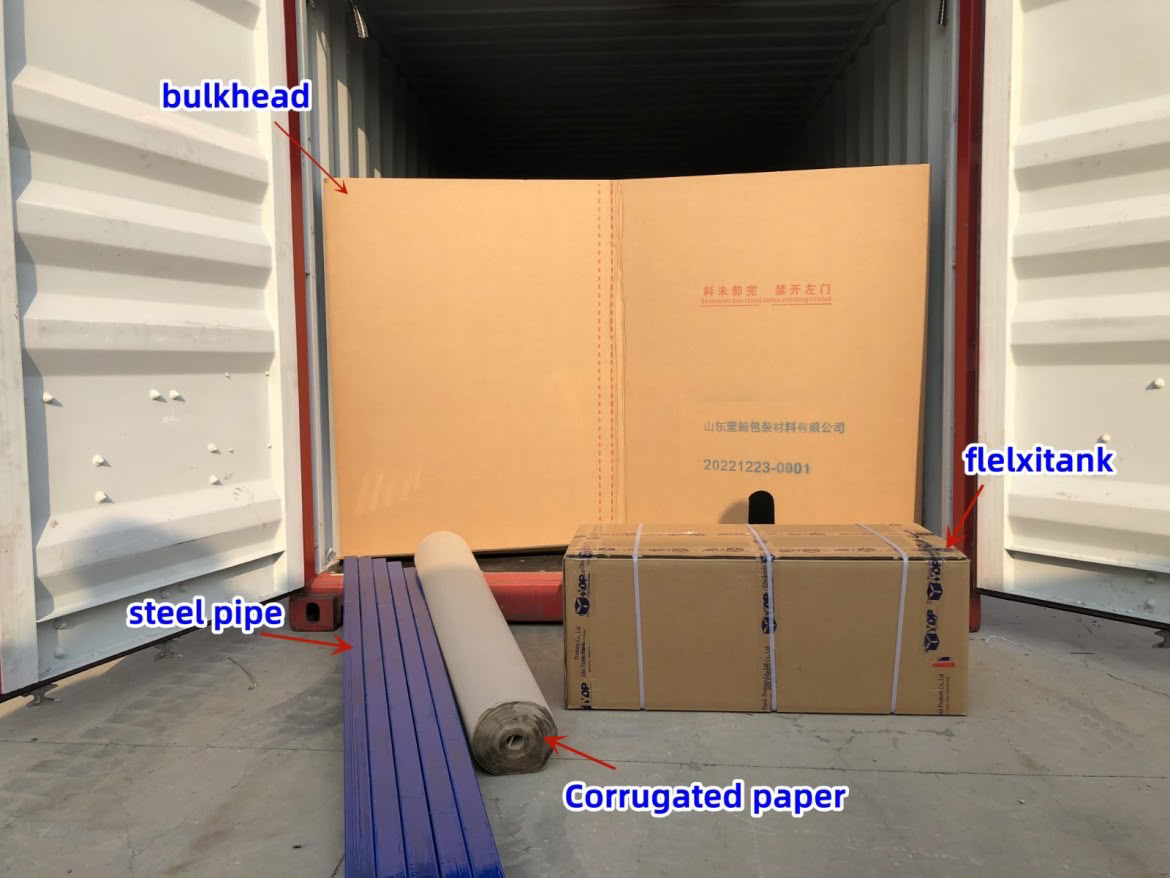
This kit photograph identifies the main components before fitting. The exact hardware and installation method depend on the flexitank design.
What liquids can be shipped in a flexitank
Common applications include edible oils, wine, juice and concentrates, and selected industrial liquids such as glycerine and lubricants. MSC's cargo examples cover both food products and nonhazardous industrial liquids.
A product name is a starting point for review. Provide the exact grade or formulation, its safety data sheet where applicable, and the conditions expected during loading and transport. Two products described as “oil” can have different classifications, temperatures, and handling needs.
Before selecting a tank, establish:
- Transport classification: Check the rules for every relevant mode and country on the route.
- Material compatibility: Obtain confirmation for the actual liquid and flexitank model.
- Temperature and viscosity: Identify loading conditions and whether the product will remain pumpable at destination.
- Product protection: State any food-contact, oxygen-barrier, odor, or other quality requirements.
- Carrier acceptance: Confirm the commodity and equipment are accepted for the planned service.
Maersk's flexitank requirements, for example, exclude dangerous goods and require a new, compatible flexitank from an accepted supplier. Other vessel operators and ports can impose their own conditions. Approval by one participant does not establish acceptance throughout the route.
For food cargo, ask for the relevant compliance and product-contact documentation for the supplied equipment. For base oil or another industrial product, give the precise product description and SDS instead of assuming that all grades have the same transport status. The guide to what makes a shipment hazmat explains why classification needs more than a commodity label.
Capacity, container size, and cargo weight
Flexitank capacity is a volume measurement. Road and container weight limits are mass measurements. Both need to be resolved before the tank size and loading quantity are confirmed.
The usual container arrangement
A 20-foot general purpose dry container is the standard starting point. Under the COA code of practice, the standard arrangement has a nominal capacity of 24,000 liters and a maximum cargo mass of 24,000 kg. The code also identifies other configurations requiring prior carrier authorization.
Treat 24,000 liters as a common reference, not a promise that every liquid, bag, container, or route can support that quantity. Smaller nominal capacities are available. The supplied model, container rating, carrier conditions, and inland transport plan determine the appropriate selection.
Specially designed systems for 40-foot and refrigerated containers exist, but a larger box is not automatic permission to use a larger bag. Confirm the specific combination. For equipment background, see standard container sizes and payloads.
Convert volume to cargo weight
For planning, liquid mass is calculated as:
Liquid volume in liters × density in kg/L = liquid mass in kg
The following examples use illustrative densities, rather than specifications for particular products:
| Liquid volume | Assumed density | Liquid mass |
|---|---|---|
| 24,000 L | 0.90 kg/L | 21,600 kg |
| 24,000 L | 1.00 kg/L | 24,000 kg |
| 24,000 L | 1.20 kg/L | 28,800 kg |
The third example exceeds the 24,000 kg cargo-mass limit described above even though the volume is still 24,000 liters. The first example has a lower liquid mass, but its road movement still requires a route and equipment check.
Use the product's actual density at the relevant temperature. Keep liquid mass, the weight of the bag and fitting materials, container tare, and complete vehicle weight identifiable in the planning information. They answer different questions. For a Portmate drayage request, provide the net cargo weight clearly and identify any separately stated packaging weight; VGM and the truck's scale gross weight are different figures.
Choose a bag that suits the intended quantity
The filling range is part of the tank specification. The COA code calls for filling within ±3% of nominal capacity. An oversized bag with a substantially reduced load is not a general solution to a road-weight problem.
Liquid moves as the vehicle brakes, accelerates, and turns. Underfilling can increase movement within the system, while overfilling can overstress it. TT Club's risk guidance connects filling limits with the dynamic forces acting on the bag and container.
If weight planning requires less product, ask the supplier to select a suitable nominal capacity and approved fill quantity. Agree that quantity before the shipper schedules production or starts pumping.
Check rail precarriage before selecting the system
If the container will travel by rail before reaching the ocean port, identify that rail precarriage when requesting the tank. The same check applies to a rail leg after the sea voyage. Not every bag or flexitank system is suitable for the stresses of rail operations, including impacts during wagon handling and shunting. TT Club's rail-transport guidance notes that some operators may not recommend rail because of the stress on the flexitank and container.
Ask the supplier to confirm the specific bag, container, and restraint combination for the planned rail movement. The COA quality scheme includes rail-impact testing for particular flexitank models and container types. Relevant test evidence supports the review, but the actual rail carrier and other carriers involved must also accept the arrangement. Settle those requirements before fitting or loading.
Flexitanks compared with ISO tanks, totes, and drums
Choose packaging around the shipment size, product requirements, and the receiver's operation. A facility that consumes liquid directly from individual totes has different needs from a plant that can receive a full bulk load into storage.
| Option | Main planning consideration |
|---|---|
| Flexitank | One bulk liquid load in a fitted container, with suitable pumping arrangements at both ends |
| ISO tank container | A reusable tank with its own specification, cleaning history, and handling requirements |
| IBC totes | Separate units that can be handled, stored, and used individually |
| Drums | Smaller individual packages, with more units to fill and handle for the same shipment volume |
An ISO tank may suit a product that needs a different containment or heating arrangement. Stolt Tank Containers describes tank construction, heating, and cleaning between trips. The precise tank type still has to match the product.
For a flexitank, a fresh bladder avoids a previous cargo inside that bag, but quality also depends on the transfer equipment and handling. When comparing quotes, include the complete work at origin and destination. A low packaging price can be misleading if the receiver then needs an unplanned transfer location or cannot unload the product.
For example, consider two hypothetical buyers ordering the same liquid. One has a bulk receiving tank and a compatible pump. The other distributes the product a tote at a time and has no bulk storage. The packaging decision should reflect those different receiving operations, even if the ocean lane is identical.
If the shipment will use an ISO tank rather than a dry container fitted with a bladder, identify it explicitly. Portmate's special container guide explains the additional equipment review.
How to ship a flexitank
Arrange the product, equipment, loading facility, carrier, and receiving operation as one shipment plan. The following sequence identifies the decisions and handoffs; the installer and transfer operators must use the supplied manufacturer's procedures for the actual equipment.
Before the truck arrives
1. Provide the cargo and lane details. Start with the exact commodity, SDS where applicable, volume, density, net cargo weight, loading temperature, origin, destination, dates, and planned transport modes. Identify a flexitank shipment explicitly in the booking instructions.
Tell the provider whether the move needs a new tank and fitting, or whether an already fitted and loaded container is being collected. An export delivery for loading and an import delivery for discharge involve different preparation.
2. Confirm acceptance and the tank specification. Resolve cargo compatibility, container type, capacity, carrier approval, and any route restrictions before dispatch. For supplier due diligence, the COA Flexitank Quality List records manufacturers, operators, designs, and audit information. Check the actual design and manufacturing site rather than relying on a general company claim.
State whether rail precarriage or any later rail leg is required, and obtain confirmation that the selected system and carriers support that part of the route.
3. Arrange inspection and fitting. The fitting provider inspects and prepares the container, installs the specified lining, positions the empty bladder, and fits the valve and restraint assembly. SIA's container-preparation guidance illustrates why cleaning, sharp-object checks, lining, and correct positioning matter.
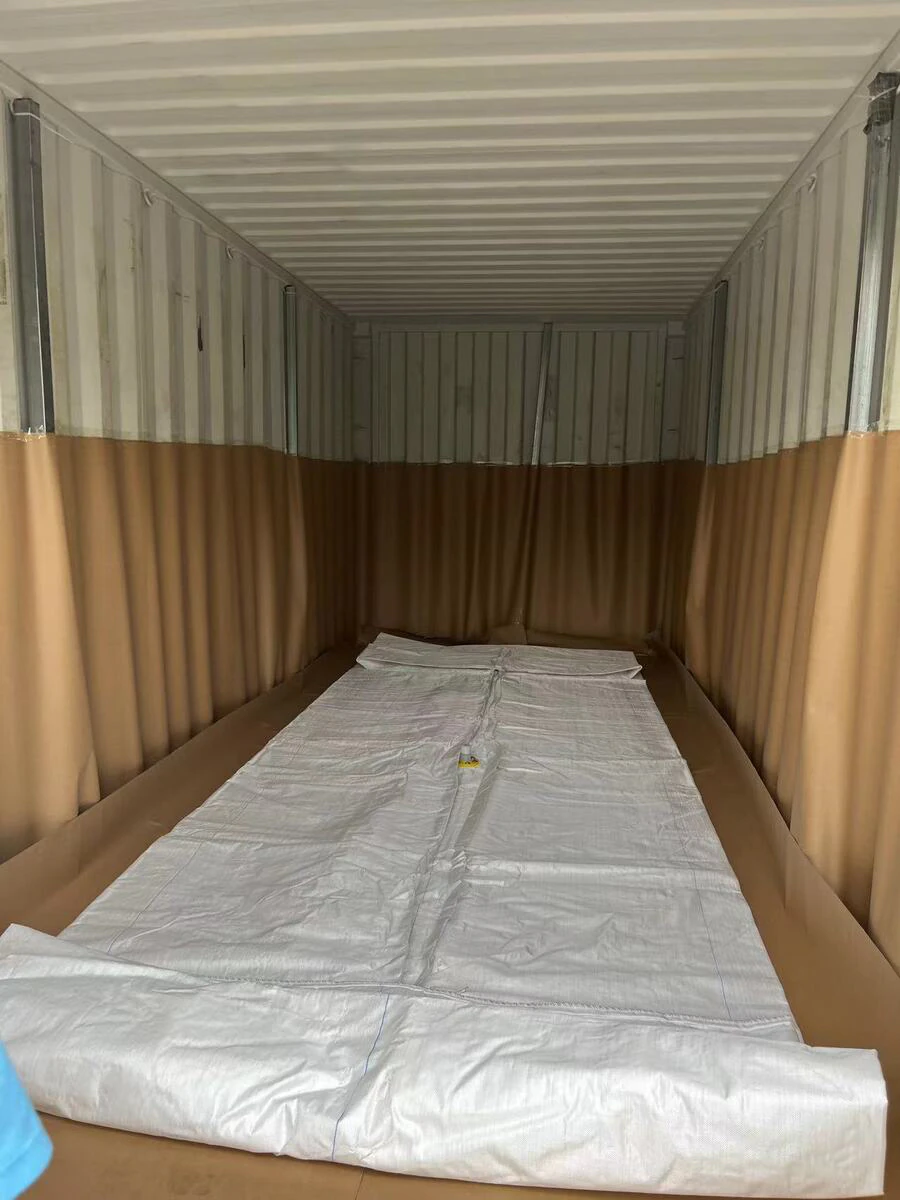
Before loading, the bladder lies flat inside the prepared container. It expands as the product enters.
Request photographs of the preparation and retain the tank model, serial number, capacity, and fitting record with the shipment documents. These details make it easier to resolve a question about the equipment without reconstructing the installation later.
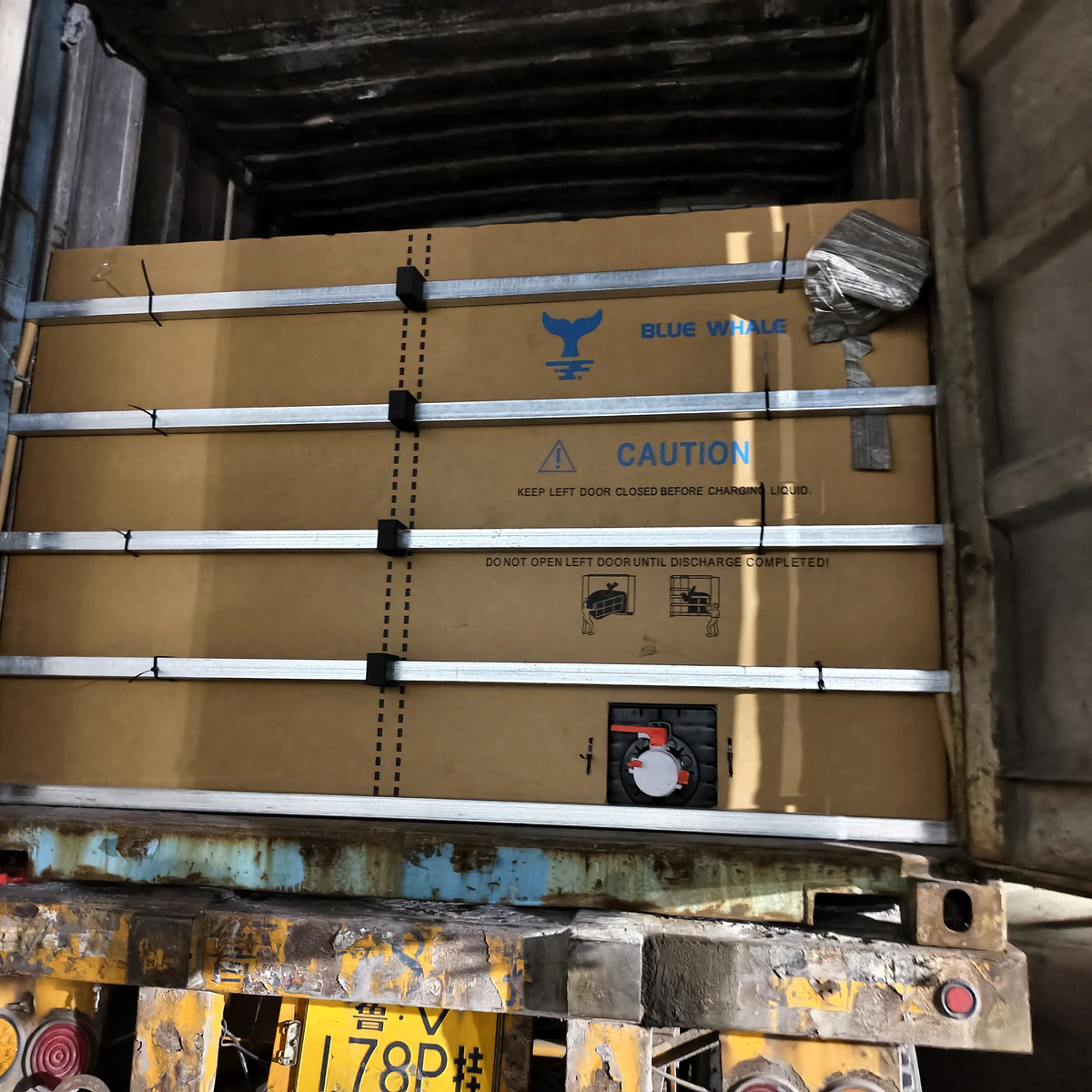
The valve opening provides transfer access while the door-end assembly remains in place. The exact restraint configuration must follow the supplied design.
At the shipper's loading facility
4. Have the pump, hose, and coupling ready. For Portmate's supply-and-fitting service, the shipper provides the pump. The facility should also have the compatible transfer hose or pipe, coupling, and any required adapter available before the truck arrives.
The valve is usually 3 inches. Confirm the actual connection with the fitting provider: diameter, coupling type, seals, product compatibility, temperature suitability, and cleanliness all matter. A matching hose and fitting can connect the facility's pumping equipment to the valve once those details are established.
Facility requirements can be specific. Standic Antwerp's published filling instructions, for example, specify 3-inch Elaflex couplings and require the bag and valve to be fitted before arrival. Use the actual loading facility's requirements for your shipment.
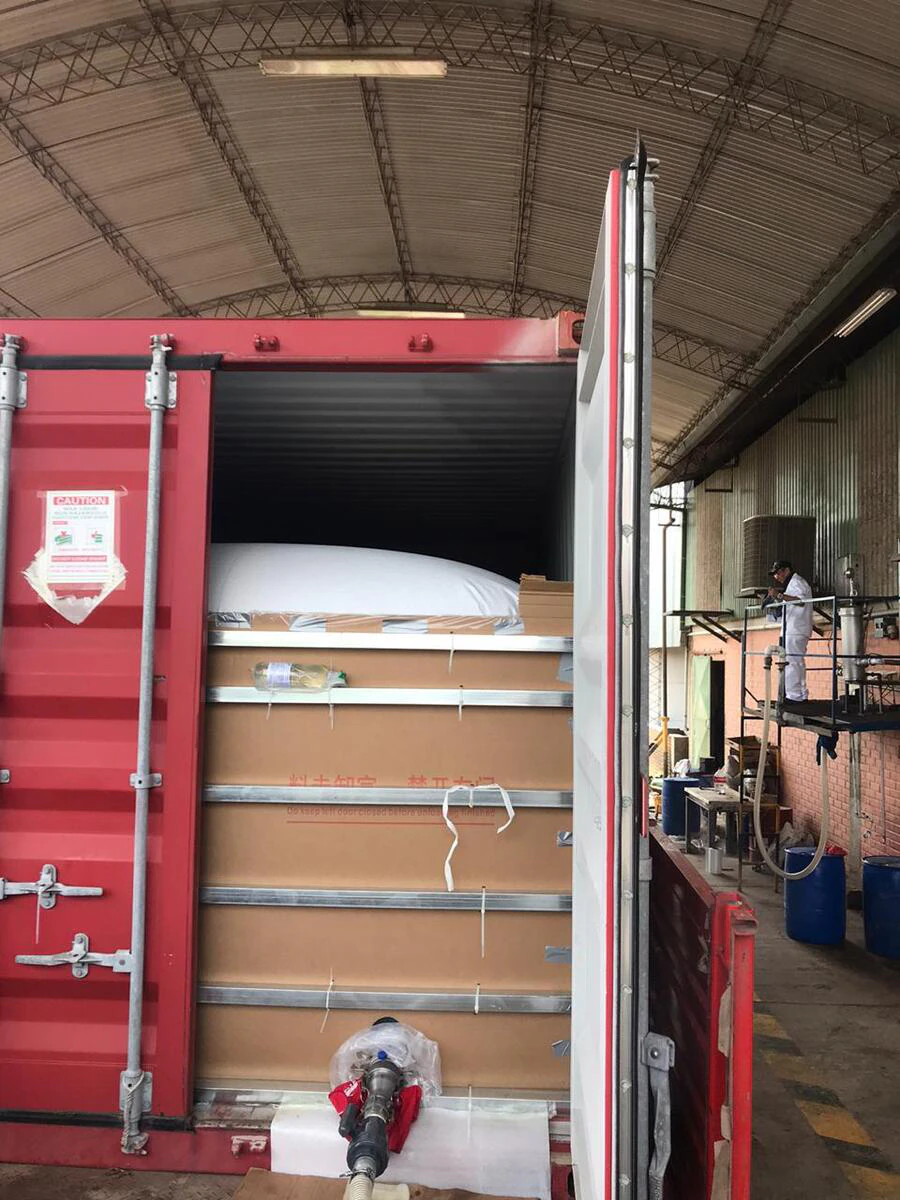
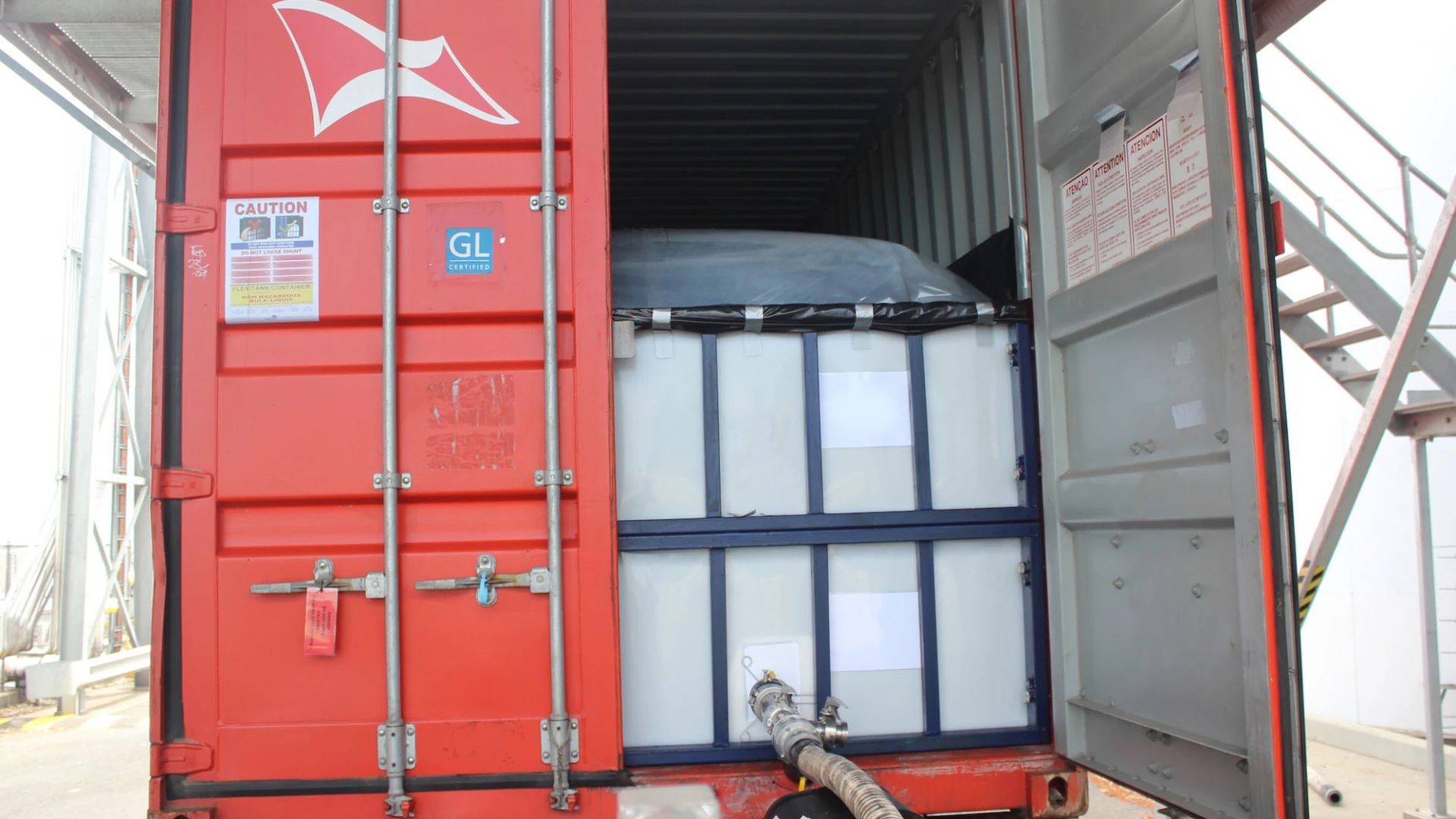
The connected hose shows the interface between the flexitank and the facility's transfer equipment.
5. Load to the agreed quantity and inspect before release. Trained personnel should monitor the transfer, use suitable spill protection, and follow the tank's specified temperature and pumping limits. Support the hose so its weight does not strain the valve. Cefic's loading guidance emphasizes controlled filling, hose support, and the manufacturer's limits; compressed-air filling is not permitted under that guidance.
Confirm who is operating the pump and supervising the facility equipment. A driver arriving with a fitted tank does not, by itself, establish that pumping labor is part of the transport service.
At completion, record the actual quantity, close and secure the valve as specified, complete the leak and container-condition checks, and apply the required seals and warnings. SIA's operating manual illustrates the importance of a supported connection and supervised loading. Obtain the current instructions for the model actually supplied.
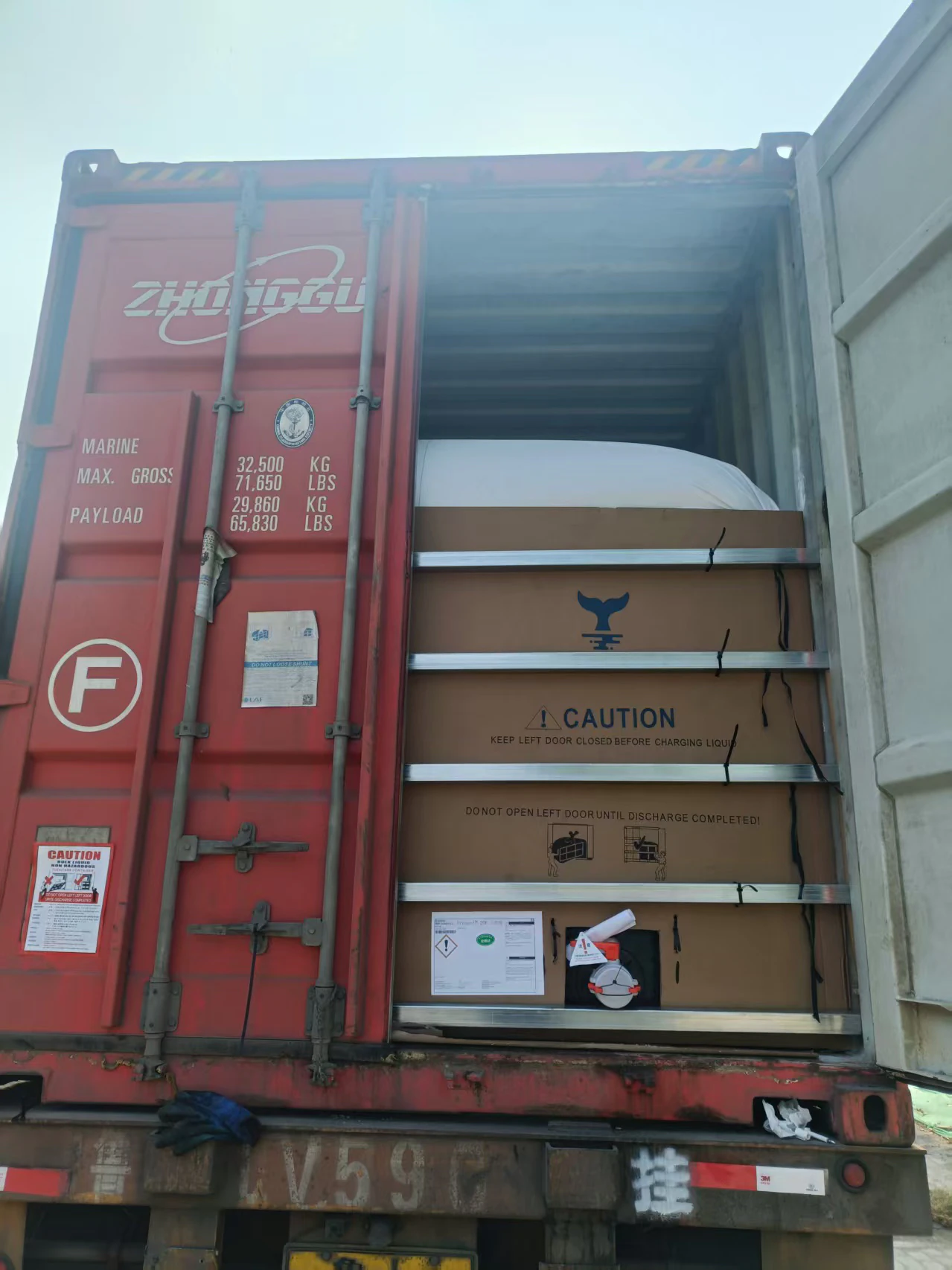
The expanded bladder sits behind the restraint assembly. Its visible shape is not a substitute for measuring the loaded quantity and checking the equipment limits.
Documents and inland transport
6. Complete the shipping records. Keep the product description, actual volume and cargo weight, container number, flexitank identification, seal details, and handling instructions consistent across the shipment paperwork. Provide the receiver with the connection and discharge information before delivery.
For sea carriage, arrange the Verified Gross Mass, or VGM, required for the packed container. VGM includes the container and its contents; it is different from liquid mass alone. The Maritime and Coastguard Agency's VGM guidance explains the shipper's responsibility and the permitted weighing approaches.
7. Confirm road weight support and driver qualification. For the U.S. road leg, the complete vehicle, axle groups, spacing, equipment ratings, and route need to be supportable. FHWA's Bridge Formula guidance explains why a total weight alone does not establish axle-group compliance.
A flexitank does not inherit the dry container's full payload allowance as an automatic loading entitlement. Check the liquid system's limit and the road plan separately. Use Portmate's container overweight guide to understand cargo-weight planning and request a lane weight-support check for the actual terminal and facility.
Driver licensing also needs attention. FMCSA confirms that qualifying bladder bags attached to trailers are tank vehicles. The federal tank-vehicle definition uses individual rated capacity over 119 U.S. gallons and aggregate rated capacity of at least 1,000 U.S. gallons for the described attached tanks. A typical loaded container flexitank is well above those capacity figures.
Tell dispatch about the bladder, its capacity, and the liquid cargo so an appropriately qualified driver can be assigned. Nonhazardous cargo can still require the tanker endorsement. The tanker endorsement guide covers the U.S. licensing distinction in more detail.
Discharge, removal, and container return
Plan unloading before shipping. Confirm the receiver's storage capacity, pump, hose and coupling, access for the container, and time needed for transfer. Give the facility the tank instructions and identify who will remove the empty bag and fitting materials afterward.
Door access is a safety-critical part of discharge. In the conventional arrangements shown here, the left-hand door stays closed during unloading and the right-hand door provides valve access. Follow the actual system's instructions and warning labels. TT Club's flexitank guide explains the door-opening precautions and the need for spill protection.
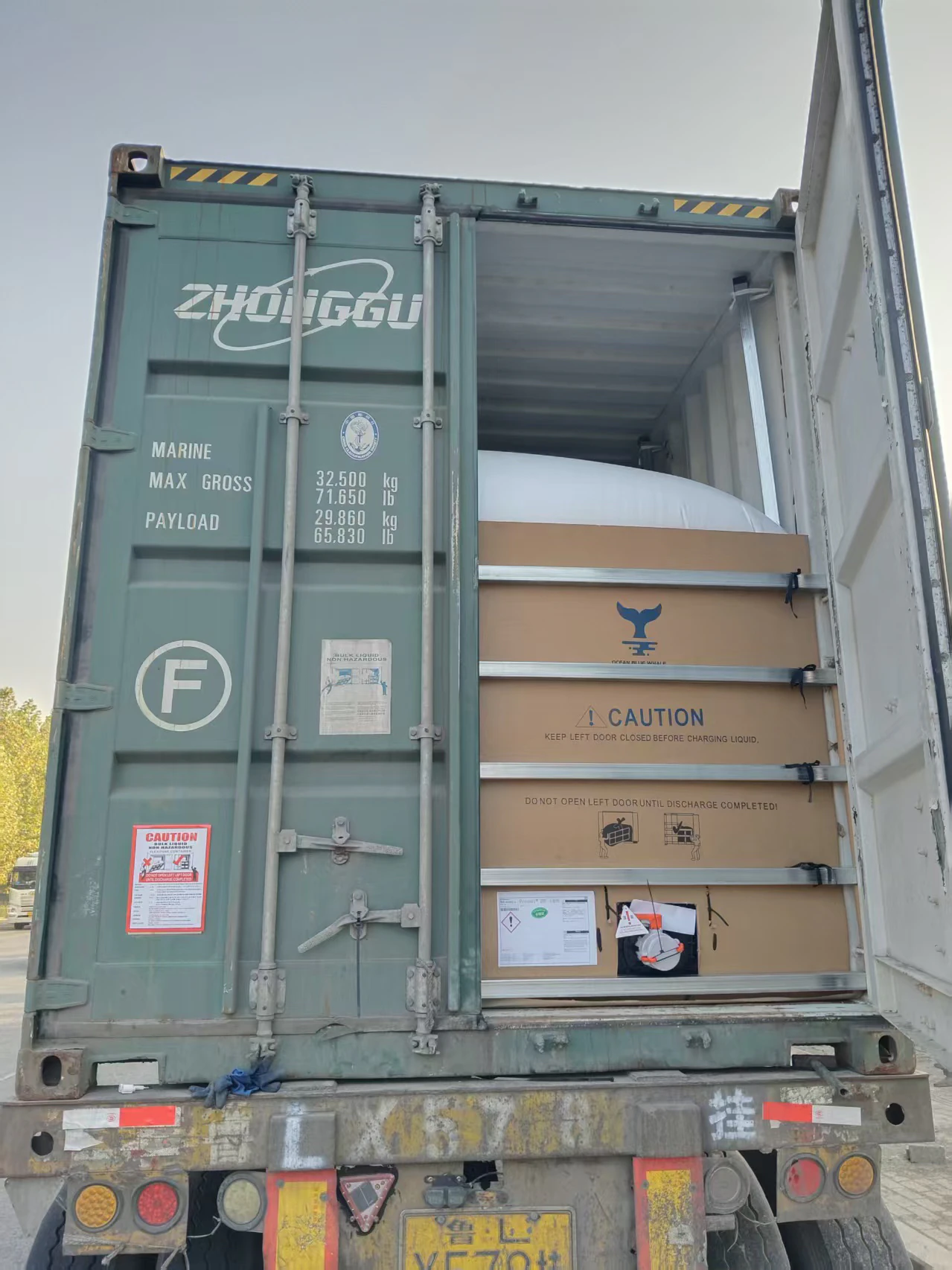
This installation shows how the valve can be reached without opening both doors. Read the warnings before approaching or operating the equipment.
If the liquid becomes too viscous or solidifies at destination temperatures, discuss heating before selecting the system. ZIM's flexitank guidance describes heater pads installed with the tank for use before discharge. Heating equipment, energy supply, and operating limits need to suit the product and supplied bag. A heating option is a separate specification, rather than an assumed feature of every installation.
After discharge, arrange controlled drainage of residues, removal of the bladder, lining, and fitting materials, and recycling or lawful disposal. TT Club's guidance on removal and container return makes clear that the freight container must be cleared for return to its operator. Recycling depends on handling the residues and separating the materials appropriately.
Assign this work before delivery. The receiver needs to know who performs it, where the used materials go, and when the container must be ready for empty return.
Requesting a flexitank and fitting through Portmate
Portmate can provide the flexitank itself and arrange fitting on request. Request this service when planning the shipment so tank supply, preparation, and trucking can be coordinated. With the fitting arranged, our driver arrives at the shipper's facility with the flexitank already installed in the container and ready for loading.
This saves the customer from sourcing the bag and coordinating fitting separately. Make the requirement explicit: a request to transport a container does not automatically communicate that you also need a tank supplied and installed.
Preparation usually takes a few days and can take up to a week, depending on the terminal. Supply and fitting are subject to flexitank inventory availability. Confirm availability and the preparation schedule before fixing the loading appointment.
The shipper must have the pump and compatible transfer connection ready. The valve is usually 3 inches; confirm the supplied valve and match the hose or pipe and fittings to it. Include any special product, temperature, coupling, or loading-site requirements in the request.
For an export shipment needing supply and fitting, provide:
- The port or terminal and the shipper's loading address.
- The commodity and relevant SDS or product specification.
- Liquid volume, density, and net cargo weight, with units.
- The proposed container type and loading date.
- Any rail precarriage or destination rail leg, including known routing and carrier requirements.
- A clear request for flexitank supply and fitting.
- Loading temperature and any known heating or product-protection needs.
- The facility's pump, hose, coupling, and operating arrangements.
- Any acceptance or handling instructions already received from the shipping line or facility.
For example:
Please quote an export move from our Houston loading facility to the booked terminal using a 20-foot dry container with a flexitank. The proposed load is 24,000 liters of a base-oil product, with stated density 0.90 kg/L and liquid weight 21,600 kg. We can provide the SDS and loading-temperature details. We need Portmate to supply the flexitank and arrange fitting so the container arrives ready for loading. Our facility has the pump; please confirm the valve and coupling details before arrival. Please confirm inventory, preparation timing, cargo acceptance, and lane weight support before we schedule loading.
The figures illustrate the information to provide. The product and proposed quantity still need cargo acceptance and route review.
Start with the drayage quote workflow and include the flexitank requirements in the same request. If the details are already in a booking or shipment file, upload the documents and add the supply, fitting, and facility instructions that the documents do not contain.
Costs and avoidable delays
Compare the full shipment scope when reviewing a flexitank price. Ask which items are included and which will be arranged or billed separately:
- Tank supply, fitting materials, inspection, and installation.
- Trucking, chassis, and any applicable weight-related equipment or permit work.
- Driver qualifications and any associated service charge.
- Loading and unloading time, waiting, and additional facility visits.
- Pumping equipment, transfer labor, and any agreed heating work.
- Removal, residue handling, recycling or disposal, and empty-container return.
If you are comparing an international shipment total, also identify which ocean, terminal, customs, and destination services each offer covers. A drayage quotation and an international door-to-door quotation have different scopes.
Many preventable delays begin with a missing handoff: the tank is fitted but the facility lacks the correct coupling; the loading date is set before inventory is confirmed; the receiver has storage but no discharge equipment; or the road-weight check uses liters as though they were kilograms.
Use one final readiness check before dispatch: accepted product, confirmed tank and fitting, supported loading quantity and route, ready transfer equipment, and an agreed receiving plan. Keep the confirmed requirements with the booking so the shipper, driver, and receiver are working from the same information.
Common questions
These questions often come up when a shipper first considers flexitank transport.
Can a flexitank be reused?
The container-shipping systems described here use a single-use bladder. Removal and recycling or disposal follow discharge. The freight container itself remains reusable.
Can I ship a partially filled flexitank?
The quantity must be within the supplied model's approved filling range. If the shipment needs less liquid, resolve the tank size and permitted quantity with the supplier before loading.
Does the driver arrive with the product already in the tank?
For Portmate's requested supply-and-fitting service, the container arrives at the shipper with the empty flexitank installed for loading. An import delivery or collection of an already loaded container is a different shipment arrangement.
Does a 3-inch valve mean any 3-inch pipe will work?
Confirm the coupling, seals, cargo suitability, temperature rating, and cleanliness as well as the diameter. Send the facility's connection specification before arrival.
Does a flexitank need a special truck?
Describe the container and liquid system to the provider. The move needs a compatible chassis, supported weights and route, and the required driver qualification. Those requirements are established from the actual shipment details.