
What is an ISO tank
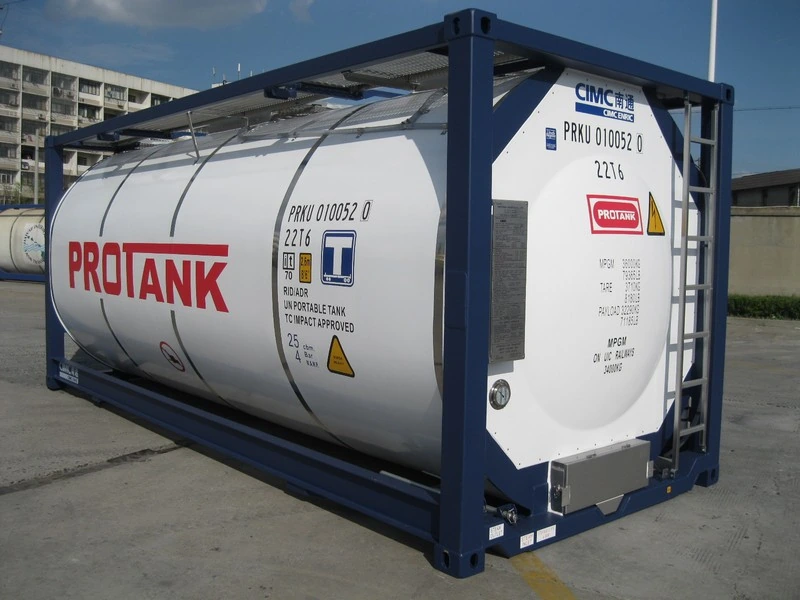
An ISO tank, or ISO tank container, is a reusable tank built for standardized container handling. The familiar liquid-cargo version has a cylindrical vessel supported within a rectangular steel frame. The same loaded unit can travel by truck, rail, and ship, keeping the product in one tank as the transport equipment changes.
In a freight conversation, “ISO tank” usually identifies the equipment arrangement. It does not, by itself, tell you the cargo, capacity, pressure rating, cleanliness, or loading requirements. A tank carrying vegetable oil and one carrying a hazardous chemical may look similar while having different specifications and operating requirements.
This guide explains the terminology, construction, cargo types, capacities, markings, and shipment process, including the details a shipper should establish before requesting transport. The ISO tank-container standard covers equipment for liquids, gases, and certain dry-bulk substances, so the broader category extends beyond the common liquid tank.
What people mean by ISO tank
ISO is the short name of the International Organization for Standardization. Strictly speaking, it is a universal short name rather than an English acronym, as ISO explains. In container shipping, its importance is practical: standardized dimensions, fittings, and testing allow equipment to work within established intermodal systems.
You may hear tank container, isotank, intermodal tank, or tanktainer used for the same general equipment. “Tank” alone is less precise. A dispatcher, warehouse, and chemical supplier might use it for a tank container, a road tanker, a storage tank, or a flexible bladder inside a dry container.
The clearer description is something like 20-foot ISO liquid tank container, followed by the commodity, tank specification, quantity, and shipment condition. For example, distinguish an empty tank being delivered for loading from an imported tank already carrying product.
A tank container travels on a chassis; the chassis is separate equipment. On the road, a tractor pulls the chassis carrying the tank. At a rail terminal or port, appropriate handling equipment transfers the container to another vehicle or vessel. A conventional road tanker's vessel is part of a different vehicle arrangement. Likewise, the tank containers in the photograph below are cargo units riding on railway cars, rather than conventional railway tank cars.
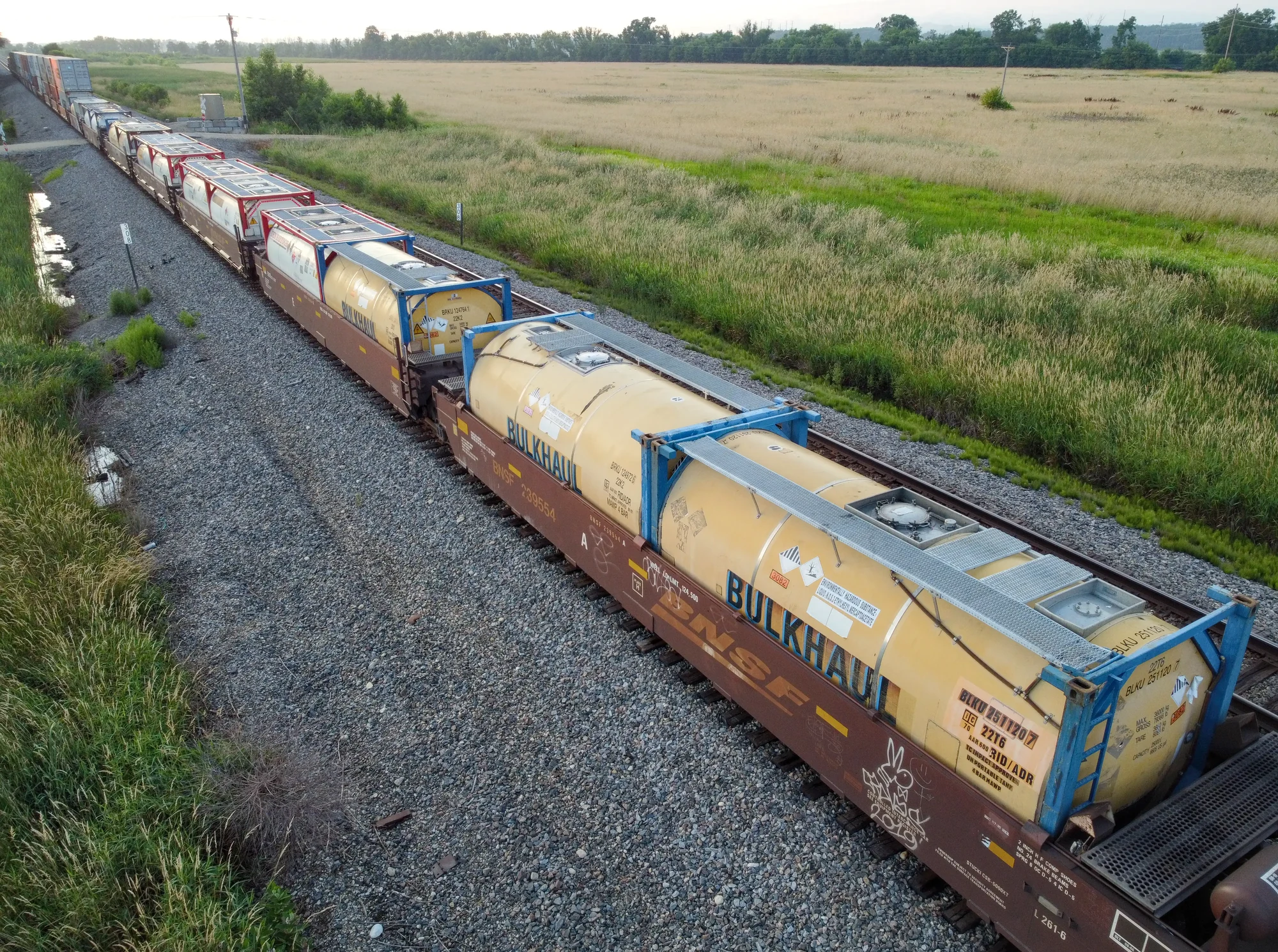
The tank stays with its cargo through these modal changes. Separate product transfers may still be arranged where the shipment requires them. Portmate's guide to what drayage means explains the local trucking connections between terminals and facilities.
How an ISO tank is built
A liquid tank combines containment, structural support, and equipment for transferring and protecting the product. Understanding those functions helps when a supplier asks about an outlet, gasket, heating system, or tank approval.
The vessel, frame, and outer covering
The vessel holds the cargo. Many standard liquid tanks have a stainless-steel shell with curved ends. The actual material, internal surface, lining where fitted, seals, and gaskets must suit the product. Stainless steel is not compatible with every chemical or every concentration and temperature.
The frame carries the structural loads. Its corner fittings provide the interfaces used for lifting, securing, and stacking within the equipment's approved limits. ISO 668 addresses container dimensions and ratings; ISO 1161 addresses corner fittings. BIC's overview of the container standards explains their separate roles. Familiar corner fittings do not establish that any chassis, lifting method, or stacking arrangement is suitable for a particular loaded tank.
The visible outer surface may be cladding. An insulated liquid tank can have an inner cargo vessel, insulation around it, and an external protective covering. The white or colored barrel surface you see in a photograph may therefore be the outer cladding. Eurotainer's T11 specification illustrates that layered construction alongside its fittings and heating coils.
Manways, valves, and discharge equipment
The exact arrangement varies, but common liquid-tank components include:
- Manway or manlid: A large access opening used for inspection, cleaning, or specified loading operations.
- Filling and discharge connections: Interfaces for the loading or receiving facility's transfer system. Some tanks have bottom discharge; others require top discharge.
- Airline or vapor connection: Part of the equipment used for specified venting, vapor return, or pressure-assisted operations.
- Pressure-relief equipment: Devices selected for the tank design and cargo requirements.
- Ladder and walkway: Access to top fittings, subject to the site's working-at-height arrangements.
- Heating connections and temperature indication: Where fitted, these support the specified temperature-management plan.
Fort Vale's tank-container equipment range shows why the fittings need to be identified individually: manways, relief valves, outlet assemblies, and specialized gas equipment have different jobs.
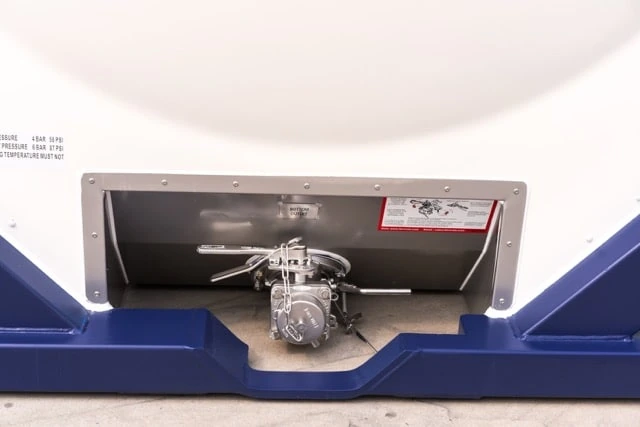
This bottom-outlet example shows the connection area a receiving facility needs to accommodate. Seaco's equipment page describes several outlet and fitting options; the supplied tank's connection must be confirmed before delivery.
A pressure-test value is different from an operating limit. For instance, a tank may be tested at a pressure above its permitted working pressure. Use its data plate, documents, and operator instructions for the actual limits. An illustration or another tank's specification is not a loading or valve-operation procedure.
What can an ISO tank carry
Tank containers serve chemical, food, industrial-gas, and other bulk supply chains. The cargo must be matched to a suitable design, preparation standard, and transport plan.
Chemical liquids can include solvents, resins, lubricants, and other industrial products. Some are regulated as dangerous goods, and others are nonhazardous for the intended transport. EXSIF's standard liquid-tank range expressly covers hazardous, nonhazardous, and food-grade cargoes. That range is not a statement that any tank in it can carry any of those products.
Food and beverage liquids include products such as wine, spirits, vegetable oils, and fruit juice. Dedicated food-service fleets exist; Stolt's food-grade operations provide examples. Food suitability involves the vessel and fittings, acceptable previous cargoes, cleaning, and any customer-specific requirements. The word “stainless” alone does not establish food-grade status.
Gases require equipment appropriate to their pressure, temperature, and physical state. A non-refrigerated liquefied-gas tank, a cryogenic tank, and a frame carrying multiple compressed-gas tubes are distinct arrangements.
Certain dry-bulk substances also fall within the wider tank-container standard. That does not make a common liquid tank a general-purpose powder container. The design and discharge equipment still need to match the cargo.
Before equipment selection, establish the precise product, relevant safety data sheet, transport classification, density, viscosity, loading temperature, and required condition at discharge. Add concentration or formulation information where it affects compatibility. The guide to what makes a shipment hazmat explains why a trade name or broad label such as “chemical” leaves important questions unanswered.
Tank types, T-codes, and gas containers
Several descriptions can apply to the same tank. A unit might be a 20-foot T11 liquid tank, insulated, fitted with heating coils, and assigned to food service. These labels describe its dimensions, regulatory instruction, features, and use; they are not mutually exclusive categories.
What T11 and other tank instructions mean
For dangerous goods, portable tank instructions, commonly called T-codes, specify requirements such as minimum test pressure, shell thickness, pressure relief, and bottom openings. The cargo's applicable entry and special provisions determine the requirements. A T-code is separate from a UN cargo identification number and a hazard class.
The portable-tank provisions in 49 CFR 172.102 illustrate the distinctions:
| Instruction | What it helps identify |
|---|---|
| T11 | A widely used liquid-tank instruction with a 6-bar minimum test pressure and specified relief and bottom-opening requirements |
| T14 | A liquid-tank instruction with different shell and relief requirements and prohibited bottom openings |
| T50 | Equipment requirements for specified liquefied compressed gases and chemicals under pressure |
| T75 | Equipment requirements for specified refrigerated liquefied gases |
T11 does not mean nonhazardous only, and T14 does not automatically mean a lined tank. Neither code alone proves compatibility with a particular acid or other chemical. A numerically higher code is also not a universal substitute: permitted alternatives must satisfy the relevant requirements.
For sea carriage of dangerous goods, the IMDG Code supplies the maritime framework. A shipment involving U.S. roads, European roads, or rail also needs the applicable requirements for those legs. Equipment approval and carrier acceptance must cover the intended movement.
Insulated, heated, baffled, and specialized tanks
Insulation slows heat transfer. Maintaining or raising the cargo temperature needs an appropriate system and energy supply. Heating coils do not imply that heat is continuously available during transport.
Stolt's explanation of cargo heating distinguishes steam and hot-water heating before discharge from electric systems used on suitably equipped tanks during transport. The method, maximum contact temperature, product-temperature range, monitoring, and available facilities need to be agreed. A product that arrives solid or too viscous to pump can create a lengthy discharge problem.
Baffles or surge plates reduce liquid movement. Their design matters when part loads are proposed. Do not assume that every tank has them, or that the presence of a baffle removes every filling restriction.
Other configurations include different vessel materials, protective linings, refrigerated equipment, compartments, and larger swap tanks. Trifleet's equipment overview separates standard ISO tanks, swap tanks, gas tanks, and cryogenic tanks. A larger tank with familiar fittings may have different handling, stacking, and route requirements.
The compressed-gas tubes in the BOC photograph
The BOC container below has several elongated gas cylinders assembled within a container frame. Its markings identify tetrafluoromethane, compressed. This multi-tube construction differs from the single-vessel liquid tanks elsewhere in this guide.
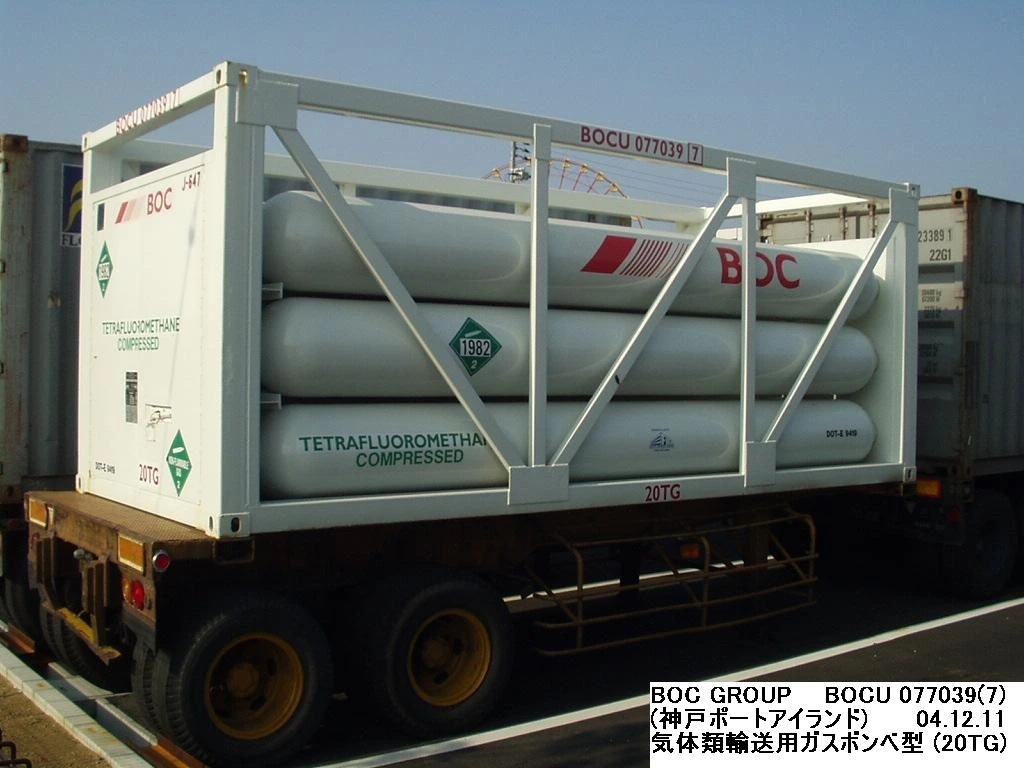
A multiple-element gas container, or MEGC, is an assembly of qualifying cylinders, tubes, or cylinder bundles connected by a manifold within a framework. The federal MEGC definition includes its service and structural equipment.
Read the unit's data plate and documents before assigning a tank instruction; the visible tubes are not evidence of T50 approval. When requesting gas transport, identify the actual gas, equipment design, pressure or temperature requirements, and approval documents.
ISO tank dimensions, capacity, and weight
A common liquid tank uses the 20-foot by 8-foot by 8-foot-6-inch container envelope, approximately 6.058 × 2.438 × 2.591 meters. That describes the external equipment size, not the volume of product it can carry.
Standard liquid-tank ranges include capacities around 17,500–26,000 liters, with other capacities and specialized designs available. For example, Eurotainer lists common liquid-tank capacities of 17,500, 21,000, 24,000, and 26,000 liters. A 24,000-liter capacity is approximately 6,340 U.S. gallons; capacity and permitted fill quantity remain separate figures.
The four figures to keep separate
Weight planning becomes clearer when each number has a name:
| Figure | Meaning |
|---|---|
| Capacity | Internal volume, usually expressed in liters or cubic meters |
| Net cargo mass | Weight of the product loaded into the tank |
| Tank tare | Weight of the empty tank container, including its frame and installed equipment |
| Loaded tank gross mass | Tank tare plus cargo and anything else included in the loaded unit |
Maximum gross mass is an equipment rating. Subtracting the actual tare gives a structural payload ceiling, subject to other limits. The weight the road movement can support may be substantially lower. The tractor and chassis also contribute to the complete vehicle's gross and axle weights.
For ocean carriage, Verified Gross Mass, or VGM, concerns the loaded container. It is different from net cargo mass and from the complete truck's scale weight. IMO's VGM guidance explains the shipper's responsibility and why the verified figure is required before vessel loading.
A worked example
Consider a hypothetical load in a tank with these stated figures:
- Tank capacity: 24,000 L.
- Proposed cargo volume: 21,600 L.
- Product density at the relevant temperature: 1.10 kg/L.
- Actual tank tare: 3,700 kg.
- Tank maximum gross rating: 36,000 kg.
Calculate liquid mass from volume and density:
21,600 L × 1.10 kg/L = 23,760 kg of cargo.
Add the tank tare:
23,760 kg + 3,700 kg = 27,460 kg loaded tank gross mass.
The proposed volume is 90% of tank capacity. The figures fall below the hypothetical tank's maximum gross rating, but they do not establish an approved shipment. Filling limits, compatibility, temperature expansion, actual equipment condition, and the transport plan remain to be checked.
If a route and vehicle review supports only 22,000 kg of product, this proposal exceeds that cargo allowance by 1,760 kg. A high tank rating cannot override the lane's limits. The revised quantity must also suit the tank's permitted fill range, rather than simply being reduced until the weight calculation passes.
FHWA's Bridge Formula explanation shows why axle loads and spacing matter alongside total truck weight. Use the actual tank and vehicle figures when checking whether a container is overweight.
Why a half-full tank can be a problem
Liquid can move within a tank during braking, acceleration, and turns. A partially filled tank leaves room for that movement, called surge or free-surface movement. Weight and stability therefore need to be considered together.
For the hazardous-material portable tanks it covers, 49 CFR 173.32 generally prohibits filling more than 20% but less than 80% by volume in a tank or compartment larger than 7,500 liters. The rule includes specified exceptions for non-flowable solids, sufficiently viscous liquids, and tanks divided into qualifying sections by partitions or surge plates.
For broader planning, ITCO's bulk-liquid guidance also addresses surge precautions for nonhazardous cargo and the space required for thermal expansion. Maximum filling depends on the product and applicable provisions; a blanket instruction to “fill every ISO tank to 95%” is inadequate.
A smaller-capacity tank or an appropriate baffled design may be needed for a lower-volume shipment. Have the operator confirm the allowable quantity for the product, tank, temperature range, and complete route before loading.
How to read the numbers and plates
Several systems appear on a tank, and they answer different questions. Photograph the relevant markings and keep the documents with the booking instead of relying on an equipment nickname.
Container identification identifies the unit. BIC describes a three-letter owner or principal-operator prefix, an equipment-category letter, six serial digits, and a check digit. In BOCU 077039 7, the last digit checks the recorded identification; it is not a hazard class or tank instruction. See BIC's identification guide.
Size and type codes describe container characteristics. A marking such as 22T6 belongs to the container size/type system. Its T6 characters should not be read as the separate UN portable tank instruction T6. BIC's size/type explanation describes how that four-character system is structured; the applicable coding edition also matters when reading older equipment.
The CSC safety approval plate concerns container safety approval and structural information. IMO's CSC overview explains the structural tests, approval plate, and owner's examination responsibilities. A CSC plate is not a cleaning record or approval for a particular commodity.
Tank data and inspection markings provide information such as capacity, pressure limits, approval references, and test dates. Obtain legible copies and the corresponding inspection documents. A five-year periodic inspection and test and a 2.5-year intermediate inspection and test apply to IM and UN portable tanks under the U.S. periodic-testing provisions, with the detailed requirements and exceptions in that section. Other tank designs have their own schedules.
Cargo placards and identification numbers communicate the transported hazard and material. They do not identify the tank's capacity or establish that it has been cleaned. The distinctions between hazard classes are covered in the hazmat classes guide.
How an ISO tank shipment works
A tank movement combines equipment preparation, product transfer, transport, and a return plan. The receiving facility and cleaning destination should be resolved before the loaded tank leaves origin.
Select and prepare the equipment
1. Establish the cargo and the full journey. Give the operator the product information, volume, density, net weight, loading and discharge temperatures, origin, destination, dates, and transport modes. Identify any hazardous-goods classification and special handling requirements. The equipment review must cover the actual route, including terminal acceptance and the receiving operation.
2. Confirm a suitable tank and its condition. Review capacity, materials, seals, tank instruction where applicable, fittings, heating or cooling, and current inspection status. Agree any previous-cargo restrictions and the preparation standard. Stolt's description of its pre-load inspections includes the vessel, frame, valves, seals, and fitted heating or venting equipment. Periodic testing does not replace preparation for the next load.
3. Arrange delivery to the loading site. Confirm the chassis, appointment, site access, transfer connection, and responsibility for loading equipment and labor. Specify whether you need an empty prepared tank supplied, transport of a shipper-owned unit, or collection of an already loaded tank. Those are different service scopes.
Load and transport
4. Load to the approved quantity under the facility's procedures. The loading plan must address the product, connections, filling limit, pressure and temperature limits, required vapor arrangements, and any grounding or other cargo-specific controls. Trained personnel should perform the transfer using the actual tank's procedures. Record the loaded quantity and secure the fittings and seals as required before release.
5. Complete the documents and transport handoffs. Keep the tank number, commodity, weight, quantity, seal information, and handling instructions consistent. Arrange the VGM for the sea leg and the required dangerous-goods documents where applicable. Confirm which party manages the ocean or rail booking, local trucking, and terminal charges.
For U.S. road transport, driver qualification is a separate part of preparation. The federal tank-vehicle definition can cover qualifying attached tanks carrying liquids or gases, including nonhazardous products. Tank and hazmat qualifications are distinct; the tanker endorsement guide explains N, H, and X endorsements and empty-return considerations.
Discharge, clean, and return
6. Have the receiving operation ready. Confirm available storage capacity, the product's discharge temperature, tank access, hose and coupling, pump or other approved discharge method, transfer personnel, and time allowance. Arrange any heating before the delivery appointment. Never assume a tank-delivery quotation includes the facility's pump, hose, adapter, or product-transfer labor.
7. Follow the agreed empty-return and cleaning instructions. Establish who handles residues, which depot can accept the previous product, who pays for cleaning and any additional work, and where the tank is returned. ITCO's cleaning guidance emphasizes planning for a qualified cleaning station at destination; not every station can clean every cargo.
An empty dirty tank has been discharged but still contains product residue or vapors. It is different from a clean, prepared tank. In U.S. hazardous-material transport, 49 CFR 173.29 generally requires residue-containing empty packaging to move as it did when carrying a larger quantity, subject to the section's exceptions. Do not remove placards merely because the receiver has finished pumping.
Cleaning documentation needs to match what was done. The EFTCO Cleaning Document records cleaning steps and is explicitly described by EFTCO as a support document, not a certificate. A record of cleaning does not, by itself, establish suitability for every next product. Follow the shipper's acceptance requirements and the agreed inspection standard.
Tank entry and access to top fittings require their own controlled working arrangements. A clean-looking tank is not evidence of a safe atmosphere; ITCO's safety guidance addresses trained personnel and atmosphere checks before entry.
ISO tanks compared with other liquid-shipping options
Choose the packaging around product suitability, shipment quantity, the route, and how the receiver will use the cargo. A plant receiving bulk liquid into storage has different needs from a distributor selling individual totes.
| Equipment | Main distinction |
|---|---|
| ISO tank container | Reusable tank and intermodal frame, with a specification and service history to manage |
| Flexitank | Flexible bladder fitted inside a suitable freight container for accepted non-dangerous liquids |
| IBC totes | Separate bulk packages that the receiver can handle and use individually |
| Drums | Smaller individual packages, with more units to fill, handle, and empty |
| Road tanker | Tank-vehicle arrangement selected for road transport and the facility's transfer requirements |
A flexitank and an ISO tank are different containment systems even when both travel through a container terminal. Standard container flexitanks use a single-use bladder; the freight container remains reusable. See what a flexitank is for the bag, fitting, capacity, and loading arrangements.
An ISO tank's reuse can reduce the need for individual disposable packages, but its cleaning, repositioning, and return movements belong in the comparison. Avoid assuming that one option is always cheaper or environmentally preferable on every lane. Product loss, washing, energy, packaging, equipment availability, and the transport cycle can change the result.
For example, a receiver with bulk storage and a compatible unloading system may be able to use a tank delivery directly. A receiver distributing the same product in small quantities may need decanting, additional storage, or a different package. Compare the delivered operation, including what happens after the truck reaches the gate.
What to provide when requesting ISO tank transport
Tell the provider that the move involves an ISO tank at the start of the request. Tank containers require equipment and service review; selecting a standard dry-container category leaves out essential information. Portmate's special-container guide explains the manual review needed for tank drayage.
Provide these details together:
- Service scope: Import delivery, export loading, empty positioning, loaded transfer, depot return, or a broader tank-supply arrangement.
- Locations and timing: Terminal or depot, loading or receiving address, appointment requirements, dates, and planned return location.
- Cargo: Exact product, relevant SDS, transport classification, and any food-grade or previous-cargo restrictions.
- Quantity and weight: Liters or cubic meters, density and temperature basis, net cargo mass, tank tare, and loaded gross mass where known.
- Equipment: Tank size, capacity, number, specification and inspection documents, plus whether it is loaded, empty clean, or empty dirty.
- Transfer and temperature needs: Connection details, approved discharge method, pump responsibility, heating or cooling, and available site facilities.
- Agreed instructions: Carrier or terminal acceptance, cleaning destination, and any restrictions already identified by the tank operator.
For an imported loaded tank, a request could read:
Please review an import delivery of a 20-foot ISO liquid tank from the booked terminal to our receiving plant. It contains 21,600 liters of product at a stated density of 1.10 kg/L, with net cargo mass of 23,760 kg and tank tare of 3,700 kg. We can provide the product specification, SDS, tank number, and inspection documents. Our facility has bulk storage and a pump; please confirm the outlet and coupling before delivery. Please confirm the chassis and route weight support, cargo acceptance, driver requirements, and approved depot return. Advise whether heating or cleaning needs a separate arrangement.
The numbers illustrate a complete request, rather than a pre-approved loading quantity. Keep net cargo mass identifiable when asking for a lane weight-support check. Standard-container assumptions should not be applied to a tank without review.
If the details are already in a booking, tank certificate, or shipment file, upload the shipment documents and add the facility and service requirements the documents do not cover. Confirm tank supply, pumping, heating, and cleaning explicitly whenever they are needed.
Costs and avoidable delays
There is no single meaningful “ISO tank shipping price” without a defined scope. Transporting a loaded tank for one local leg differs from supplying equipment and arranging an international round trip.
When comparing quotations, identify which costs are included:
- Equipment hire or use, positioning, and any agreed return or repositioning movement.
- Ocean or rail transport, terminal handling, local trucking, and chassis.
- Cargo-specific handling, driver qualifications, and applicable route or weight arrangements.
- Facility waiting, additional visits, pumping, product transfer, and heating.
- Tank use beyond the agreed allowance, storage, cleaning, residue disposal, inspection, and repairs under the contract.
Ask which charges depend on time, actual services, or tank condition. Confirm the start and end of any equipment-use allowance and which party authorizes extra depot work. A price comparison is useful only when the offers cover the same movement and responsibilities.
Common delays arise when the receiver has the wrong coupling, the cargo arrives too cold to unload, the proposed weight cannot be supported on the road leg, or no nearby depot accepts the previous product for cleaning. An unconfirmed tank-return location can also leave the truck and equipment without an agreed next destination.
Before dispatch, the shipper, tank operator, carrier, and receiver should share one consistent plan: the identified tank and product, permitted loading quantity, supported route, ready transfer facilities, and agreed return instructions.
Common questions
The name and appearance of the equipment leave several recurring questions.
Are all ISO tanks 20 feet long?
No. Twenty-foot liquid tanks are a familiar starting point, but specialized sizes and other tank-container designs exist. Confirm dimensions, handling approvals, and capacity for the actual unit.
Does an ISO tank always carry hazardous cargo?
No. Tank containers also carry nonhazardous industrial liquids and food products. Cargo classification and equipment suitability must be established separately.
Is every ISO tank pressurized during transport?
The pressure rating establishes an equipment limit; it does not tell you the tank's actual pressure. Cargo properties, temperature, and the specified operating arrangement determine the condition. Treat pressure as a fact to establish through the operator's procedures.
Can it be used for storage?
Tank containers can form part of a storage arrangement, but an approval for transport does not settle all site-storage requirements. Confirm the product, duration, temperature management, local site requirements, and tank owner's permission and charges.
Can I ship less than a full tank?
Possibly, using equipment and a quantity that meet the relevant filling, surge, expansion, and weight requirements. A smaller tank or suitable baffled design may be needed. Agree the permitted quantity before loading.
Can a chemical tank be washed and used for food?
A wash alone does not establish acceptance. The tank specification, previous cargoes, fittings, preparation, and food customer's requirements must support the intended use. Confirm those requirements before sourcing the unit.
Does ISO tank delivery include unloading?
The transport and transfer scopes must be agreed. Confirm the pump, hoses, couplings, labor, heating, and receiving storage explicitly, along with who performs each task.
Does an empty tank need cleaning before return?
Follow the tank operator's return instructions. Some movements deliver an empty dirty tank to a designated cleaning depot; others require a specified clean condition. Declare residue and previous contents accurately, and retain the applicable transport controls until the relevant requirements have been met.