
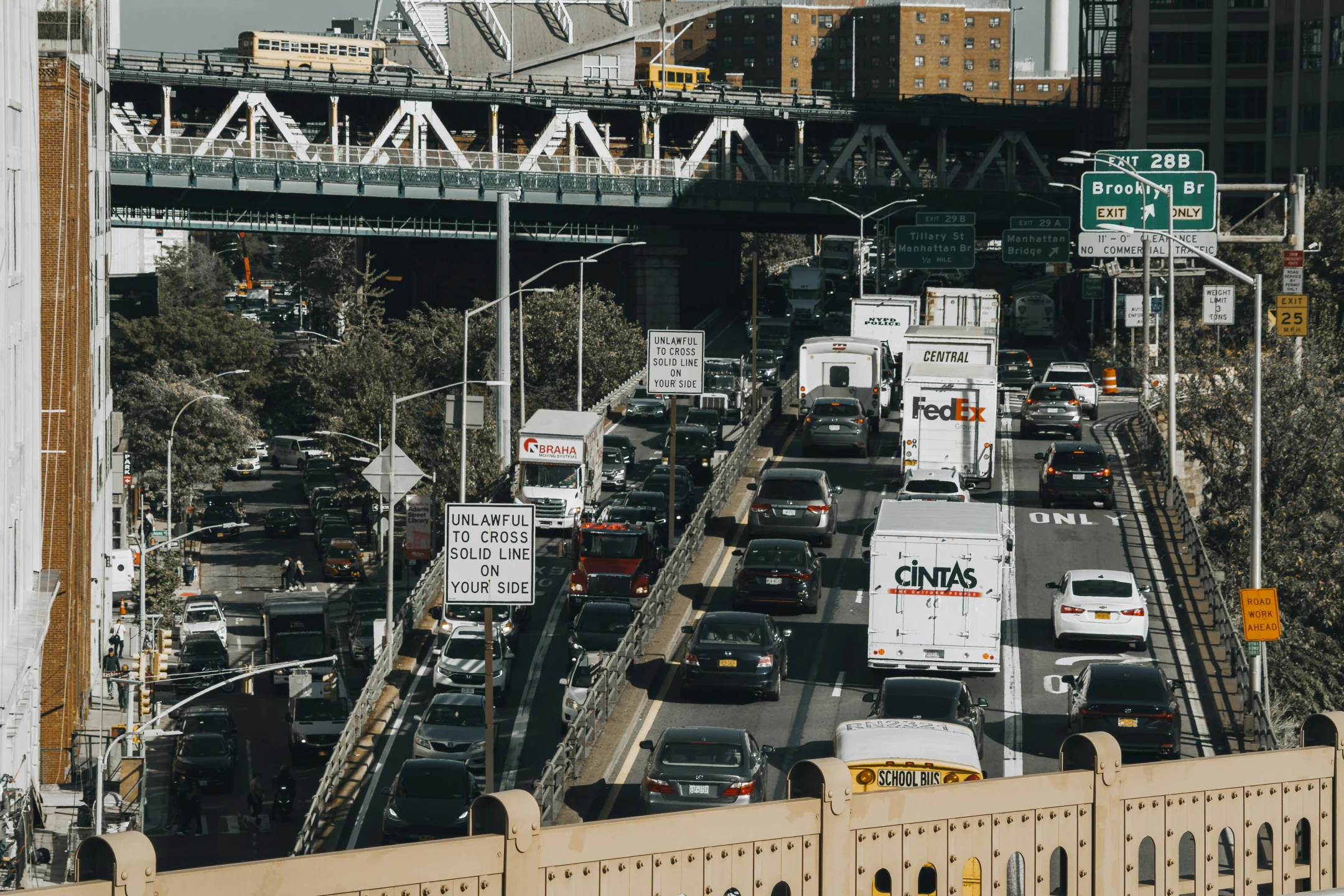
Overweight limits in New York
Under state law and NYC's weight rules, 80,000 lb is the upper limit for the complete loaded vehicle, including the tractor, trailer or chassis, container, and freight. A truck can be overweight below 80,000 lb if an axle, a group of axles, or a posted bridge has a lower limit. To find out what you can haul, start with the assigned truck and check its weight against every segment from the pickup gate to the receiver's truck entrance.
That last step matters around the harbor. An 88,000 lb tractor and chassis with a sealed ocean container may qualify for the Goethals Bridge corridor to Port Liberty New York on Staten Island. Send it to a warehouse in Queens and the carrier needs a different set of approvals. On an eligible state route, New York's Type 12 permit can reach 100,000 lb, but it does not authorize a city street or raise the 90,000 lb Goethals corridor ceiling.
Find the legal weight for the route
Use the table to screen an ordinary truck with pneumatic tires. In all three cases, the usual gross ceiling is 80,000 lb. Axle count, spacing, and road or crossing restrictions can lower it.
| Road rules | Single axle | Typical pair |
|---|---|---|
| Interstate | 20,000 lb | 34,000 lb |
| New York State outside NYC | 22,400 lb | 36,000 lb |
| NYC streets | 22,400 lb | 36,000 lb |
On an Interstate, under the federal weight rule, axles no more than 40 inches apart count as a single axle, and the federal tandem limit applies above 40 inches through 96 inches. Apply the Federal Bridge Formula as well. Use the FHWA's Interstate baseline for New York when screening a route that includes Interstate miles, even if the pickup and delivery are on local roads.
Under New York State law, axles less than 46 inches apart count as one. Two separately counted consecutive axles less than 8 ft apart can carry up to 36,000 lb. At 8 ft through just under 10 ft, the state uses the bridge formula for the pair with a 40,000 lb cap. At exactly 8 ft the state rule changes, while the federal tandem rule still includes 96 inches. Use the actual center-to-center measurement when a group is near a boundary.
On NYC streets, NYC DOT's published table lists 36,000 lb for two axles spaced at least 4 ft 6 in and less than 10 ft apart. If the pair is closer, confirm the applicable limit with the NYC DOT Truck Unit before using the 36,000 lb figure. For three or more axles, the city calculation uses 34,000 lb plus 1,000 lb per foot between the outer axles, subject to the 80,000 lb ceiling. NYC DOT also directs carriers to check the bridge formula for permit eligibility; check the Interstate and crossing rules separately wherever they apply. State and city rules also list 800 lb per inch of tire width and 11,200 lb on one wheel for pneumatic tires.
Certain vehicles have narrow statutory exceptions. For example, § 385 provides a gross exception up to 82,000 lb for qualifying natural-gas vehicles and excludes up to 400 lb of documented, functioning idle-reduction equipment from specified state weight calculations. Ask the carrier to identify the exact rule, equipment and documentation before using an exception on the route.
Check the inner groups and the full axle span
For three or more axles, the NY DMV weight guide explains how to compare 34,000 lb plus 1,000 lb per foot and major fraction of a foot of outer axle span with the allowance under § 385(10)(b) if actual gross is below 71,000 lb. The higher allowance applies, subject to the other limits. At 71,000 lb or more, use paragraph (b), the Federal Bridge Formula. For example, a four-axle truck spanning 30 ft gives 64,000 lb under the state outer-span calculation and 62,000 lb under the federal formula. Its operation at 63,000 lb might pass the state gross comparison while failing the ordinary Interstate comparison. It still needs to pass the other checks.
The Federal Bridge Formula uses L, the distance in feet from the first to the last axle center in the group, and N, the number of consecutive axles in that group. W is the allowed group weight to the nearest 500 lb. Use the FHWA bridge table and worked examples for actual spacings and group weights.
W = 500 × [(L × N ÷ (N − 1)) + 12N + 36]
A truck can pass its tandems and still fail the bridge check. Take five axles over 48 ft carrying 13,000 lb on the steer and 33,000 lb on each conventional tandem. That is 79,000 lb gross and both tandems are below 34,000 lb. The outer group's formula limit is 78,000 lb, so it fails the gross group check. Now give the truck a 51 ft outer span but keep the span from the first drive axle to the last chassis axle at 34 ft. The outer group can pass at 79,000 lb, while that four-axle group carries 66,000 lb against a formula limit of 64,500 lb. On a tractor and chassis, check the steer through the drives, the drives through the chassis axles, and the other applicable groups of consecutive axles. Two consecutive tandems can carry 34,000 lb each under the federal exception when the span from the first to the last axle of those tandems is at least 36 ft, provided the other limits are met. A three-axle chassis has no universal legal tridem allowance.
Check postings, registration, and equipment ratings
A numbered weight posting can cap the truck below its ordinary legal weight. An R-posted bridge has a different restriction: it can generally carry legal weights, but trucks operating over legal weight under a permit are barred unless an applicable waiver or specific authorization covers the crossing. NYSDOT's blanket waiver applies only to listed state bridges and qualifying permit types and weights. A local R-posted bridge needs the local owner's decision. Use the state route screening map to look for a workable alternative. If the bridge is unavailable, route around it with the permit issuer or get the load down to a weight that can cross legally.
Check the power unit's registered weight or apportioned cab card and the manufacturer's limits on the tractor, trailer or chassis, axles, tires, suspension, and container. Use the NYSDOT tire worksheet to check the applicable single or dual rating. The steer axle, for example, may reach its equipment limit well before 20,000 lb. A permit does not raise a manufacturer's rating. Check separate operating credentials, such as New York's highway use tax registration or trip certificate if applicable, before sending an out-of-state truck.
Turn the booking weight into a scale check
Start by asking which weight the shipper supplied. Net cargo weight may exclude pallets, dunnage, or securing material. Packed-container gross, which may be reported as verified gross mass (VGM), includes the container itself. Road gross includes the whole operating combination. Confirm whether the figures are in pounds or kilograms and use the actual container and road-equipment tare.
| Component | Illustrative weight |
|---|---|
| Packed cargo, including pallets and dunnage | 40,000 lb |
| Empty container | 8,500 lb |
| Packed-container gross | 48,500 lb |
| Chassis | 8,500 lb |
| Tractor, driver, fuel, and operating equipment | 21,000 lb |
| Loaded road combination | 78,000 lb |
If the booking already gives the packed-container gross of 48,500 lb, add the chassis and operating tractor only. Add separate gear, such as a mounted reefer genset, if it is missing from those figures. With 38,000 lb of operating tare in this example, the truck has at most 42,000 lb for packed cargo under an 80,000 lb gross ceiling. If its axle span lowers that ceiling to 78,000 lb, the gross-based cargo budget drops to 40,000 lb before considering individual axles or the box's own ratings. Use the container size and payload guide to understand the equipment figures, then check the actual container plate.
Suppose the loaded truck scales at 12,000 lb steer, 29,000 lb on the drives, and 37,000 lb on the chassis tandem. The gross is 78,000 lb, but the chassis group is 3,000 lb over the ordinary Interstate tandem limit and 1,000 lb over the state limit for a conventional pair spaced under 8 ft. A gross-only scale ticket would miss that. When checking the container's road weight, use a scale that can supply the needed axle or group readings. If the carrier makes an approved adjustment or changes the chassis, reweigh and check all groups again: shifting weight off the rear can overload the drives.
Choose a permit by cargo and road owner
Use the NYPermits categories to identify which permit fits the reason the load cannot move at legal weight. Then identify who controls each road. An application can run through the same portal as another agency's permit without giving the carrier permission to use that agency's roads.
| What is moving | Where to start |
|---|---|
| Sealed container tied to a maritime shipment | Check Type 12 for state roads, the separate Thruway program if needed, or the specific Goethals program for the Staten Island terminal trip. |
| An indivisible machine, transformer, or structural component | Apply for Special Hauling on the proposed route. Check city and crossing approvals if the route uses them. |
| Divisible freight such as aggregate, scrap, or other separable cargo | Check the NYSDOT Divisible Load Overweight program and the actual route. If it does not qualify, reduce or split the load. |
| Domestic intermodal freight with no qualifying maritime movement | Check the rules for the cargo itself. A sealed domestic box does not establish Type 12 eligibility. |
Type 12 for qualifying sealed maritime containers
NYSDOT treats certain sealed container movements as nondivisible under Type 12 of its Special Hauling program. The gross ceiling is 125% of the applicable legal gross under § 385(10), capped at 100,000 lb. The combination needs at least five full-time load-bearing axles and at least 51 ft from the first to the last axle, measured as the permit manual specifies. Straight trucks are ineligible. The manual lists 8 ft 6 in width, 13 ft 6 in height, and 65 ft overall length, with a separate length rule for a trip using only Qualifying and Access Highways. A short combination with a heavy 20-ft box can fail the 51-ft check even with the right seal and gross weight. Have the carrier verify dimensions, spacings, permitted axle weights and approved roads together.
Establish the maritime connection on imports and exports, including a truck-and-rail leg where eligible. The container must retain the original unbroken seal or a qualifying replacement U.S. Customs seal. The program excludes municipal solid waste and construction and demolition debris and restricts hazardous cargo. The Type 12 permit manual calls for signed or authenticated hard-copy shipping documentation: a short-form master bill of lading, a copy of the transmitted waybill, or the qualifying U.S. Customs authority to move. Check that the paperwork shows the parties, origin, destination, seal number, and required cargo statement. The application also calls for an affidavit. The trip affidavit allows the carrier to describe domestic or international maritime movements, while the monthly and annual affidavits specify international moves. Confirm an unusual domestic maritime, resealed, or hazardous shipment with the permit office before booking it under Type 12.
The NYSDOT fee schedule lists $40 for a trip, $250 for a month, or $750 for an annual permit. The trip permit covers five permissible hauling days; the issued permit controls the actual movement and whether a return is authorized. If a Thruway segment is on the route, the Authority's annual container program also requires the state sealed-container permit and separate authorization per power unit. It calls for specified insurance, legal dimensions, a bill of lading and a certified port-of-entry weight slip. Its fee is separate and ranges from $312.50 to $1,250 by application quarter. For an occasional move, confirm with the Authority which Thruway authorization the carrier can use before committing to the route.
Divisible loads such as aggregate and scrap
New York has a permit program for eligible divisible freight of legal dimensions, including loads such as sand, stone, scrap and logs. Choose the permit using the truck or combination, axle count and spacing, trailer length, ratings, and roads. The published gross maximum is a ceiling for a permit type. The permitted weight printed for the actual truck can be lower.
- Statewide permits. The NYSDOT statewide permit table lists up to 97,400 lb for Type 1 with three or four axles, 102,000 lb for Type 1A with five or more, 107,000 lb for Type 7 with six or more, and 117,000 lb for Type 9 with seven or more. Each has its own axle, wheelbase, and trailer rules. Check the large truck restrictions and waivers for Types 1A, 7, and 9. The statewide table covers eligible NYSDOT roads and the Thruway; check the permit and Thruway restrictions for the actual trip. It does not cover municipal roads, NYC DOT roads, or MTA or NYS Bridge Authority structures.
- Downstate permits. These permits require Downstate Grandfather Rights and apply to eligible NYSDOT roads in Westchester, Rockland, Putnam, Orange, Dutchess, Nassau, and Suffolk. The designation does not include New York City. Read the applicable permit table and check the permit's geography before pricing a downstate load.
NYSDOT's vehicle and axle requirements include steerable or trackable lift axles, lift-axle pressure controls outside the occupants' reach while moving, and dual tires except where the rule allows singles. The 80% rule means no axle in a group may carry less than 80% of another axle in that group. NYSDOT also uses the lowest applicable axle rating in a group to limit the other axles when calculating permitted weight. Adding an axle alone may not make a truck eligible.
For a recurring quarry move, check the carrier's configuration and permit before bidding the job. The truck might qualify on a state route but still need separate authorization for a county bridge or the road to the jobsite. The NYSDOT application instructions call for Perm 61 for each power unit, the applicable trailer attachment forms, registration or an apportioned cab card listing New York, and the correct fee. Check the approved tractor and trailer pairing whenever dispatch substitutes equipment.
Special Hauling for machinery and project cargo
A single machine or structural component may qualify as nondivisible if taking it apart would compromise its intended use, destroy its value, or require more than eight work hours using appropriate equipment. Document why the load cannot be reduced to legal weight or dimensions. For out-of-gauge cargo, give the carrier the piece weight, loaded dimensions, axle layout, center of gravity and handling requirements. A crate of removable accessories and a one-piece transformer may need different transport plans.
NYSDOT's general Type 1 Single Trip permit costs $40 and is valid for five permissible hauling days on the approved route. The manual sets a 199,999 lb ceiling for that category and lists separate dimensional thresholds. A round trip needs to be authorized; a change of route, axle weights or spacing cannot be made through an ordinary Type 1 amendment. For qualifying superloads, including moves at 200,000 lb gross or more, budget for additional review, a bond and police escort. At that weight the superload application asks for a drawing of the loaded combination, tire counts and ratings, and the axle and vehicle ratings. It may require an engineering analysis for bridges on the route. A load can also meet the superload thresholds by dimensions at a lower weight.
For an Albany-to-Syracuse machine move, for example, get the plant gate and loading orientation, identify the local streets at both ends, and check the Thruway segment separately. Ask the carrier to align the permitted crossing and travel windows with the crane and crew at the site. A truck that is both oversize and overweight needs approval for both the oversize limits and the applicable weight limits.
Bulk milk and some coiled-steel movements have dedicated Special Hauling programs. For example, the state Type 10 bulk-milk permit applies its 125% calculation to axle groups as well as gross, up to 100,000 lb gross; the Thruway publishes a separate annual milk permit. Check the commodity-specific rules instead of assuming that another permit with the same gross ceiling covers the load.
Apply and check the issued permit
- Put the truck and load on one worksheet. Record the carrier and USDOT number, truck and trailer plates or VINs, registration, loaded dimensions, actual or proposed gross and axle weights, and center-to-center spacings. Add the commodity or piece description, seal and shipment documents, and any required insurance, bond or survey.
- Break the route into segments. Mark the origin and destination entrances, roads, ramps, bridges and tunnels in order, and identify the owner of each. Include the return if the equipment or load will still exceed a limit. Ask about permit availability and operating windows before fixing the loading or delivery time.
- Apply with each issuer. NYSDOT, the Thruway Authority, and the New York State Bridge Authority use HOOCS, the Highway Oversize Overweight Credentialing System. Commercial carriers can link their One Stop Credentialing and Registration (OSCAR) account using the NYSDOT account instructions. Follow the city, municipal, Port Authority and out-of-state procedures separately.
- Read the issued documents back against the actual trip. Match the tractor and trailer, load, weights, dates, origin and destination, direction, ramps, route, crossings and any escorts or speed and lane conditions. Put the required documents and instructions in the driver's hands. If dispatch swaps equipment or a closure forces a detour, confirm whether the approval still applies or needs to be replaced before moving.
Plan the route through New York
Start with the facility named on the release or delivery order. Use the New Jersey marine terminal guide for Port Liberty Bayonne and the NYC marine terminal guide for Port Liberty New York on Staten Island or Red Hook in Brooklyn. A booking that says only “NY/NJ” leaves out the information that determines which gate, bridge and permit process the carrier needs.
Goethals Bridge to Port Liberty New York
The designated corridor connects the Goethals Bridge and the Howland Hook terminal. NYC DOT describes a 90,000 lb gross and 73 ft 6 in overall length allowance for qualifying combinations picking up or delivering sealed ocean containers. The seal must be from the shipper, U.S. Customs and Border Protection, or another government agency under the city rule. Use the designated I-278 ramps and local segments shown on the city's corridor map, including the relevant parts of Gulf Avenue, Goethals Road North and Western Avenue. Follow the direction-specific routing and the bridge desk's instructions. For a semitrailer over 48 ft, check the applicable trailer length, kingpin and rear protection requirements in § 4-15(j).
- Obtain the NJDOT Annual Ocean Borne Containerized Cargo Multiple-Trip Permit. Check the vehicle, axle weights, dimensions, seal and NJ approach against the New Jersey permit conditions. The driver must carry the valid permit.
- Request the Port Authority's annual approval letter. Send a copy of the NJDOT permit to SIBOperations@panynj.gov. Allow three to five business days for processing. The letter expires with the NJDOT permit.
- Get permission for the crossing time. The Port Authority's corridor instructions direct drivers to call 718-390-2501, 15 to 30 minutes before crossing. Carry the letter and NJDOT permit, and maintain at least 1,000 ft between tractor-trailers moving under the program on the bridge. A qualifying move on the designated corridor does not need a separate NYC daily permit for that corridor.
For a 92,000 lb loaded combination, hold the move and check alternatives. The corridor does not cover it, even if the carrier holds a New York State permit with a higher ceiling. Port Liberty New York says it can arrange to lighten a load or transfer it to a domestic trailer at its on-site warehouse dock. Confirm availability, cargo release, the seal procedure, fees and the legal weight of the outbound truck. For a New Jersey pickup, the Port Authority's 128,000 lb allowance applies to specific roads shown on the Port Newark/Elizabeth and Doremus Avenue corridor map, within equipment ratings. The next road may have a much lower limit.
NYC streets, Port Authority crossings, and MTA facilities
City streets and bridges. For eligible moves, NYC DOT's Daily Over Dimensional Vehicle Permit covers a specific move and route. The standard application is for nondivisible loads. The city's fee and application guidance lists $35 per application and a 48-hour lead time after receiving the application and payment. If the truck needs permits both into and out of the city, apply for each move and check whether additional movements within the city need separate permits. Call the NYC DOT Truck Unit at 212-839-6341 for the route and load's eligibility. Under the city's divisible-load guidance, for overweight palletized freight without a specific allowance, plan to adjust, transfer or split it before using city streets.
Port Authority bridges and tunnels. Outside the Goethals corridor program, use the operator's normal rules and approval process. The Port Authority bridge rules list 20,000 lb single, 34,000 lb tandem, and up to 80,000 lb gross for a combination with four or more axles, subject to the bridge formula. Tunnels have a separate weight table and vehicle restrictions. Trucks must use the upper level of the George Washington Bridge; tractor-trailers cannot use the Holland Tunnel; and trucks cannot use the Lincoln Tunnel's center tube. Check the allowed configuration, dimensions, hazardous cargo rules, approach, and crossing approval by facility. The Bayonne Bridge and Outerbridge Crossing do not substitute for the Goethals corridor authorization.
MTA Bridges and Tunnels. The MTA commercial vehicle rules list ordinary ceilings of 22,400 lb single, 36,000 lb on two axles, and 80,000 lb gross, subject to the applicable bridge formula. For eligible nondivisible loads, NYC DOT coordinates MTA crossing approval through its daily permit process. Since May 26, 2026, MTA issues divisible-load permits only to carriers with an annual NYC DOT divisible-load permit for the vehicle; a state divisible-load permit does not qualify. On the Throgs Neck Bridge, MTA lists permit ceilings of 102,000 lb for five axles and 105,000 lb for six or seven axles, with center-lane travel at no more than 30 mph under the stated conditions. Check the actual facility: the Queens Midtown and Hugh L. Carey tunnels list a 12 ft 1 in clearance and prohibit hazardous materials, and trucks cannot use the Henry Hudson Bridge.
Work back from the receiver's commercial entrance. Confirm the direction of approach, turning space and unloading point. Follow the city's truck routing rules and use the Through Truck Route network for a borough you pass through, and the applicable Local Truck Route for pickup or delivery access. If the entrance is off the network, leave it at the nearest intersection and use the most direct permitted route. Keep a bill of lading or similar document showing origin and destination. The truck-route redesign took effect October 4, 2026; compare older maps or stored dispatch directions with the city's list of changes. Check parkway restrictions such as the commercial vehicle ban on the Belt Parkway and check the restrictions at city crossings, including the Brooklyn Bridge's commercial-vehicle ban.
Thruway, Hudson River crossings, and local roads
New York State Thruway. The Thruway Authority honors eligible NYSDOT divisible-load permits, but a state Special Hauling approval alone does not authorize the Thruway. Check the Authority's own single-use and annual programs and its route, weight and travel rules. The Governor Mario M. Cuomo Bridge is part of the Thruway, so confirm that segment with the Thruway Authority. Price New York tolls, permit and engineering charges, and any escort costs separately when you quote.
Some Thruway segments have grandfathered rules for permitted longer combinations. The higher limits you may see for tandem trailers apply to that program, with its own equipment and route conditions.
New York State Bridge Authority. The Newburgh-Beacon, Mid-Hudson, Bear Mountain, Kingston-Rhinecliff and Rip Van Winkle bridges have their own overweight approvals. NYSBA offers an annual option for eligible repeat crossings. It looks at single axles and groups of axles within 14 ft of an adjacent axle when applying its thresholds. Heavier configurations can need a scheduled crossing with an escort and bridge closure. Use the bridge-specific category in HOOCS and confirm any restrictions with the bridge office.
County, town, and other local roads. A state permit and a clear Interstate route can still leave the last mile uncovered. Use the NYSDOT permit FAQ to identify jurisdiction, then check with the highway department that owns the local road and the operators of any separately controlled bridge, private yard or access road. For Long Island, use the NYSDOT route screening tool to check the permitted eastbound route from the mainland or NYC and the Nassau or Suffolk approach to the receiver; a passenger-car parkway shortcut may be prohibited. For interstate moves, confirm the other state's permit from its side of the crossing through the remainder of the route.
Check again on dispatch day. Review 511NY for restrictions, construction and weather, the NYSDOT holiday and escort guidance, and the crossing operator's advisories. A legal-dimension weight-only move can have different hours from a load that is also over width or height. Use the times, lanes and conditions on the issued permit. If a closure blocks an approved ramp or bridge, contact dispatch and the issuing authority before taking a detour.
Confirm the terminal and equipment handoff
A road permit and a terminal release solve different problems. Confirm that the box is available, the truck can enter the facility, and the assigned chassis can carry the load. Make these calls before the driver arrives, especially if the first legal place to weigh or transfer the freight is inside the terminal.
- Confirm the pickup or export receiving gate. Use the container number, line or rail release, booking number, transaction type and appointment or cutoff. Check customs, freight and payment holds, along with the terminal's daily notices. For Port Liberty New York, use the terminal's availability and gate links. For Red Hook, confirm the Brooklyn truck entrance with the operator and check the city route from there; the Goethals program does not cover it.
- Confirm the driver's access and the chassis source. For marine terminal access, the Port Authority trucker guide lists a valid Class A CDL, TWIC and SeaLink credentials, drayage truck registration through PortTruckPass and a registered RFID tag. Ask which chassis pool or provider applies, whether the rated configuration is available for that container, and where it will be mounted. A triaxle chassis can help with distribution, but its extra tare uses part of the gross allowance and its axle spacing still has to qualify. If the terminal has to lift the box onto another chassis, confirm the appointment, fee and who can authorize the lift.
- Plan the scale and what to do if the truck fails. Ask the terminal or ramp what weight information and weighing options are available before exit. Identify a scale on a lawful route, or arrange an on-site check or transfer if the truck cannot leave at the expected weight. If a customs exam or other authorized opening changed the seal, record the replacement and verify that the permit program accepts it before moving.
- Confirm the receiver and return instructions. Check that the receiver can accept the equipment and unload the freight. Record the empty-return location and chassis drop separately, along with hours, booking requirements and who pays for an extra trip. An empty return may go to another facility. Use the line's instructions and the terminal's empty acceptance updates where applicable.
For a rail pickup, use the ramp's own release, gate and equipment rules. If the carrier proposes Type 12, establish the qualifying ocean movement with the shipment paperwork and check the seal history. An inbound international box delivered by rail and a domestic intermodal box can look similar at the gate. The shipping documents determine whether the carrier can use the maritime permit path.
Handle an overweight result or enforcement notice
The next action depends on what failed: one axle, the bridge formula, gross weight, an equipment rating, or a limit on the route. Identify that constraint before sending a different truck or ordering a permit.
- One axle or group is over. Have the carrier confirm the scale readings, axle spacings and equipment ratings. If a lawful fifth-wheel, slider, cargo distribution or chassis change is available, make it at an appropriate location and weigh again. Verify every group and any resulting change to the loaded dimensions or permit configuration.
- Gross weight or an equipment rating is over. Moving weight between axles leaves gross unchanged. Reduce or split the load, transfer it to suitable equipment, or obtain an eligible permit if the governing issue is road weight. If the container itself is overloaded or the load cannot be safely carried, resolve that before arranging the road leg. Get release and seal authority before opening or repacking a sealed box.
- The route or permit is the constraint. Keep the truck at a lawful staging point. Get a route the issuer will authorize, or arrange a lawful transfer or lighter delivery. If the first public road is the problem, an off-site scale or warehouse is useful only if the truck can legally reach it.
- An officer stops the truck. Follow the officer's instructions about where it can wait and whether it can move. Send dispatch the scale readings, the location, the applied limit, the citation and any permit or registration involved. Preserve the original documents and arrange any adjustment, transfer or onward movement as directed.
Under VTL § 385(19), the general roadside fine schedule uses the percentage of excess weight. NYC has separate schedules for gross excess in pounds and axle excess by percentage. Exceeding a permit can invalidate it and shift the fine calculation back to the ordinary legal weight; the statute treats that differently inside and outside NYC. Follow the deadlines and instructions on the actual citation. Scale tolerances are part of enforcement and should not be added to the load plan.
Brooklyn-Queens Expressway weigh-in-motion enforcement
NYC uses roadway sensors and plate cameras on the city-owned part of the BQE between Atlantic Avenue and Sands Street in Brooklyn. Queens-bound enforcement began November 13, 2023, and Staten Island-bound enforcement began June 22, 2025. The NYC DOT BQE enforcement FAQ lists $650 per violation. VTL § 385-a sets automated owner-liability thresholds of 10% or more above the applicable gross limit or 20% or more above the axle limit; separate penalties can apply if both qualify. Those thresholds do not change what the truck can legally carry. NYC DOT says its daily permits route overweight indivisible moves away from this portion of the BQE; follow the issued route.
If you receive a notice, check the plate, time, location, measured weight and stated limit. Keep the scale ticket, dispatch and equipment records, and any permit covering the trip. Use the instructions and deadline on the notice to respond. The NYC Finance guidance on weigh-in-motion notices explains how to request calibration records and dispute the violation. The law allows additional sites; use the operator's notices to check where enforcement is active.
Decide between direct delivery and transloading
Return to the 88,000 lb sealed container from Newark to Queens. Ask the carrier for the proposed crossing, city route and authorization for the specific truck, seal and cargo. If the carrier cannot identify a legal route to the warehouse, use the guide to drayage and transloading to compare a transfer at the terminal, where available, with a short lawful move to a transload site and a lighter or split final delivery. A warehouse on the New Jersey side may let the carrier rework the load before the New York crossing, provided the truck can legally reach that warehouse. If axle distribution is the only problem, a suitable equipment change might be enough. If the freight is an indivisible machine, price an eligible heavy-haul move and the lifting plan for that piece.
Compare quotes for the same work. For direct delivery, ask about the chassis and any lift, scaling, permit and engineering costs, tolls, escorts, waiting and the empty return. For transloading, include the first truck, handling and storage, the outbound equipment and trips, and the extra appointments. Confirm the last free day and who pays if a hold, missing permit or unavailable chassis delays pickup. Get the opening or transfer authorization in writing where required.
Give the carrier enough information to quote the route and give dispatch a clear yes or no:
- Shipment: Container size and type, cargo and packaging weights with units, packed-container gross if known, commodity, ocean or domestic status, seal and holds. For machinery, include the piece's dimensions and weight, what can be removed, and how it loads and unloads.
- Trip: Actual pickup gate, receiver's truck entrance, proposed crossings, appointment windows, unloading plan, and empty or equipment return instructions.
- Truck and approval: Assigned tractor and chassis or trailer, axle count and spacings, loaded dimensions, scale readings when available, and the permit or corridor approval needed for each segment. Ask the carrier where it will weigh and what it will do if the truck fails.
To screen a move before assigning a truck, use the origin, destination, container type and net cargo weight with units to check supported weight for a Portmate lane. Use the result to discuss equipment and pricing. For dispatch, use the assigned vehicle's measured weights and the approvals for the actual route.