
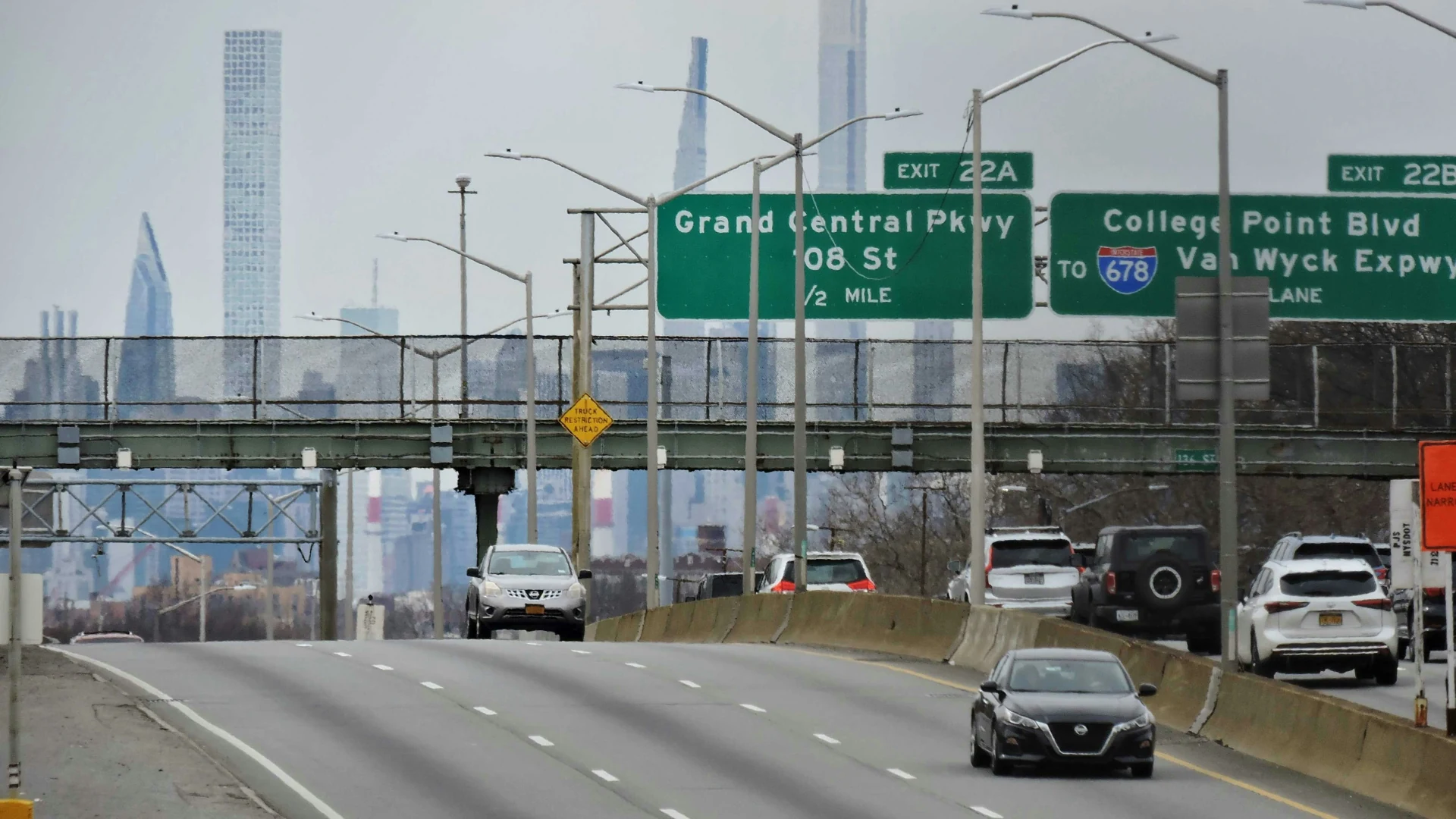
Oversize limits in New York
The general legal height limit for a typical freight truck is 13 ft 6 in under New York Vehicle and Traffic Law § 385 and NYC DOT size and weight limits. The ordinary width limit is 8 ft, with 8 ft 6 in allowed on qualifying state roads and under specific city rules. An ordinary tractor-trailer combination can be up to 65 ft on state roads where the general length limit applies, compared with 55 ft in NYC. Lower posted clearances, trailer-specific restrictions, and bridge and tunnel rules can change the answer even when the truck fits those figures.
Start with the loaded truck and the two gates it needs to reach. A state highway, a Thruway segment, a bridge, and the last city street can each have different conditions. A 13 ft 4 in truck is under the general height limit and already too tall for ordinary travel under the Port Authority's Lincoln Tunnel rules. That difference can change the trailer, route, and delivery appointment before a permit application is even filed.
Find the legal dimensions for the loaded truck
Use the table to screen ordinary freight equipment. Apply the state vehicle law or NYC DOT vehicle rules for each leg, then check restrictions posted on connecting roads and structures.
| Dimension | New York State general rules outside NYC | NYC ordinary freight limits |
|---|---|---|
| Width, including load | 8 ft plus qualifying safety devices. 8 ft 6 in plus qualifying safety devices on qualifying and access highways and on other roads with lanes designed to be at least 10 ft wide, subject to restrictions. | 8 ft for ordinary trucks. Qualifying federal STAA vehicles can use 8 ft 6 in under the access rules below. |
| Height, including load | 13 ft 6 in | 13 ft 6 in |
| Single-unit length | 40 ft, including load and bumpers | 35 ft for ordinary single-unit trucks |
| Combination length | 65 ft, including load and bumpers. Exceptions include combinations on qualifying and access highways. | 55 ft for ordinary combinations. Separate provisions cover eligible trailers and long articles. |
| Trailer length | 48 ft generally. Eligible semitrailers over 48 ft through 53 ft are limited to qualifying or specifically designated access highways. | Separate rules cover qualifying 48 ft STAA trailers and semitrailers over 48 ft through 53 ft on designated routes. |
Width and length depend on the road
The designated network matters even for an empty trailer. Outside NYC, a semitrailer over 48 ft through 53 ft needs a qualifying highway or a specifically designated access highway under the state trailer-length rule. Qualifying highways include the Interstate and other designated National Network routes. Access highways connect the network to approved destinations and other routes. Check for a maximum 43 ft from the kingpin to the rear axle centerline. The required rear protective beam must reach within 4 in of both sides and sit no more than 22 in above the road, measured with the trailer empty and level. Use the designated truck access highway list to check the feeder road and confirm access to the destination before assigning that trailer. The general 65 ft combination exception on qualifying and access highways leaves the separate trailer-length and equipment rules in place.
Check front and rear projection separately from trailer and combination length. State law provides a combination-length exception for poles, girders, columns, and similar long articles that meet applicable safety requirements. Width, height, weight, securement, and markings still need their own checks. NYC DOT requires a daily permit for the corresponding long-article combination over 60 ft overall. On the Thruway, an overhang of 4 ft or more triggers the Authority's special hauling rules even if the combination otherwise fits the ordinary length limit.
Measure and weigh the actual equipment
- Height. Measure from the pavement to the highest point with the truck loaded and the suspension at travel height. Include dunnage, cradles, lifting lugs, and securement if they project above the cargo. For a container, use the height of the chassis at the container support points and confirm the finished measurement on the assembled truck.
- Width. Record the widest loaded point and left and right projections. A flat rack can project on one side or at one point along the trailer. Identify any mirrors or other safety devices separately so the road owner can apply its measurement rule.
- Length. Record loaded combination length, trailer length, front and rear overhang, and kingpin-to-rear-axle distance where applicable. Use the expected axle position and check how the load and rear of the trailer swing through turns.
- Weight. Use the NYSDOT pre-trip checklist to record the loaded gross weight, individual axle weights, axle-group weights, center-to-center spacings, and equipment and tire ratings. A truck under 80,000 lb can still exceed an axle limit or bridge posting under New York's weight rules. Recalculate after changing the deck, tractor, axle positions, or load placement.
Measure before choosing between standard and lower chassis or step decks and lowboys. A lower deck buys overhead clearance and can make a raised rail crossing or steep driveway harder to clear. Confirm the lift method, load support, axle distribution, and unloading space with the terminal or shipper and receiver. Ocean out of gauge (OOG) describes the cargo relative to its ocean equipment or service. Its road permit status depends on how the truck is actually loaded.
Choose the permit and confirm who owns each leg
Draw the route in order from the pickup gate to the receiving entrance. Identify the state line, highway operators, exact bridge or tunnel, and each county or municipal approach. Work through the same exercise for any return trip with an oversize trailer or equipment.
| Road or facility | Where to apply or confirm access |
|---|---|
| NYSDOT highways outside NYC | Follow the NYSDOT application instructions to request a Special Hauling Permit through the Highway Oversize/Overweight Credentialing System (HOOCS). |
| Thruway and Governor Mario M. Cuomo Bridge | Select the Thruway Authority permit through HOOCS. Check segment, ramps, direction, and validity. |
| NYC streets and MTA facilities | Use the NYC DOT daily permit for an eligible nondivisible move. Identify the MTA structure on the application so NYC DOT can coordinate approval under the MTA crossing procedures. |
| Port Authority bridges and tunnels | Use the Port Authority truckers' resources to find the facility desk and call for oversize movement approval, applicable limits, and escort arrangements. |
| New York State Bridge Authority bridges | Contact the specific Hudson River bridge about the oversize crossing procedures and any separate overweight approval. |
| County, town, village, or other city roads | Confirm the owner, permit threshold, and application order. Suffolk County, for example, asks for the NYSDOT trip permit first and requires a county trip permit for moves over 80 ft long or 12 ft wide that use county roads. A superload needs earlier county coordination. |
| New Jersey roads | Check the NJDOT permit requirements and confirm the conditions of any separate toll-road operator for the New Jersey leg. |
Nondivisible loads, recurring work, and fees
For ordinary special hauling, explain why the load cannot reasonably be reduced to legal size or weight. In its permit FAQ, NYSDOT explains that it generally issues a permit for a single item and considers whether dismantling would make the item unusable, destroy its value, or take more than eight work hours using suitable equipment. Give the issuer a specific description, such as a transformer with transport-removable parts accounted for. For multiple pieces or removable components, check eligibility under the state nondivisible hauling regulations before quoting the move. NYC's daily overdimensional permit is for nondivisible loads. If the dimensions are legal and the problem is weight, check the applicable divisible-load or qualifying sealed-container program.
| Permit | Typical use and published fee |
|---|---|
| NYSDOT Type 1 general trip | One approved trip between named locations. A round trip can cover the same load or the unladen vehicle on the return if approved. $40 for five permissible hauling days. The published category limits are 16 ft wide, 160 ft long, 15 ft 11 in high, and 199,999 lb gross, subject to route review. |
| NYSDOT Type 2 radius | Eligible repeat work within 25 air miles of the boundaries of the applicant's business municipality. Up to 12 ft wide, 79 ft 11 in long, and 13 ft 6 in high, with configuration-specific weight limits. $60 monthly or $360 annually. |
| NYSDOT Type 4 statewide blanket | Eligible repeat work on state highways with at least 20 ft of pavement width. Up to 10 ft wide, 79 ft 11 in long, and 13 ft 6 in high, subject to gross and axle limits. $60 monthly or $360 annually. |
| NYSDOT Type 1S superload | A specific move requiring enhanced review. $40 base state fee, with separate costs such as bonding, survey, and escorts. |
| NYC daily overdimensional permit | Route-specific city permit for an eligible move. $35 per application. Plan separate permits into and out of the city when both legs require authorization. |
| Thruway single-use permit | One direction, with interruptions limited to 24 hours. The Authority lists a $3 or $21 base fee by section for overdimensional vehicles at or under 80,000 lb, with additional mileage-based charges for overweight vehicles. |
NYSDOT lists separate permit types for manufactured or modular homes, self-propelled cranes, some steel-hauling combinations, and qualifying sealed shipping containers. A blanket or radius permit applies to the vehicles, loads, and network it covers. An NYSDOT annual or radius permit that requires special hauling approval on the Thruway still needs a Thruway single-use permit. Confirm recurring-use eligibility and budget separately for crossing tolls, police or certified escorts, surveys, utility crews, and any lift or staging charges. Use the state fee schedule and the NYC daily permit fee to price the relevant applications.
For container drayage, give the carrier both gate addresses, the loaded dimensions and weight, and any special handling needs. Confirm who will arrange permits and escorts and which costs are included before accepting an all-in drayage quote.
Apply with the measured configuration and a route
- Get access to the right portal. Commercial applicants for NYSDOT permits and Thruway permits use One Stop Credentialing and Registration (OSCAR) to access HOOCS. If the accounts are still unlinked, contact the NYSDOT permit office at 518-485-2999 or 888-783-1685. Noncommercial applicants can use NY.gov ID. NYC DOT has a separate online application. The NYC paper form asks for 48 hours from receipt of the application and payment. Allow additional time for any survey, crossing, or local review.
- Gather the application data. Have the carrier name, USDOT number where applicable, power-unit and trailer identification, cargo description and weights, loaded measurements, axle details, dates, and the proposed route ready. Use actual street addresses, entrance and exit ramps, crossing direction, and the correct pickup and delivery gates. Add the applicable vehicle diagram, route survey, insurance, municipal permissions, and other supplements listed in the NYSDOT permit requirements. Use the NYC application form to check the information the city requires.
- Check the issued permit against the dispatch plan. Reconcile plates, vehicle and axle configuration, load, route, dates, travel direction, and operating conditions before releasing the truck. Active NYSDOT Type 1 permits can generally be amended once for specified changes, such as plates, dates, or dimensions that leave the route intact. Its fee schedule lists a $10 trip amendment fee. Apply for a new permit if the load description, route, axle weights, or axle spacings change. Check each other issuer separately if equipment, timing, or routing changes. For the city leg, check the NYC permit's validity conditions before changing the route or truck configuration.
Start superload review before committing to a date
The NYSDOT superload page lists over 16 ft wide, 16 ft high or greater, over 160 ft long, or 200,000 lb gross or greater. Confirm classification at exactly 160 ft with the Central Permit Office. Its Perm 12S form includes that length, while its superload page and the general trip permit guide place it at the general trip boundary. Type 1S is a route and engineering review. Ask about NYSDOT's Perm 12 preapproval process when bidding or testing route feasibility.
- Document the load and the route. Gather the manufacturer's or designer's indivisibility certification, the permittee's letter accepting responsibility for damage, and written municipal permissions as required. A state review can also require a route survey, bridge engineering, an axle and tire diagram, and a traffic control plan by a New York licensed professional engineer for a load 18 ft wide or more.
- Resolve overhead and ground clearance. Perm 12S calls for identifying utility conflicts and remedial arrangements on overheight moves. For a load 15 ft high or more, overhead traffic signal equipment within 3 in of the load height at normal travel speed triggers a signal-contractor requirement. For an at-grade railroad crossing on the state route, provide the required clearance certification and railroad emergency contacts.
- Arrange the bond and police escort. Under the Perm 12S superload requirements, bond amounts depend on the dimensions and weight that trigger review and can be added together. After issuance, the state asks the carrier to contact police at least two business days before the move. Coordinate the rest of the convoy, engineering supervision where required, and the staging points around the permitted travel window.
Survey the route from the highway to the gate
Use the NYSDOT prescreening tool to check the numbered highways, bridges, ramps, and connections. Check 511NY for current travel advisories. Then add the last-mile roads and gates that a highway map may omit. New York also restricts large trucks using some permitted routes in the Finger Lakes. Check the Finger Lakes restrictions and exemptions before proposing a detour across that area.
When a physical survey is needed
The NYSDOT permit guidelines call for a survey at 14 ft or more in height, 100 ft or more in length, or 16 ft in width, and for specified wide manufactured homes and modular units. The issuer can require a survey or extra controls based on the road and the load. Use a New York State certified escort for the physical survey recorded on Perm 85 and follow the NYSDOT overhead-obstruction instructions. The prescreening tool helps find a candidate route. Use the field survey and issued permit to establish the route for the move.
- Check overhead obstructions in the lane the truck will actually use. Include bridges, scaffolding, work-zone structures, signals, wires, signs, and gates. Record the location and planned action for each conflict. Arrange written permission and any utility or signal work with the owner before moving.
- Check horizontal clearance through ramps, toll lanes, work-zone barriers, traffic islands, and the receiver's turn. Consider rear swing and offtracking, which is the tendency of the trailer wheels to cut inside the tractor's path on a turn.
- In the route survey, check ground clearance at rail crossings, crowned roads, and grade breaks. Use the certified escort manual to plan where the truck can pull completely out of traffic if it has to wait. Verify that the terminal and receiver can fit the equipment through the gate and set it up for unloading.
NYC truck routes and 48 ft or 53 ft trailers
Under the city's truck routing rules, use the Through Truck Route Network in a borough the truck only passes through and the appropriate Local Truck Route Network for a pickup or delivery. For the final approach, follow the applicable truck route to the closest intersection with the destination and use the connecting streets as the city's rules allow. Check the current map alongside the truck route changes effective October 4, 2026. The city's parkway rules prohibit commercial traffic on many parkways. The Grand Central Parkway exception near the RFK Bridge and Brooklyn-Queens Expressway covers certain single-unit trucks on a short segment. Check the exact vehicle and ramp before relying on it.
Qualifying STAA combinations with trailers up to 48 ft. Under the federal Surface Transportation Assistance Act (STAA) access rules, NYC allows eligible vehicles up to 8 ft 6 in wide and 13 ft 6 in high, subject to the lower of the bridge formula weight or 80,000 lb under NYC DOT's size and weight guidance. Vehicles carrying household goods can use interstates and local and through truck routes under this provision. For other freight under the city's STAA access rules, local and through truck-route access is limited to within one mile of the interstate exit. Check this route separately from the rule for an ordinary 55 ft combination.
Semitrailers over 48 ft through 53 ft. Check the 43 ft kingpin-to-rear-axle limit, rear protection, and the 73 ft 6 in loaded combination limit under NYC Traffic Rules § 4-15. The NYC DOT guidance lists the I-95, I-695, I-295, and I-495 segments connecting the Bronx-Westchester and Queens-Nassau lines, plus the specified I-95 segment to the upper George Washington Bridge and I-678 from I-95 to JFK. Confirm the exact entry and exit, the road and crossing width limits, and legal access beyond the corridor. The NYC DOT guidance directs 53 ft trailers carrying nondivisible loads to the daily permit process. If divisible freight needs a delivery outside the longer-trailer routes, check a shorter configuration that fits the city's rules all the way to the dock. The sealed ocean container route near Goethals Bridge has its own terms.
Airport air cargo. NYC's height rule has a limited exception for containerized or palletized air cargo on flatbeds between a Port Authority airport and an off-airport cargo facility within one mile, on city-designated local routes. If planning that transfer, confirm the designated route and applicable conditions with the NYC DOT permit office at 212-839-6341.
Check the crossing and its approaches
The operator's height and width figures are a first screen. Confirm the deck, direction, lane, access ramp, closures, and eligibility for special approval before picking a crossing. Apply the city or state rules again on the road immediately after it.
Thruway and Hudson Valley bridges
Under the Thruway's special hauling rules, the Authority ordinarily requires special hauling review above 8 ft 6 in wide or 65 ft long for the combinations described in its guidance, and for a load with 4 ft or more of overhang. It publishes a general height limit of 13 ft 6 in, with overheight movements allowed only on narrowly specified segments under its permit guidelines. The mainline and the Governor Mario M. Cuomo Bridge have a 12 ft 6 in width ceiling in the general guidance. TAP-623 lists specific segment exceptions, such as 12 ft 7 in to 13 ft between I-87 Exit 15 in Suffern and Exit 1 in Yonkers, excluding the Cuomo Bridge. It lists different limits for the Cross Westchester and New England sections and short approaches near state lines. Match the full entry-to-exit itinerary to the permitted segment.
The Thruway's operating guidelines calls for a valid E-ZPass tag over 10 ft wide. A permitted load from 12 ft 1 in through 12 ft 6 in wide also calls for daylight movement and a New York certified rear escort. For length, the guideline adds a rear escort at 80 ft and a front escort at 100 ft. An overhang of 10 ft or more falls into a stricter band with daylight and escort conditions. A segment exception can have additional requirements. Check the Authority's ramp list for one-direction exits and transfers that appear to be exits on a map.
The Bear Mountain, Newburgh-Beacon, Mid-Hudson, Kingston-Rhinecliff, and Rip Van Winkle bridges are operated by the New York State Bridge Authority. If one is on the route, contact its office about oversize passage and advance notice, construction, and any applicable weight approval. Evaluate the two approaches as well as the crossing.
Port Authority crossings from New Jersey
The table shows ordinary screening dimensions from the Port Authority truckers' guide. Check sections 2 and 3 of the traffic rules for the vehicle type, including length, side overhang, and any safety-device exclusions.
| Crossing | Ordinary height | Width and access checks |
|---|---|---|
| George Washington Bridge | 13 ft 6 in | Trucks use the upper level. Use 8 ft 6 in as the body-width screen and call the bridge desk for a wider move. |
| Lincoln Tunnel | 13 ft | 8 ft 6 in body width. Trucks use the outer tubes. For a tractor with a single trailer or semitrailer, the drawn unit is limited to 45 ft and the combination to 85 ft. |
| Holland Tunnel | 12 ft 6 in | 8 ft body width. Truck access is limited to two- and three-axle single-unit trucks. |
| Goethals Bridge | 13 ft 6 in | 8 ft 6 in body width. Qualifying sealed ocean containers have a separate authorization process. |
| Bayonne Bridge | 13 ft 6 in | 8 ft 6 in body width. The facility asks oversize operators to seek approval at least two days before the intended trip. |
| Outerbridge Crossing | 13 ft 6 in | 8 ft 6 in body width. Check both the NJ 440 and Staten Island approaches. |
For the George Washington Bridge, the truckers' guide lists 10 ft in its body-width table. The traffic rules give 8 ft 6 in as the general bridge body-width limit, including side overhangs, with specified safety-device exclusions. Call 201-346-4100 before dispatch if the loaded body is wider than 8 ft 6 in. Give the desk the loaded dimensions, direction, approach, and intended exit. For oversize passage where approved, the Port Authority calls for its police escort. Its guide lists double the ordinary toll and a $40 escort fee subject to change. Confirm charges and facility restrictions with the desk. The three Staten Island crossings share a general facility desk at 718-390-2502.
MTA bridges and tunnels within NYC
The MTA bridge clearances differ by direction and, at the Verrazzano, by deck. Its ordinary width figures are 9 ft 6 in on bridges and 8 ft 6 in in tunnels. The city approach has its own limits. MTA directs vehicles above its bridge width limit or above published height limits to its night-crossing procedures. For a nondivisible move, submit the city daily permit through NYC DOT and include the MTA facility for coordinated review. Confirm the actual crossing approval and time before dispatch.
| MTA facility | Published height for ordinary travel |
|---|---|
| Queens Midtown and Hugh L. Carey tunnels | 12 ft 1 in |
| Verrazzano-Narrows Bridge, lower deck | 13 ft 6 in eastbound, 13 ft 7 in westbound |
| Verrazzano-Narrows Bridge, upper deck | 14 ft 5 in eastbound, 14 ft 6 in westbound |
| Robert F. Kennedy Bridge | Span- and direction-specific. For example, 13 ft 3 in from the Bronx and 14 ft to the Bronx on the Bronx truss spans. |
| Bronx-Whitestone Bridge | 15 ft Bronx-bound, 15 ft 1 in Queens-bound |
| Throgs Neck Bridge | 15 ft 2 in Bronx-bound, 14 ft 11 in Queens-bound |
The MTA facility rules prohibit trucks on the Henry Hudson Bridge. Its Cross Bay and Marine Parkway bridge figures vary by direction and approach. For any crossing, include hazardous-material restrictions if relevant and confirm whether the permitted vehicle can reach and leave the assigned deck.
Once the route works, price both directions using New York toll rates and Manhattan congestion charges. Compare the approved crossings, truck configuration, and empty return leg with the toll estimate in your quote.
Western New York and the Canadian border
A cross-border move can need state or Thruway authority, separate bridge approval, and a permit on the Canadian side. The Peace Bridge special-load application asks about the NYSDOT permit. The Niagara Falls Bridge Commission has a separate request process for the Lewiston-Queenston Bridge. Confirm access, inspection routing, and timing with the chosen bridge before planning the state route around it. For the Ontario leg, check provincial oversize and overweight permits and any separate municipal approvals for the onward roads.
Arrange escorts, markings, and travel windows
Plan the convoy after you know the road, loaded dimensions, and permit conditions. A two-lane road and a divided highway can require different escort positions on the same trip. Book escorts who hold New York certification where required. Confirm separate arrangements with the Thruway, NYC DOT, or a crossing operator for the portions they control. If you're assigning pilot cars for the first time, review what an escort does before booking.
NYSDOT escort thresholds and placement
Use this table to plan escorts on NYSDOT routes. It summarizes the state escort manual and Perm 87 guidelines for common freight moves. The issued permit can add escorts for road geometry, bridge conditions, or combined triggers. Where separate conditions call for both a lead and a rear escort, plan for both.
| Loaded size or operating condition | Typical NYSDOT escort requirement |
|---|---|
| Over 12 ft wide or 80 ft long or more | Certified front escort on two-lane highways or rear escort on highways with more than two lanes. Larger moves trigger the additional conditions below. |
| 14 ft high or more | Plan a route survey and a certified front escort with a height pole under the permit guidelines. Confirm the required pole setting and any rear escort with the issuer. |
| 16 ft wide or 100 ft long or more | Plan for certified front and rear escorts. At 100 ft long or more, plan for two front and one rear on two-lane highways. |
| Over 16 ft wide on a two-lane highway or 18 ft wide or more on a four-lane highway | Two front and one rear certified escorts, plus applicable police escort requirements. |
| 160 ft long or more | The escort manual generally calls for two front and one rear on four-lane highways, with two escorts when the approved route is entirely Interstate. Check the permit at the 160 ft classification boundary. |
| Front or rear overhang greater than 10 ft | Perm 87 assigns a front escort for front projection and a rear escort for rear projection. Confirm road-specific positioning, including requirements on two-lane highways. |
| Unable to maintain normal highway speed, or a structure has a special crossing speed | Check for a rear escort on the route or at the structure as directed by the permit. |
| Superload, a movement across a bridge or highway centerline, or wrong-way travel on a one-way street or ramp | Plan for police escort under NYSDOT's guidelines, in addition to the applicable certified escorts. Follow the issued traffic-control conditions. |
For an overheight move, the state escort manual specifies a height pole 3 in above the loaded height for loads up to 12 ft wide and 6 in above for wider loads. Confirm the setup with the surveyor and issuer. Give the hauling driver and every escort the same route, communication plan, crossing instructions, and stop locations. The Thruway's escort thresholds apply on its network and include a rear escort from 12 ft 1 in wide in its permitted width bands. The Port Authority arranges its own police escort for approved oversize crossings.
Signs, flags, and lights
- Permitted hauling vehicle. The state special hauling regulations specify front and rear warning signs for overwidth and other covered movements. The permitted load's yellow OVERSIZE LOAD sign must be at least 7 ft by 18 in with black lettering at least 10 in high. The escort vehicle has a separate sign specification of at least 5 ft by 12 in, with lettering at least 8 in high and the wording visible on both sides. Check placement against the state manual and permit.
- Overwidth and overhang flags. Use red or orange fluorescent flags at least 18 in square on staffs at the required extremities. For permitted overhang of 4 ft or more, Perm 87 calls for marking the end of the load, with two flags at its extremities when the projecting portion is more than 2 ft wide. Check the state's maximum overhang and support requirements as well.
- Warning lights. Check the amber warning light on the power unit, exterior lighting, and the escort's roof light bar. If the load obscures the truck's running, brake, turn, or hazard lights, provide equivalent visible lighting. The escort manual's diagrams show the extra lamp placement rules for authorized night moves.
Daylight, weekends, holidays, and closures
- NYSDOT weekday baseline. Plan for favorable weather and daylight from 30 minutes before sunrise to 30 minutes after sunset, Monday through Friday. The NYSDOT hauling-day rules allow qualifying Saturday moves until noon within 12 ft wide, 85 ft long, and legal height if they can keep pace with traffic and the permit and holiday schedule allow it.
- Peak-hour restrictions. Large state moves can face 7–9 a.m. and 4–6 p.m. restrictions. NYSDOT flags business districts at 14 ft wide, 90 ft long, or 14 ft high, and applies broader restrictions to larger moves. Check the permit for statewide and local restrictions, including special conditions for cities and manufactured or modular homes.
- Night travel. Ask the issuer before scheduling. NYSDOT's night-move notice covers requests in the Lower Hudson Valley and on Long Island, including extra escort and lighting conditions. In NYC, use the issued city route and time window and confirm any coordinated crossing slot under the MTA crossing procedures. Time the handoff so that a truck approved for a night crossing can also legally reach it and leave it.
- Thruway schedule. The Thruway's operating rules generally exclude permitted oversize moves on Saturdays, Sundays, and listed holidays. Some size bands allow night travel on otherwise eligible days, while others are daylight only. Check the Authority's conditions even if the NYSDOT leg qualifies for Saturday travel.
- Day-of checks. Compare the NYSDOT holiday notices, operator advisories, and the issued permit with current weather, work zones, and closures. A blocked ramp or new obstruction means holding at a safe location and contacting dispatch and the permit issuer for routing instructions. Keep the driver, escorts, crossing desk, terminal, and receiver on the same schedule.
Plan port pickups and sealed-container moves
The Port of New York and New Jersey has gates on both sides of the state line. Confirm the actual release terminal and equipment before choosing a bridge. The NYC marine-terminal guide covers Port Liberty New York on Staten Island and Red Hook in Brooklyn. For Port Liberty Bayonne and other west-side gates, check the New Jersey terminal guide. A port booking or OOG release tells you where the cargo is and how the terminal will handle it. The assigned road configuration determines which route and permits the carrier needs.
For a flat rack or open top, obtain the cargo measurements, projections, weight, lifting points, and terminal handling instructions. Confirm the trailer or chassis, securement plan, release status, and appointment. Port Liberty New York lists OOG pickups by appointment on Monday or Wednesday and asks for payment before arrival. If the move needs a transload to a lower trailer, confirm the lift and securement at the transfer site, then check both road legs with their respective loaded dimensions.
Goethals Bridge and the designated Staten Island corridor
The designated Goethals route to or from Port Liberty New York allows eligible combinations carrying a qualifying sealed ocean container up to 90,000 lb gross and 73 ft 6 in overall under its corridor conditions without a NYC daily overdimensional permit. NYC Traffic Rules § 4-15(j) lists specific parts of I-278, Goethals Road North, Western Avenue, and nearby connecting streets. Confirm the permitted turns and ramps, a qualifying government or shipper seal, axle and equipment limits, and remaining dimensional conditions. Use the Port Authority's crossing checklist to plan the bridge approval.
For the Port Authority's overweight sealed-container authorization, obtain the NJDOT Annual Ocean Borne Containerized Cargo permit and send a copy with the request to SIBOperations@panynj.gov. The Port Authority's crossing checklist asks carriers to allow three to five business days for letter processing. It directs the driver to call 718-390-2501 15–30 minutes before the requested crossing slot, carry the permit and letter, and maintain 1,000 ft of separation between vehicles moving under the program on the bridge.
The corridor is tied to a particular terminal route. A subsequent move to a warehouse in Queens or another state follows the rules for that itinerary. NYSDOT's Type 12 is a separate permit for eligible sealed shipping containers on its authorized network, and the Thruway has its own sealed-container permit. If the cargo projects from a flat rack or exceeds road dimensions, screen it for the applicable oversize approval. Check New York's overweight and sealed-container rules if the loaded dimensions are legal and weight is the issue.
Worked examples
These examples use assumed measurements to show which part of the plan changes. Use the actual equipment and approved route for dispatch.
A high cube that fits the state limit on a lower chassis
A 9 ft 6 in high cube on a chassis with a measured support height of 4 ft 2 in reaches 13 ft 8 in. A support height of 3 ft 10 in brings it down to 13 ft 4 in, below the general height limit. For a delivery from New Jersey, the Lincoln Tunnel still has a 13 ft height limit and the Holland Tunnel excludes this tractor-trailer under the Port Authority's crossing rules. Check a bridge and both approaches, including the city delivery street. Confirm the loaded height on the actual chassis and its clearance at the dock approach.
A 13 ft wide machine bound for a Suffolk County site
A 13 ft wide indivisible machine needs state special hauling review on its NYSDOT leg. A proposed route over the Governor Mario M. Cuomo Bridge exceeds the published 12 ft 6 in ceiling. Check a viable alternate itinerary or whether the machine can legally be reduced in width. On a two-lane NYSDOT segment, the state escort guidelines call for a lead escort. If the delivery approach uses a Suffolk County road, the width also triggers county trip review after the state trip permit. Check the driveway turn with the actual load and trailer swing before accepting the receiver's appointment.
A flat rack from Staten Island to Queens
An indivisible machine on a flat rack measures 10 ft 4 in wide and 13 ft 10 in high on its assigned road equipment. On a proposed route via the Verrazzano, the eastbound lower deck is too low and the load exceeds MTA's ordinary bridge width. The eastbound upper deck's published height is 14 ft 5 in, so it is a candidate to discuss through the NYC daily permit and MTA review. Confirm the approach and deck approval, the through truck route across Brooklyn, and the final turn in Queens. If the crossing window and Port Liberty New York OOG pickup slot are hours apart, arrange legal staging or price a transload with a separate review of both road legs.
A 14 ft 2 in load with a low utility line
A machine on a step deck measures 14 ft 2 in with its transport cradle. The NYSDOT permit guidelines call for a physical survey and a lead escort with a height pole. Have the surveyor document the wire conflict in the overhead-obstruction addendum, identify the owner, and verify the clearance after any authorized work. If a lower deck can eliminate the overhead conflict, remeasure the loaded truck and check ground clearance at the rail crossing and delivery gate. Update the application or issued authorization before dispatch if the equipment or dimensions change.
An 88,000 lb sealed container and a later warehouse move
A 72 ft combination carrying a sealed ocean container at 88,000 lb gross is within the Goethals corridor's published length and gross ceilings. Confirm all other eligibility conditions and obtain the NJDOT permit, Port Authority letter, and crossing slot before scheduling the terminal leg. If the same container later leaves Staten Island for a warehouse, evaluate the loaded combination and axle weights against the city's limits and any MTA crossing conditions on the new route. The original corridor approval applies to the designated terminal trip.
Before releasing the truck
- Match the actual tractor, trailer, axle setup, load, and loaded dimensions to the permit package.
- Confirm the authorized route in both directions where applicable, down to the bridge deck, lane, ramps, and final gate. Give the driver the route and safe holding locations.
- Recheck closures, clearances, curfews, weather, staging, and terminal and receiving appointments. Confirm the crossing slot and any required advance calls.
- Confirm escort credentials, placement, communications, signs, flags, lights, and utility or police arrangements. Put permits and crossing authorizations in the driver's dispatch packet.
- Tell the driver who to call if a dimension differs, an escort is unavailable, or the planned route is blocked. Resolve permit changes with the issuing authority before resuming the move.