

Flatbed trailer types
A flatbed trailer is open-deck equipment used for freight that needs side, top, crane, or drive-on access, or that does not fit safely inside an enclosed trailer. The category includes much more than the familiar level-deck flatbed: step decks, double drops, lowboys, removable goosenecks, extendables, rolling-tarp systems, tilt decks, and multi-axle heavy-haul configurations all solve different loading and road-profile problems.
This guide explains the main flatbed trailer types used in the United States, how their names relate, what each is best suited for, and which cargo, securement, route, and permit details must be checked before booking.
Planning note: Dimensions and capacities below are representative, not guarantees. The assigned tractor, trailer model, deck construction, axle layout, tires, suspension, concentrated-load rating, state rules, route, and permits control the actual move.
Quick answer
The most common flatbed and open-deck configurations are:
- Standard flatbed: One level deck for general freight, machinery, steel, lumber, pipe, and side- or crane-loaded cargo.
- Step deck or drop deck: A short upper deck and lower main deck that create more vertical room for taller freight.
- Double drop or lowboy: A very low well between the gooseneck and rear axle area for tall or heavy equipment.
- Removable gooseneck (RGN): A low-deck trailer whose front neck detaches so equipment can be driven onto the deck from the ground.
- Extendable or telescopic trailer: A flatbed, step deck, or double drop that lengthens for beams, poles, vessels, and other long freight.
- Conestoga: A flatbed or step deck fitted with a retractable tarp-and-bow system for weather protection and flexible loading access.
- Side-kit trailer: A flatbed with removable side panels, stakes, bows, and a tarp roof.
- Tilt, traveling-axle, or hydraulic-tail trailer: Equipment that lowers or angles its deck to load rolling and tracked machinery.
- Multi-axle heavy-haul trailer: A specialized configuration that uses additional axles, axle groups, jeeps, boosters, or modular sections for exceptional loads.
The correct choice is based on the complete loaded configuration, not the trailer name alone.
How flatbed trailer names fit together
Flatbed terminology is confusing because the names describe different features. A single trailer can belong to several categories at once.
| Feature being described | Common choices |
|---|---|
| Deck geometry | Standard flatbed, step deck, double drop, lowboy |
| Loading method | Fixed neck, removable gooseneck, ramps, hydraulic tail, tilt deck, traveling axle |
| Deck length | Fixed length, extendable, telescopic |
| Weather cover | Open deck, manual tarp, side kit, Conestoga rolling-tarp system |
| Running gear | Tandem, spread axle, tridem, quad, steerable axle, jeep and booster, modular platform |
For example, an extendable RGN is both a telescopic trailer and a removable-gooseneck lowboy. A Conestoga may be built over a standard flatbed or a step deck. An RGN describes the detachable front connection and loading method; lowboy describes the low deck profile.
Flatbed types at a glance
This comparison helps narrow the equipment family before a carrier checks the actual model and route.
| Type | Best fit and main limitations |
|---|---|
| Standard flatbed | Versatile side and top access for ordinary open-deck freight. Its relatively high deck leaves less room for tall cargo. |
| Step deck | Taller freight that benefits from a lower main deck. The upper deck, transition, and wheel area divide the usable loading surface. |
| Double drop or lowboy | Tall or heavy equipment carried in a very low center well. Well length, low ground clearance, loading method, and specialized availability matter. |
| RGN | Drive-on machinery and heavy equipment. The detachable neck simplifies loading but adds equipment weight, cost, and operating complexity. |
| Extendable | Long self-supporting freight. Open extension changes capacity, turning path, axle loading, and permit requirements. |
| Conestoga | Freight needing flatbed-style access plus a retractable weather cover. The system's internal clearance and track width can restrict the cargo envelope. |
| Side kit | Weather-sensitive freight that works with removable sides and a tarp roof. Setup takes labor, and the system does not become a structural dry van. |
| Tilt or traveling axle | Rolling or tracked equipment loaded without a crane or detachable neck. Approach angle, winch rating, traction, and ground condition must be checked. |
| Multi-axle heavy haul | Exceptional concentrated weight or route-specific axle distribution. It requires engineering, permits, route analysis, and specialized operators. |
Main trailer types
The categories below cover the equipment most commonly requested for flatbed, project-cargo, construction-equipment, and out-of-gauge moves.
Standard flatbed
A standard flatbed has one straight, level deck with no permanent roof or sides. Forklifts can approach from either side, and cranes can load from above. Common nominal trailer lengths are 48 ft and 53 ft, and 102 in is a common deck width. Actual deck height, tare, payload, axle spacing, and concentrated-load rating vary.
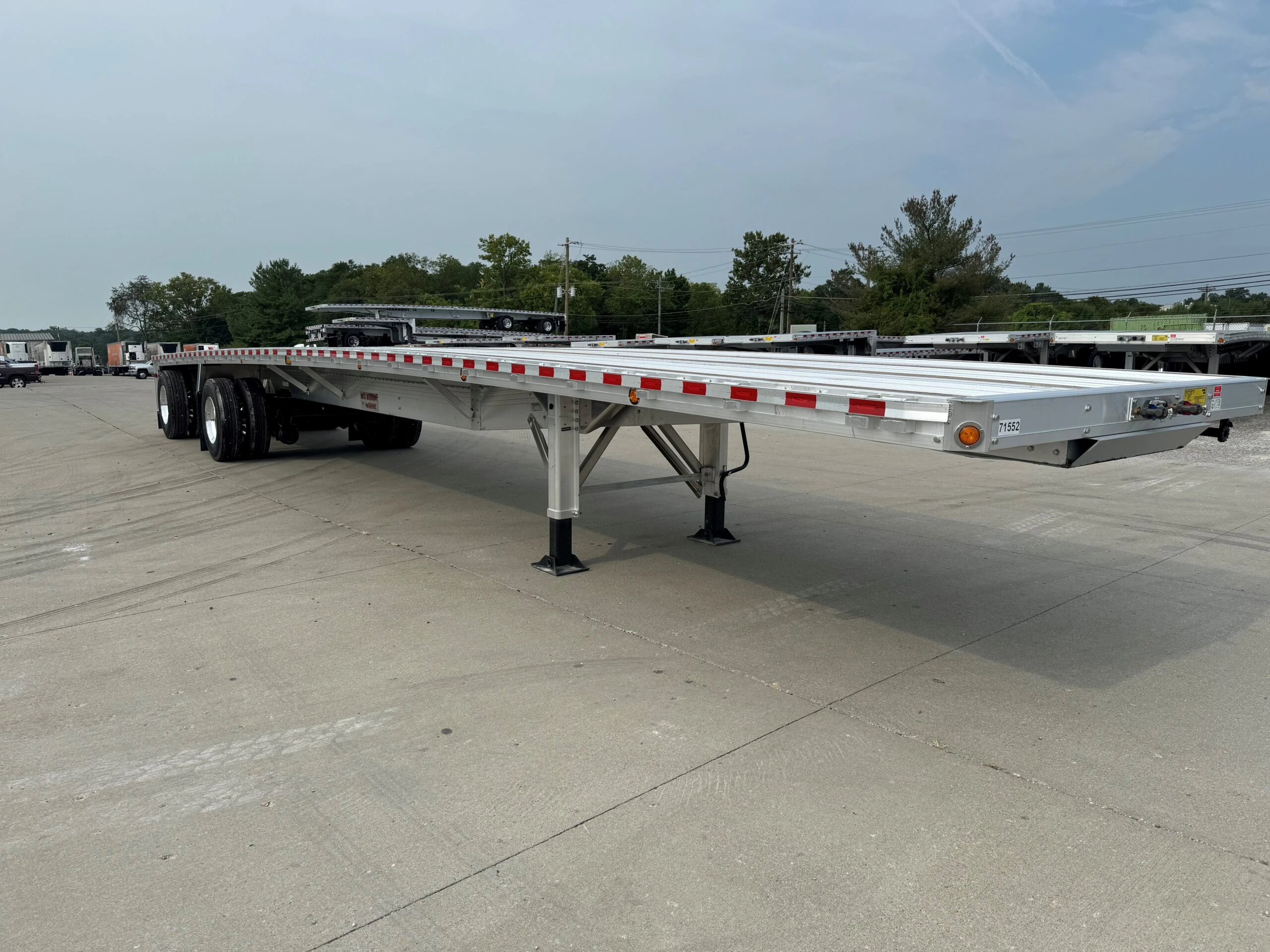
Typical freight includes:
- Lumber, steel, plate, pipe, and fabricated components
- Palletized building materials
- Crated machinery and industrial equipment
- Freight that is too wide for an enclosed trailer door
- Cargo loaded by crane or from the side
Choose a standard flatbed when loading access and a continuous deck matter more than added vertical clearance. Do not assume that a nominal 48,000 lb freight target or any other rule-of-thumb is the trailer's legal payload. Tractor and trailer tare, gross and axle limits, cargo position, trailer ratings, and the route must all be checked.
Great Dane's Freedom Steel specifications illustrate the model-specific nature of these ratings: its listed lengths, widths, distributed-load rating, and concentrated-load rating change with the selected configuration and options.
Step deck or drop deck
A step deck has a short upper deck over the tractor connection and a longer, lower main deck behind it. Lowering the main deck can create additional vertical room while retaining side and top access. The terms step deck and drop deck are often used interchangeably.
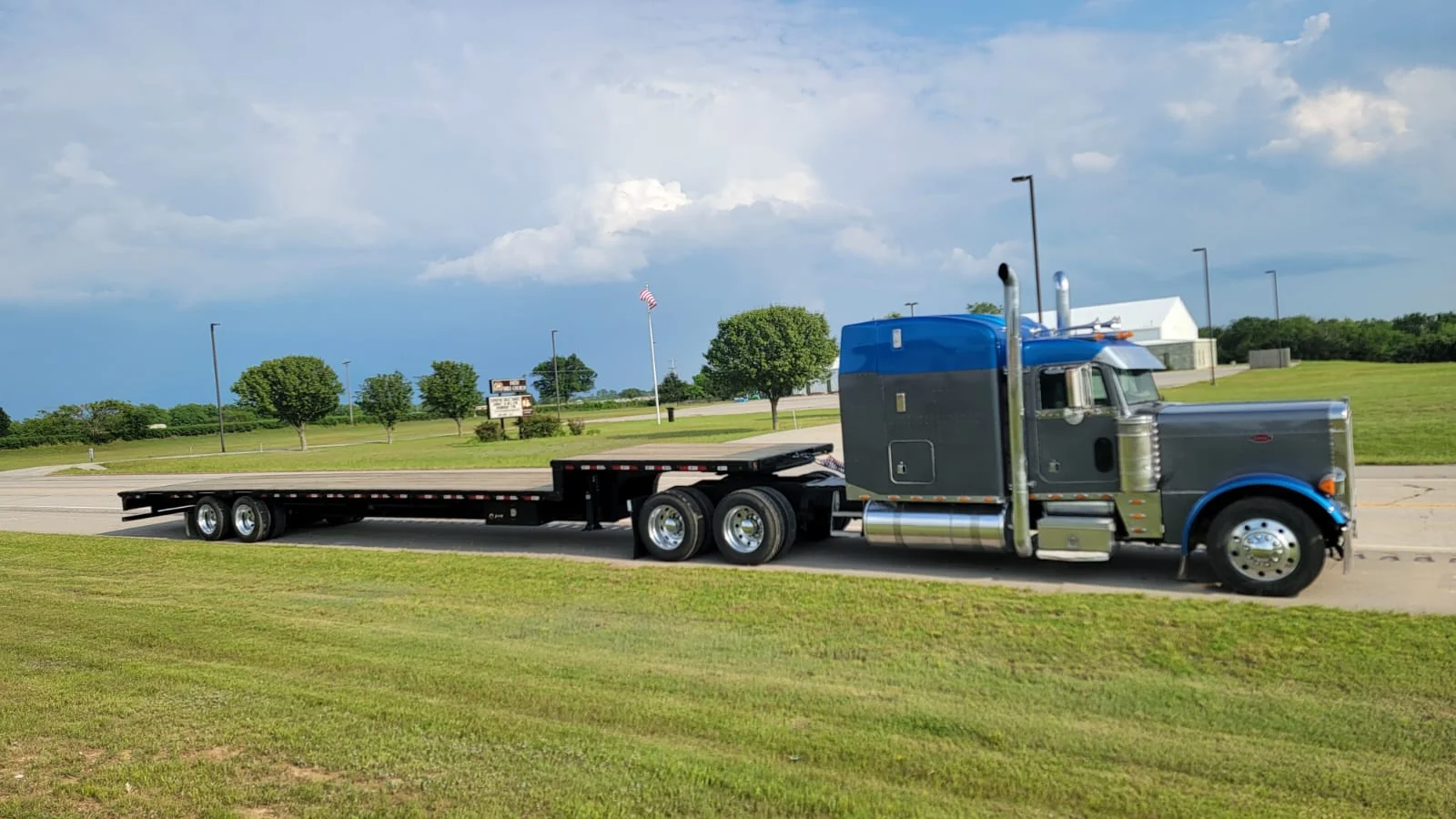
Step decks are commonly used for:
- Machinery and equipment too tall for a standard flatbed profile
- Large crates, tanks, skids, and fabricated assemblies
- Freight needing side loading but a lower supporting surface
- Loads that can use separate upper- and lower-deck positions
The lower deck does not make every tall load legal. Calculate the overall loaded height using the assigned trailer's loaded deck height, cargo height, cribbing, saddles, packaging, and protrusions. Also confirm whether the cargo footprint crosses the deck transition or wheel area.
Double drop, lowbed, and lowboy
A double-drop trailer has a low center well between a raised front gooseneck section and the rear axle deck. Lowboy and lowbed are broader operating terms for trailers designed to carry cargo close to the road; usage varies by region and company. Many lowboys use a double-drop geometry, but the exact neck, well, axle, and loading design differs by model.
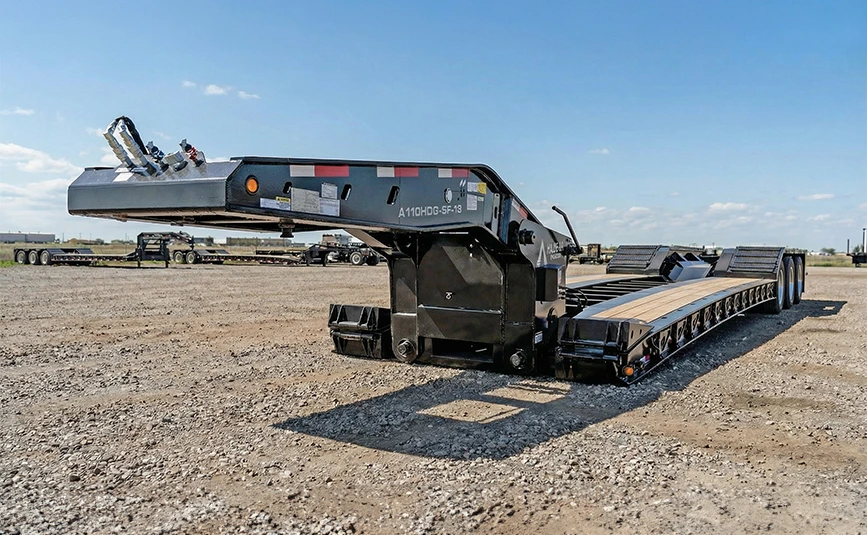
This equipment is used for:
- Excavators, dozers, loaders, and other construction machinery
- Tall industrial equipment and vessels
- Heavy pieces needing a lower center of gravity
- Loads whose height cannot be made workable on a standard or step deck
The low well creates vertical clearance but also introduces constraints. Check usable well length, loaded deck height, road clearance, rear bridge dimensions, outriggers, point-loading limits, and breakover clearance. A trailer with only a few inches of loaded road clearance may not be suitable for every driveway, rail crossing, grade, or jobsite.
Talbert's hydraulic removable-gooseneck double-drop example lists an 18 in loaded deck height for one product family. That is a manufacturer-specific specification, not a general value for all lowboys.
Removable gooseneck
A removable gooseneck, commonly called an RGN or detachable gooseneck, allows the neck to separate from the main deck. The front of the deck is lowered to the ground so suitable equipment can be driven or winched aboard. The neck is then reconnected to the tractor and deck.
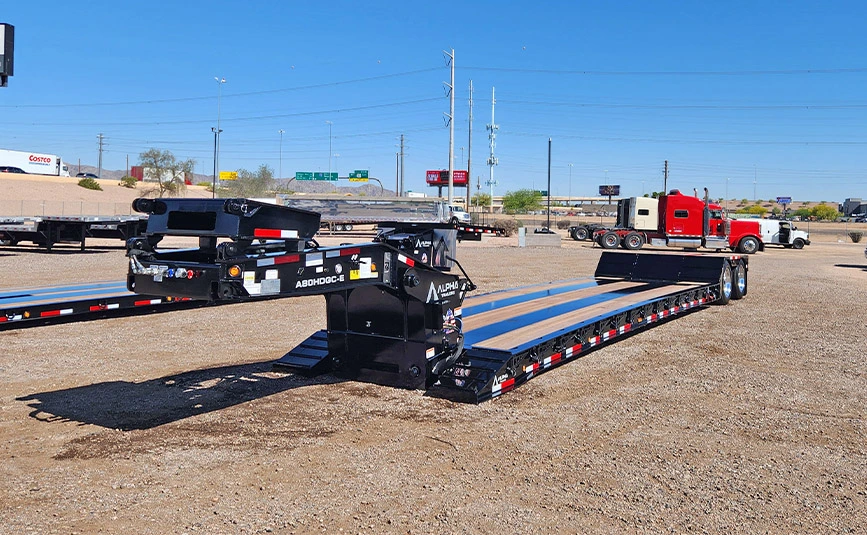
RGNs are useful for:
- Self-propelled construction, agricultural, and mining equipment
- Machines that cannot use steep rear ramps
- Heavy cargo that needs a low deck and front loading
- Projects where a crane is unavailable or unnecessary
Mechanical and hydraulic detachable systems operate differently. The ground must support the loading operation, the approach must be clear, and the machine must have suitable ground clearance and traction. Confirm ramp angle, deck capacity, tire or track loading, winch plan, securement points, and the manufacturer's operating procedure.
An RGN is not automatically the highest-capacity choice, and an equipment rating does not override road law. The Talbert operator manual emphasizes that load distribution must stay within the trailer, tire, wheel, axle, GVWR, and GAWR ratings.
Extendable or telescopic trailer
An extendable trailer lengthens its load-supporting structure for freight that cannot fit on a fixed deck. Standard flatbeds, step decks, and double drops can all have extendable versions.
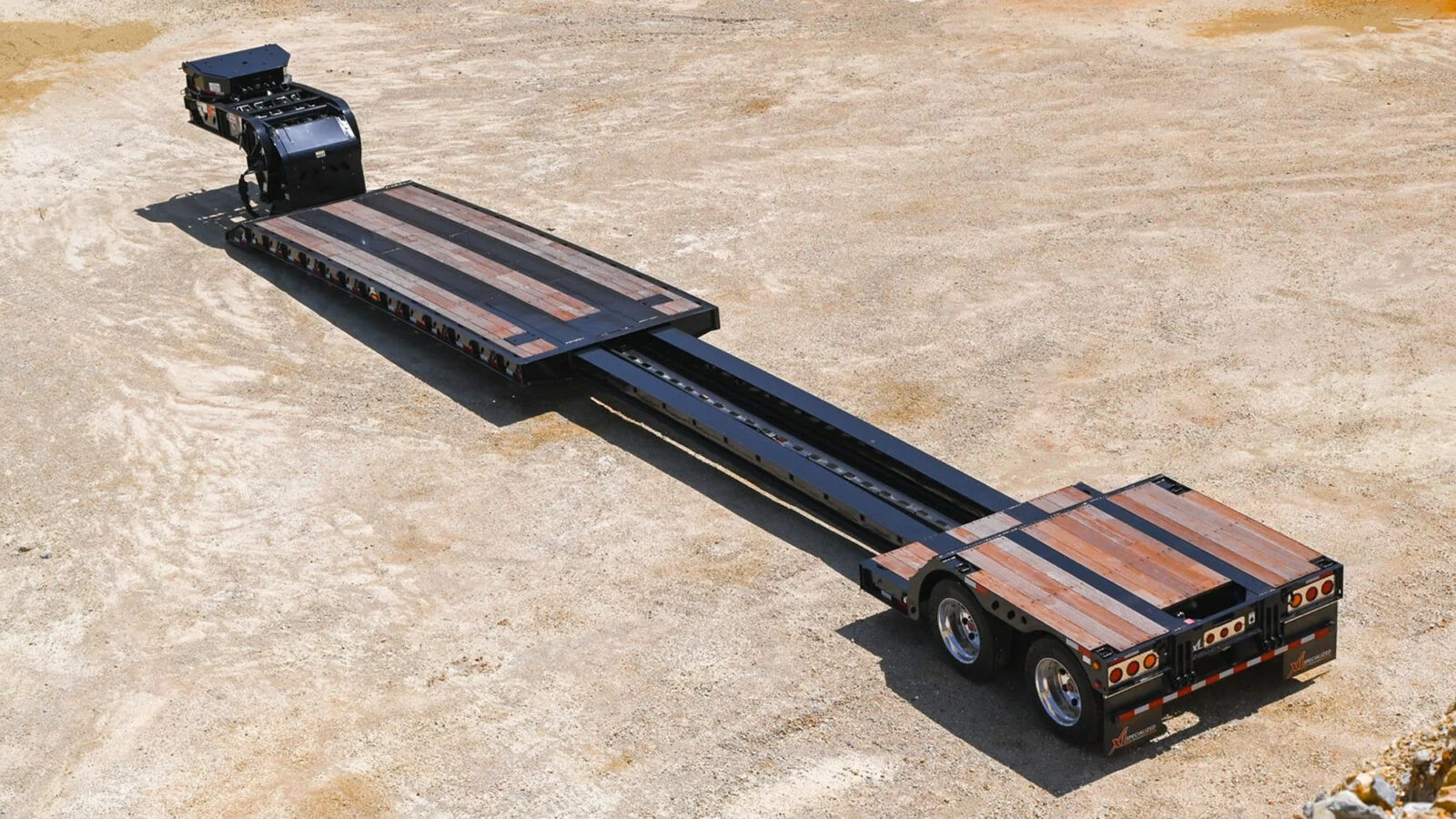
Common cargo includes:
- Structural beams, girders, poles, and trusses
- Wind-energy components
- Long tanks, vessels, pipe, and fabricated assemblies
- Self-supporting pieces with engineered support points
The extended section may not carry the same concentrated load as a closed trailer. Opening the trailer also changes turning radius, off-tracking, frame stress, axle distribution, overall length, and the permit envelope. Obtain the open and closed dimensions, locking increments, support-point rules, and capacity chart for the exact unit.
Manufacturer examples show how different this category can be. Great Dane lists straight-frame extendables reaching up to 90 ft for one Freedom Steel configuration, while Talbert publishes extendable double-drop specifications for a low-deck heavy-haul design. Those are different tools despite sharing the word extendable.
Conestoga rolling-tarp system
A Conestoga is a retractable tarp-and-bow system mounted on a flatbed, step deck, or straight truck. The cover rolls along tracks so it can expose the deck for side, rear, or overhead loading, then close around the freight.
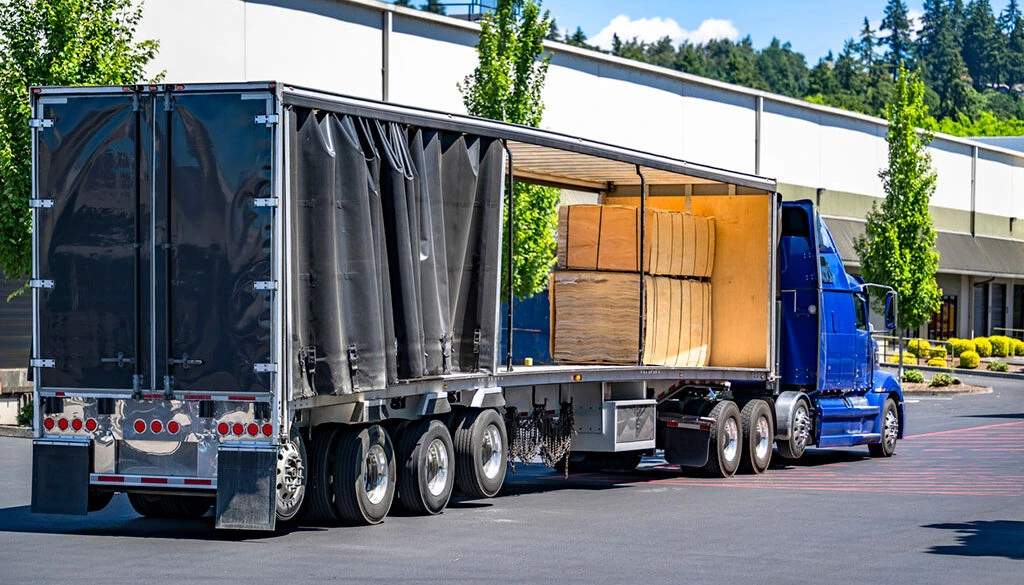
It is a strong option for:
- Machinery, metal products, and building materials that need weather protection
- Freight that benefits from side loading but should not be manually tarped
- Cargo that fits inside the system's usable envelope
- Operations seeking ground-level opening and closing procedures
A Conestoga is a cover system, not a substitute for cargo securement. Track position, front and rear bows, tarp sag, bulkhead, and closing hardware reduce usable clearance. Confirm internal length, width, height, loading opening, and whether the freight can be secured before the cover closes. Aero Industries identifies the Aero Conestoga as a rolling tarp system and lists versions for flatbeds, drop decks, and straight trucks.
Side-kit trailer
A side kit adds removable stakes or panels, bows, and a tarp roof to a flatbed. It can protect weather-sensitive cargo while retaining the ability to remove components for loading. Side kits are often used for bagged or palletized freight and other cargo that benefits from a temporary enclosure.
Confirm the internal envelope, panel and bow removal procedure, tarp condition, setup labor, loading access, and cargo securement. A side kit is not automatically equivalent to a dry van: its panels and tarp should not be treated as structural restraint unless the specific components are rated and used for that purpose. Aero's flatbed tarp-system catalog distinguishes side kits from Conestoga rolling systems.
Tilt deck, traveling axle, and hydraulic tail
These trailers create a lower loading angle without removing the gooseneck. A tilt deck pivots; a traveling-axle trailer moves its axle group while lowering the rear of the deck; a hydraulic-tail trailer unfolds or lowers a powered rear section. Some models also use a winch.
They can suit:
- Pavers, rollers, lifts, farm equipment, and recovery loads
- Wheeled or tracked equipment that cannot be crane-loaded economically
- Machines needing a shallower approach than fixed ramps provide
- Jobsite moves requiring frequent loading and unloading
Check the approach angle, breakover angle, deck and tail ratings, winch line pull, machine weight distribution, traction, ground strength, and clearance during hydraulic movement. Landoll's traveling-axle product sheet and Talbert's hydraulic-tail specifications show why capacities and operating geometry must be verified by model.
Multi-axle and modular heavy-haul equipment
Exceptional loads may require tridem or quad-axle trailers, spread-axle lowboys, jeeps, boosters, steerable dollies, perimeter frames, beam trailers, or hydraulically suspended modular platforms. These are engineered hauling systems rather than ordinary catalog flatbeds.
Additional axles can distribute weight, but they also add tare and do not automatically make a load legal. A heavy-haul plan may require:
- Engineered axle-load and bridge analysis
- Tractor, jeep, trailer, booster, and cargo weights by axle group
- State and local permits for every jurisdiction crossed
- Route surveys, turning simulations, and clearance verification
- Escorts, travel windows, utility coordination, or law-enforcement support
- Loading and securement drawings approved for the actual equipment
Talbert's heavy-haul product families illustrate the range from double drops and traveling axles to spread-axle lowboys and steerable dollies. Availability is specialized and must be confirmed early.
How to choose the right trailer
Begin with the cargo and the operating environment. A familiar equipment name is not enough for dispatch or pricing.
Cargo dimensions and support points
Collect the exact packed length, width, and height of every piece. Include skids, saddles, cradles, dunnage, lifting lugs, exhaust stacks, guards, and other protrusions.
For height planning, use:
Overall loaded height = loaded deck height + cargo height above the deck
Add anything between the deck and cargo. If a machine can be reduced for transport, document the approved transport condition rather than assuming parts may be removed.
Also collect:
- Total and per-piece weight
- Center of gravity and support footprint
- Maximum permitted point or line loads on the cargo
- Lift points, tie-down points, and no-chain areas
- Whether the cargo is self-supporting over an open extension
Loading and unloading method
Match the equipment to both ends of the move:
- Forklift from the side: Standard flatbed, step deck, or compatible covered flatbed
- Crane from above: Open flatbed, step deck, or low deck with verified lifting plan
- Drive-on or winch-on: RGN, tilt, traveling axle, hydraulic tail, or ramps
- Dock loading: Confirm the deck can meet the dock and that the rear opening is usable
- Indoor loading: Check door, roof, sprinkler, turning, and ground-clearance constraints
The pickup method does not prove the receiver can unload the freight. Confirm equipment capacity, operator availability, access hours, staging space, surface strength, and recovery plan at both locations.
Weather and handling protection
An open deck allows flexible loading but exposes freight to weather, road spray, and handling. Decide whether the cargo can move open, needs a fitted tarp, or requires a Conestoga or side kit.
Tarp dimensions and material must match the freight. Edge protection should prevent sharp cargo from cutting tarps or tiedowns. Never rely on a tarp to restrain the load, and do not assume a retractable cover makes weather-sensitive cargo suitable without checking sealing and clearance.
Weight distribution and trailer ratings
Check more than total cargo weight. The following can each control the move:
- Tractor, trailer, accessory, fuel, and cargo tare
- GVWR and GAWR
- Tire, wheel, suspension, kingpin, frame, deck, and ramp ratings
- Distributed and concentrated-load limits
- Axle count, axle spacing, and cargo center of gravity
- Fifth-wheel load, steer axle, drive group, and trailer axle loads
- Open-extension capacity and support-point restrictions
A longer or heavier trailer may solve one constraint while creating another. Load placement should be planned against the actual equipment drawing and verified by axle weights where required.
Route and receiver access
Measure the full route, not just highway miles. Check:
- Bridge, overpass, wire, canopy, gate, and indoor clearances
- Posted bridge and road weight limits
- Lane width, shoulder, medians, work zones, and construction restrictions
- Intersections, roundabouts, railroad crossings, grades, and breakover points
- Toll-road, port, terminal, and local-jurisdiction rules
- Receiver driveways, surface condition, turning room, and staging space
Permitted dimensions do not guarantee physical clearance. The permit and approved route must match the actual loaded configuration.
Cargo securement on flatbeds
Open-deck cargo must be immobilized against the forces of normal transportation. The tarp, packaging, and cargo weight alone do not secure the load.
FMCSA's cargo securement rules explain the general requirements for tiedowns, blocking, bracing, dunnage, working load limits, and cargo that can roll. Under the general rule, the aggregate working load limit of the securement system must be at least one-half the weight of the article or group being restrained. The required number and arrangement of tiedowns still depend on cargo length, weight, blocking, attachment method, and any commodity-specific rule.
The complete requirements appear in 49 CFR Part 393, Subpart I. That subpart includes commodity-specific provisions for logs, dressed lumber, metal coils, paper rolls, concrete pipe, intermodal containers, automobiles, heavy vehicles and machinery, and other cargo. When a commodity-specific rule applies, it can add to or modify the general method.
Before movement, verify:
- Chains, straps, binders, anchor points, blocking, chocks, cradles, and edge protection are suitable and undamaged
- Working load limits are known and compatible across the system
- Wheeled or rolling cargo cannot roll, articulate, rotate, or release attachments
- Securement does not damage the cargo or contact prohibited areas
- Loose parts, ramps, tarps, dunnage, and accessories are also secured
- The driver has an inspection and reinspection plan required by applicable rules
Use a carrier experienced with the commodity. This guide is not a load-specific securement plan.
Legal size, weight, and permits
Physical fit, trailer capacity, and legal road movement are separate approvals.
Width and length
FHWA's federal size guide explains that commercial vehicles on the National Network and reasonable-access routes are generally subject to a 102 in width standard, excluding specific devices allowed by regulation. Cargo extending beyond that width can require an overwidth permit.
Federal law establishes minimum semitrailer lengths that states must allow on the National Network; it does not make every trailer-and-load length legal on every road. States and local jurisdictions can have relevant rules outside the federal framework, and an extended or overhanging load may require permits, flags, lights, escorts, or restricted routing.
Height
There is no single federal commercial-vehicle height limit. FHWA notes that states set height limits, commonly in the 13 ft 6 in to 14 ft range, with lower clearances possible on individual roads. Always check every state and route segment rather than treating 13 ft 6 in as a nationwide guarantee.
Weight and bridge formula
For the Interstate System, FHWA lists federal limits of 80,000 lb gross vehicle weight, 20,000 lb on a single axle, and 34,000 lb on a tandem axle, subject to the Federal Bridge Formula, exceptions, and state-specific rights. The FHWA Bridge Formula guide explains why axle count and spacing can require a lower gross weight even when individual axle limits appear acceptable.
Off the Interstate System, state, local, bridge, and posted limits can differ. A trailer's rated capacity is never permission to exceed an applicable road or bridge limit.
Oversize and overweight permits
The Federal Government does not issue oversize or overweight permits. FHWA's permit overview and state contact list explains that permits are issued by states and may be available for qualifying nondivisible loads. Separate local, toll-road, turnpike, port, or facility approvals may also apply.
A permit can specify the route, dates, travel hours, speed, lane use, weather restrictions, signage, lighting, escorts, and other conditions. Never quote or dispatch an oversize load from a generic threshold alone.
Flatbed transloading for ocean cargo
Flatbed selection is especially important when out-of-gauge cargo arrives in an open top, on a flat rack, or on a platform. Moving the cargo from ocean equipment to a domestic lower-deck trailer may reduce overall height, improve axle distribution, or make a long inland move more practical.
It may also add:
- A terminal-to-transload dray leg
- Crane, rigging, forklift, or heavy-lift charges
- A second securement plan and cargo-condition handoff
- Storage, permits, escorts, route surveys, and specialized carrier costs
- Separate empty-container or flat-rack return activity
Compare the intact ocean-equipment profile with the proposed domestic trailer as two complete systems. Portmate's direct drayage vs transloading guide explains that decision, while What is transloading covers facility selection, handoffs, costs, and planning controls.
If the cargo is still in international equipment, identify whether it uses an open top, flat rack, platform, or another special container type.
Information needed for a flatbed quote
Send enough information for the carrier and permit team to model the real load:
- Pickup, delivery, and every planned stop or transload site
- Commodity and intended use
- Piece count and weight of each piece
- Exact packed length, width, and height of each piece
- Center of gravity, support footprint, lift points, and tie-down points
- Photos, drawings, packing list, and manufacturer transport instructions
- Required loading and unloading method
- Whether the cargo can be stacked, tilted, rotated, or partially disassembled
- Weather-protection and tarping requirements
- Hazardous-material status and required documentation
- Requested pickup and delivery dates
- Known site restrictions, appointments, permits, or escorts
For machinery, include the make, model, serial or unit description, operating condition, fluid or battery restrictions, attachments, tire or track width, ground clearance, and transport configuration. State whether it can move under its own power.
Avoid requesting only “one flatbed.” A useful request sounds like:
“One crated machine, 24,600 lb, 18 ft 4 in long × 9 ft 2 in wide × 10 ft 1 in high, center of gravity marked, crane-loaded at origin and destination, moving from ZIP 31408 to ZIP 30336. Drawings and lift plan attached.”
That information lets the provider compare a step deck, double drop, or other configuration and determine whether route and permit review are required.
How Portmate can help with flatbed shipments
A port-related flatbed move is rarely just one truck rate. The complete plan may include terminal or rail-ramp pickup, drayage to a heavy-lift facility, cargo transfer, empty ocean-equipment return, and a separate open-deck move to the final receiver. Portmate can keep those connected activities in one scoped request instead of making you coordinate each handoff in isolation.
Start with the cargo, not a trailer name
You do not need to decide whether the load needs a standard flatbed, step deck, lowboy, RGN, extendable, or another configuration before contacting Portmate. Send the cargo details, photos, drawings, pickup and delivery points, loading methods, and schedule. Portmate can use that information to identify plausible equipment families and route the request for the carrier, facility, and permit review it requires.
This is especially useful when:
- OOG cargo must transfer from an open top, flat rack, or platform
- The intact ocean-equipment profile may be too tall or heavy for the inland route
- A crane, rigging crew, heavy forklift, or specialized transload yard is needed
- The receiver needs a different unloading method from the port-side facility
- Several providers must align around terminal availability, lift time, empty return, and delivery
Scope the complete movement in one request
Depending on the shipment and available coverage, Portmate can help scope:
- The terminal or rail-ramp drayage leg
- Direct delivery versus transloading near the port
- A suitable transload or heavy-lift facility
- The required outbound flatbed or lower-deck equipment
- Crane, forklift, rigging, securement, and tarping requirements
- Empty-container, flat-rack, or platform return activity
- Permit, escort, route-survey, and delivery-site responsibilities
- The cost assumptions and exclusions that must be confirmed before booking
Final acceptance still depends on the actual carrier, trailer, facility, route, permits, and equipment availability. Portmate's role is to turn the shipment facts into a coordinated, reviewable scope rather than rely on a generic flatbed label.
What can be priced instantly
Portmate's instant chat pricing currently covers supported direct container drayage moves. Flatbed transportation, devanning or transloading, onward OTR service, specialized lifting, and oversize or overweight requirements go through manual review because the price depends on the real cargo and available equipment.
Support follows up by email, usually within a few business hours, to collect missing details and verify the custom scope. This review protects the shipper from receiving a fast rate for equipment that cannot legally load, route, or unload the cargo.
Submit the request in Portmate
Open the Portmate chat and say that you need a flatbed or open-deck shipment review. Enter the cargo, routing, handling, and timing details from the checklist above, then attach the available photos and drawings.
Portmate can separate what is already confirmed from what still needs carrier, facility, or permit verification and route the complete request for shipment-specific review. When manual review is required, support follows up using the email connected to your Portmate account.
Common questions
What is the difference between a lowboy and an RGN?
Lowboy describes a low-deck trailer family. RGN describes a removable-gooseneck loading mechanism. Many RGNs are lowboys, but a lowboy can have a fixed or mechanical neck, and not every low-deck trailer loads by detaching the front.
Is a step deck the same as a double drop?
No. A step deck drops once from the upper deck to a lower main deck. A double drop has a low center well and rises again over the rear axle area, creating two transitions.
Is a Conestoga the same as a curtain-side trailer?
Not necessarily. A Conestoga is a rolling tarp-and-bow system that retracts along tracks. Curtain-side equipment can use a different roof, post, door, and side-curtain structure. Confirm the exact system rather than using the names interchangeably.
How much weight can a flatbed carry?
There is no universal cargo number. Payload equals the allowable loaded combination weight minus the actual tractor, trailer, fuel, equipment, and accessory weight, and it remains subject to axle distribution, bridge formula, component ratings, road limits, and permits. Concentrated-load limits can control even when total cargo weight appears acceptable.
Can cargo overhang a flatbed?
Sometimes, but legality depends on the cargo, amount and direction of overhang, state and local rules, route, markings, lighting, permits, and whether the load is adequately supported and secured. Confirm the actual configuration with the carrier and permit authority.
Does a lower deck guarantee the load will clear the route?
No. A lower deck only changes one part of the loaded height. Cargo support materials, protrusions, road grades, bridge clearances, wires, construction, permit routing, and the trailer's loaded ride height still matter.
Does a tarp or Conestoga cover secure the cargo?
No. Weather covering and cargo securement are separate systems. The load still needs compliant restraint, blocking, bracing, and inspection.
Authoritative references
Use current source material for the actual move:
Manufacturer pages are useful for understanding equipment families, but the carrier must confirm the assigned unit's build sheet, rating, condition, and availability.
Bottom line
Choose flatbed equipment by stacking the required features: deck geometry, loading method, deck length, weather cover, and axle configuration. Then validate the cargo support, securement, overall dimensions, axle loads, route, permits, and receiver access against the exact tractor and trailer.
For ordinary cargo, that may lead to a standard flatbed or step deck. Tall, heavy, drive-on, long, or weather-sensitive freight may need a lowboy, RGN, extendable, Conestoga, or engineered heavy-haul combination. The right answer is the configuration that can load, travel, and unload the actual cargo safely and legally—not the trailer name that sounds closest.