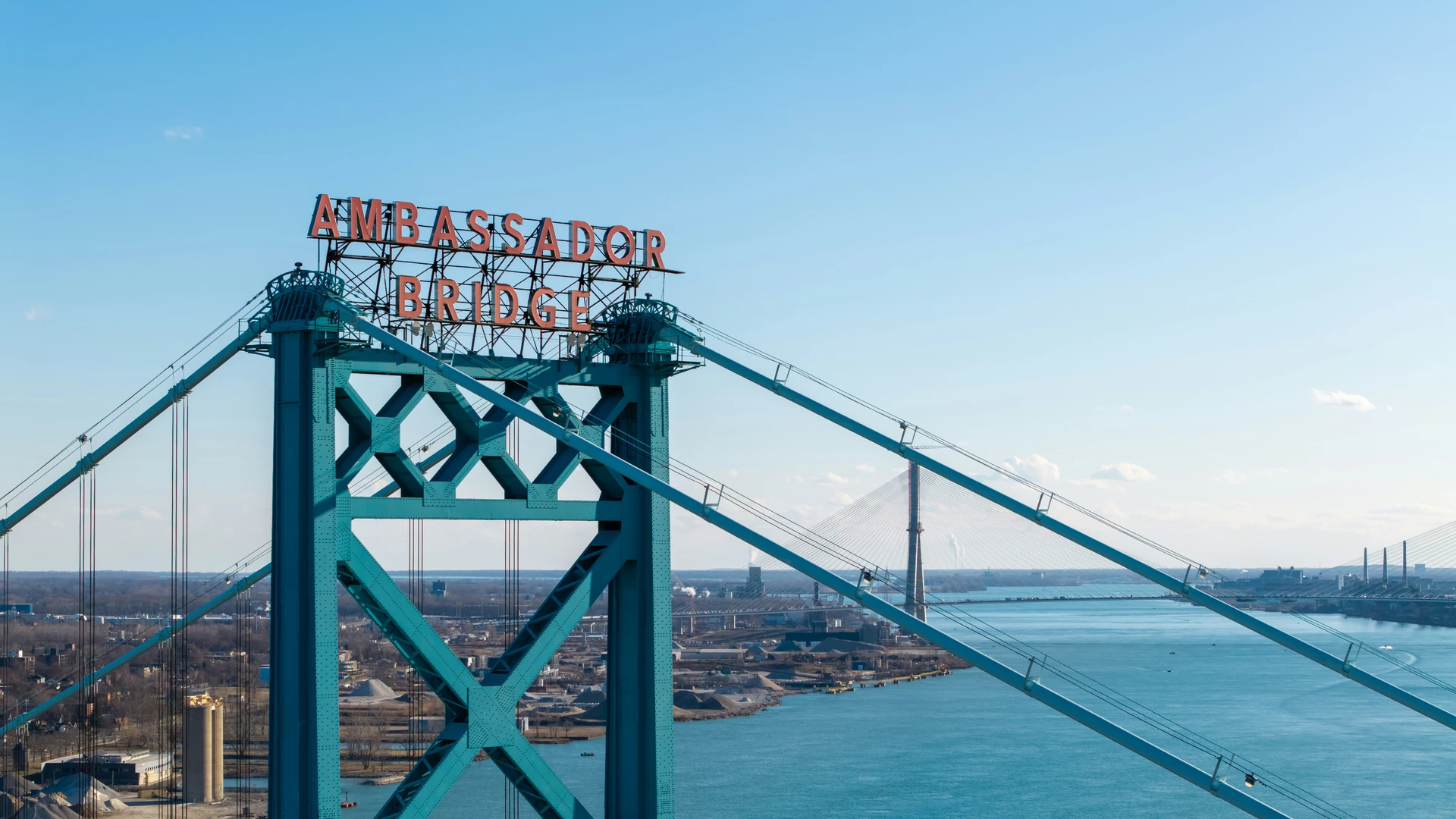

Tolls in Michigan
Michigan has no toll-road network, but several bridges and the Detroit–Windsor Tunnel charge tolls. For a truck shipment, the cost depends on the crossings actually used, the vehicle's classification, the payment account, and the direction of travel. A Michigan destination alone does not establish either a toll charge or a toll-free trip.
The distinction matters when pricing container movements. A local Detroit rail pickup may stay entirely on toll-free roads. A delivery across the Canadian border can add bridge tolls on the loaded trip and equipment return, with different currencies or payment arrangements on each leg. Freight arriving from Chicago or another state may encounter toll roads before reaching Michigan.
This guide explains where charges apply, how the main operators price commercial vehicles, and how to calculate and reconcile the complete movement. Amounts labeled US$ are U.S. dollars; amounts labeled C$ are Canadian dollars. Keep those currencies separate until you deliberately convert them.
Where tolls apply in Michigan
MDOT's Michigan Mobility 2050 financial plan distinguishes Michigan's toll crossings from its untolled road system. The main tolled crossings are:
| Crossing | Connection |
|---|---|
| Mackinac Bridge | Mackinaw City–St. Ignace; Lower Peninsula–Upper Peninsula |
| Liberty Bridge and Independence Bridge | Separate Saginaw River crossings in Bay City |
| Grosse Ile Toll Bridge | Riverview–Grosse Ile, within Michigan |
| Ambassador Bridge | Detroit–Windsor, Ontario |
| Gordie Howe International Bridge | Detroit–Windsor, Ontario |
| Blue Water Bridge | Port Huron–Point Edward/Sarnia, Ontario |
| Sault Ste. Marie International Bridge | Sault Ste. Marie, Michigan–Sault Ste. Marie, Ontario |
| Detroit–Windsor Tunnel | Downtown Detroit–Windsor, with significant vehicle restrictions |
The Mackinac Bridge carries I-75 and is a tolled crossing within Michigan. That does not make the rest of Michigan's I-75 a turnpike. Likewise, ordinary travel on Michigan's I-94 does not create a highway toll merely because the route serves an international bridge.
Michigan's statewide tolling study examines possible highway tolling and explains the legislative steps needed for implementation. Proposed toll rates in a feasibility study are not charges to add to a shipment quote.
Start with the actual pickup, receiver, and authorized equipment return. The Detroit rail-ramp and depot guide helps distinguish the local facilities and the additional planning needed when a Canadian delivery or return is involved.
Truck rates at the main crossings
Most major Michigan bridges price commercial trucks by axle, but the local Bay City bridges use vehicle-size categories. Passenger-car prices and commuter discounts should not be transferred to a tractor and chassis. Apply the operator's schedule effective on the movement date, particularly when a quote extends across a rate change.
Ambassador Bridge
The commercial toll schedule effective August 1, 2026 lists the following amounts for its published 0–145,000-pound tariff band:
| Payment basis | Commercial toll |
|---|---|
| Valid A-PASS account | US$9 per axle or less |
| No account | US$12 per axle |
At the listed US$9 account rate, a five-axle combination costs US$45 per crossing; without an account, it costs US$60. Eligible high-volume A-PASS subscription customers may have different effective costs. Do not assume that arrangement for an unrelated carrier.
The tariff also lists a US$135 escort charge for specified wide/oversize loads. A toll band is not a vehicle-weight authorization: confirm access, dimensions, escort arrangements, and the applicable charge with the operator before dispatching unusual equipment.
Confirm E-ZPass acceptance before relying on it. The adjustment notice announces acceptance beginning in fall 2026, while the operator's FAQ still says E-ZPass is not accepted. Until the bridge confirms the arrangement for the intended crossing, use a confirmed A-PASS setup or another accepted payment method. The published account column alone does not resolve that inconsistency.
Gordie Howe International Bridge
Gordie Howe connects Detroit and Windsor and opened to vehicle traffic on July 27, 2026. It is an operating option for commercial movements, subject to the shipment's border and routing arrangements.
The operator's toll table lists these commercial rates:
| Payment basis | Toll per axle |
|---|---|
| Standard | C$12 or US$8.75 |
| Breakaway account | C$9.60 or US$6.90 |
A five-axle combination therefore costs C$60 or US$43.75 at the standard published rate, or C$48 or US$34.50 through Breakaway. These are alternative currency amounts, not charges to add together.
Under the crossing agreement, tolls for both travel directions are collected on the Canadian side. The plaza's location does not mean that only Canada-bound travel is charged.
The payment FAQ makes a useful currency distinction: cash and Breakaway accounts can use the published CAD or USD basis, while credit/debit transactions are charged in Canadian dollars and converted under the bank's terms. Breakaway account holders can select their preferred currency. An ordinary card payment should not be quoted as a guaranteed US$43.75 five-axle debit.
Use the operator's toll-lane guide to match the vehicle and payment method to the overhead signs. Cash requires an attended lane; Breakaway tags, cards, and other supported electronic methods have their own lane arrangements.
Blue Water Bridge
Blue Water has separate operators and schedules for the two directions. Check each independently.
Toward Canada, from Port Huron: MDOT's eastbound schedule charges trucks and buses US$5.25 per axle. A five-axle truck costs US$26.25. The crossing is cashless. The published 50-cent EDGE Pass discount applies to cars; it should not be deducted from a commercial-truck calculation.
Toward Michigan, from Ontario: the Canadian operator's westbound schedule charges C$5 per commercial axle through ConneXion or C$7 per axle by debit/credit card. A five-axle truck costs C$25 or C$35, respectively. The commercial definition includes vehicles at least 2.45 metres/8 feet high. Cash is not accepted.
The Canadian schedule also lists separate special-load and ancillary fees. Advance registration, escorts, or time-dependent charges may apply to unusual loads. A normal five-axle subtotal does not price that additional handling.
EDGE Pass and ConneXion are separate account arrangements. The Sault bridge account FAQ explains that compatible IQ tags can be associated with Blue Water accounts, but the relevant accounts must be established. Possessing a compatible sticker does not itself fund both directions.
Mackinac Bridge
The Mackinac fare schedule charges tractor-trailers and other vehicles outside its passenger category US$5 per axle. A five-axle combination costs US$25 for one crossing. The lead vehicle determines classification, and towed equipment is generally charged at that vehicle's axle rate.
Payment options include cash, cards, mobile wallets, and MacPass. The authority applies a 2.3% fee to credit/debit card transactions; keep that separate from the base toll when applicable.
MacPass is the bridge's prepaid account program. Its passenger-vehicle return discount is not a commercial-truck discount. An empty container return still needs to be priced for the truck configuration making the trip.
Heavy and placarded vehicles need an additional access check. The bridge rules require an escort for trucks above 40 tons and identify other restrictions. The authority's truck-permit program provides an escort exemption for qualifying trained drivers and loads. Confirm eligibility rather than assuming every heavy crossing can proceed on the ordinary toll alone.
Sault Ste. Marie International Bridge
The commercial schedule effective October 1, 2026 lists US$6.75 or C$9.35 per axle. A five-axle truck costs US$33.75 or C$46.75, while a six-axle truck costs US$40.50 or C$56.10. The operator accepts cash, credit, and debit and offers prepaid commercial accounts.
Its axle rule deserves attention: loaded trucks are charged for all axles; empty trucks are charged for rolling axles. Obtain the returning equipment configuration before applying that distinction. A truck carrying an empty container should not automatically be assumed to qualify as an empty truck under the operator's rule; confirm uncertain classifications.
The long-term schedule lists commercial increases on April 1 and October 1, including US$7 and US$7.25 per axle for those respective dates in 2027. The board can suspend or delay scheduled increases. Use the effective commercial page for the travel date rather than treating an earlier quote as a fixed tariff.
Liberty and Independence bridges in Bay City
These are domestic Saginaw River crossings. The operator's rate and classification charts use size-based categories, with tractor-trailers illustrated in Class 3:
| Vehicle class | Commercial with transponder / without transponder |
|---|---|
| Class 1 | US$2 / US$5.50 |
| Class 2 | US$4 / US$7.50 |
| Class 3 | US$8 / US$11.50 |
Amounts are per crossing, not per axle. Confirm the class using the actual dimensions, particularly for equipment near a category boundary. Bay City's resident passenger exemption should not be used as a blanket exemption for commercial trucks.
Both bridges use electronic collection without booths. The operator's tolling guidance confirms E-ZPass compatibility alongside BC-PASS. A properly configured, funded account and readable transponder matter when applying the lower rate. The billing process for a vehicle without a usable account is discussed below.
Crossings where access needs special attention
The Detroit–Windsor Tunnel and Grosse Ile Toll Bridge have commercial tariffs, but their physical restrictions can rule out a proposed truck movement before price becomes relevant.
Detroit–Windsor Tunnel. The operator's requirements permit certain commercial vehicles within a 12-foot-8-inch height limit and 8-foot-6-inch width limit. Hazardous-material vehicles are prohibited. Many container combinations exceed the available height, so do not select the tunnel simply because its toll looks lower.
For a qualifying four-to-six-axle vehicle, the Detroit operator's standard commercial table lists US$19 toward Windsor and C$24.70 toward Detroit. Nexpress commercial pricing is separate. The tunnel is cashless and does not accept E-ZPass. Check the appropriate directional operator's tariff and the actual vehicle's eligibility before using any tunnel rate.
Grosse Ile Toll Bridge. This crossing connects Riverview with Grosse Ile; it does not cross into Canada. The township's restriction chart specifies 24 tons gross, 8 tons per axle, all axles down, and 14 feet of clearance. Vehicles above 12 tons require advance arrangements, weight documentation, an escort, and restricted crossing times.
The township publishes one-way and round-trip fare charts. For a high five-axle vehicle, they list US$20 cash/US$21 card one way and US$40 cash/US$41 card round trip, with a separate US$105 escort charge for specified 12–24-ton loads. The charts describe round-trip collection toward the island during Wayne County Bridge closures. Confirm the collection arrangement and access through the bridge office before calculating a visit. A fare category does not override the 24-ton limit.
Arrange payment for the actual route
Michigan's crossings do not share one statewide toll-payment account. Establish which operator is charging each leg, which account the carrier will use, and whether the published discount actually applies.
Verify the account before dispatch. Check the vehicle assignment, plate details, available funds, automatic replenishment, tag installation, and accepted payment lanes. If a tractor or temporary vehicle changes, confirm its account treatment before carrying forward the original rate assumption. A weigh-station bypass service should not be treated as proof that toll payment is covered.
Preserve the payment basis in the quote calculation. Record “A-PASS,” “Breakaway USD,” “ConneXion CAD,” or the relevant card/plate category rather than writing only “electronic toll.” Those labels explain why two estimates for the same bridge may differ.
Keep exchange assumptions visible. A total of US$26.25 plus C$35 is not a US$61.25 expense. Either show the two currencies separately or record the conversion rate, date, and any bank or foreign-transaction fee used to produce a single-currency estimate. A card processor's final conversion may differ from a planning assumption.
Use the operator's missed-payment process. If a payment fails or a notice arrives, identify the facility and use its own account or customer-service route. Another bridge's portal or a neighboring state's deadline cannot settle that balance.
Calculate tolls for the complete shipment
A useful calculation should be reproducible from the shipment instructions. That makes it easier to compare quotes and explain a later difference.
1. Establish every required stop. For an import, record the pickup terminal, delivery entrance, authorized empty return, and any separate chassis handoff. For an export, include the empty pickup, loading facility, and receiving terminal. A drop followed by later collection can create additional travel. Mark an unconfirmed return as an assumption.
2. Confirm the vehicle. Obtain the tractor-and-trailer axle count, overall dimensions, gross weight, and cargo restrictions. A three-axle tractor with a two-axle chassis totals five axles; changing to a three-axle chassis produces six. Container length alone does not determine the toll class. The container-chassis guide explains common configurations.
3. Confirm a permitted truck itinerary. Identify the actual bridge, direction, approach roads, and any out-of-state toll segments. For a border movement, coordinate the crossing with the carrier and the party handling customs documentation before substituting another bridge. Use MDOT's truck resources for truck routes, seasonal restrictions, and permit information. Cargo weight and complete vehicle weight are different inputs; the overweight-shipment guide explains the distinction.
4. Price each leg separately. For every charged passage, retain the operator, direction, vehicle class, axle basis, payment category, currency, and applicable schedule. Include special handling only when it applies to the actual load. An unresearched charge remains unresolved; it should not silently become zero.
5. Add the movement after resolving currencies. Keep loaded and return subtotals visible before combining them. The return may use a different crossing, equipment configuration, or destination. If the equipment owner changes the return, replace the affected leg in the calculation rather than rewriting the already completed travel.
6. Reconcile the result with the freight terms. Establish whether tolls are included in the total, allowed as an estimate, fixed for the agreed scope, or passed through at actual cost. Keep administration fees and penalties separate. The all-in drayage quote guide explains why the covered work and adjustment terms matter alongside the headline price.
Example with a Detroit–Windsor delivery and return
Assume a five-axle truck uses Gordie Howe for one loaded passage and one return passage, stays in the same toll category, and pays through a USD Breakaway account:
| Movement | Bridge toll |
|---|---|
| Loaded passage: 5 × US$6.90 | US$34.50 |
| Return passage: 5 × US$6.90 | US$34.50 |
| Bridge subtotal | US$69.00 |
Using the published standard USD basis instead would produce US$87.50 for two passages. The US$18.50 difference follows from the payment assumptions. This is a bridge-only illustration, not a carrier quote or a claim that either amount includes border fees, waiting, or special handling.
For comparison, two five-axle Ambassador passages at the listed US$9 account rate total US$90, while two at the US$12 no-account rate total US$120. Confirm the fleet's actual arrangement before using either result. Bridge price alone does not select the best operating route.
Example with different Blue Water schedules
Assume a five-axle truck crosses from Michigan into Ontario and returns through Blue Water with five chargeable axles. Its bridge subtotals are:
- Toward Canada: US$26.25.
- Toward Michigan with ConneXion: C$25.
- Toward Michigan by card instead: C$35.
The return alternatives replace one another. Do not add both, double the eastbound amount, or combine the USD and CAD figures without conversion.
Example with a Bay City delivery
Assume a Class 3 truck uses Liberty Bridge once toward the receiver and once on its return. At the published transponder rate, the subtotal is 2 × US$8 = US$16. By plate, it is 2 × US$11.50 = US$23.
That US$7 difference is a payment-method difference before any overdue fees. If the truck also uses Independence Bridge, count its passages separately. A reference to “the Bay City bridges” does not establish how many times either bridge was crossed.
Keep neighboring-state and border charges separate
A shipment can incur tolls on the way to Michigan even when every mile inside the state avoids a charged crossing. Price the roads actually used rather than assigning an automatic “Michigan toll” allowance.
For a Chicago-origin move, check the Illinois pickup and the selected route through Indiana. The Illinois toll guide and Indiana toll guide explain their different systems. The Indiana Toll Road calculator prices by vehicle and traveled portion; the Ohio Turnpike calculator requires the vehicle class and entrance/exit. A route that bypasses those facilities should not inherit their through tolls.
At the Canadian border, bridge tolls are separate from government arrival/inspection fees, brokerage, duties, and taxes. Do not label all of those items “tolls.” APHIS's commercial-truck fee guidance explains that its U.S.-arrival inspection fee applies to commercial trucks, including empty trucks and truck cabs, and describes per-crossing and annual-transponder arrangements. Confirm the carrier's applicable border-fee treatment before adding a shipment-level allowance.
An annual border-fee transponder and a bridge's toll account serve different payment purposes. Likewise, possession of a toll account does not establish customs clearance or authorization to perform the cross-border service.
Handle delayed bills and unclear toll charges
Cargo delivery, toll posting, and the carrier's shipment invoice can occur at different times. A later charge may reflect plate billing, account processing, a vehicle owner's involvement, or subsequent freight reconciliation. Its timing alone does not establish that the customer owes an addition.
Bay City plate invoices and overdue fees
The Bay City billing FAQ says drivers without BC-PASS or a valid E-ZPass/I-PASS account can receive an invoice at the vehicle's registered address. Account holders can review transactions online. Keep the registration address current and check the account rather than treating the absence of an early invoice as proof that the crossing was free.
The operator publishes this escalation:
| Notice stage | Additional fee listed |
|---|---|
| First notice | Pay by the invoice due date |
| Second notice | US$10 past-due fee |
| Third notice | US$15 delinquent-account fee |
| Violation status | US$50 violation fee |
| Collections | Referral to a collection agency |
Unpaid balances and new tolls carry forward. Use the actual notice and its deadline when checking the amount. Payment options include the official BC-PASS portal, phone, mail, and the operator's walk-in center.
Reconcile the charge with the booking
When a carrier requests an additional toll payment, ask for enough detail to connect the expense to the shipment:
- Transaction: Crossing or toll segment, travel date/time, direction, vehicle identification, and receipt or account record.
- Movement: Loaded delivery, empty return, later collection, or another equipment visit.
- Calculation: Vehicle class, chargeable axles, payment category, currency, and any conversion.
- Amounts: Base toll, special handling, operator late fees, and carrier administration shown separately.
- Prior inclusion: The original quote, booking terms, toll allowance, previous invoice, and any credit or payment.
Compare the proposed addition with the agreed scope. A changed empty return can create a real extra crossing; an unchanged movement may already have its toll included. An operator's penalty for late payment also needs its own explanation rather than being silently combined with the road charge. The accessorial-tracking guide explains how to review the amount and supporting records together.
Handle the operator's payment or dispute deadline while the shipment-level allocation is being discussed. Those are separate processes, and a freight-invoice question does not suspend the operator's notice.
Check suspicious toll messages independently
Michigan's Attorney General and MDOT toll-scam alert warns about messages impersonating toll agencies. MDOT does not request bridge-toll payment by text. The Detroit–Windsor Tunnel FAQ also says it does not send unpaid-toll texts or use video tolling.
Open the operator's known website independently or use its verified contact details to investigate a possible balance. Michigan's lack of highway tolls does not make every bridge invoice fraudulent, and a real out-of-state toll still needs to be checked through that operator.
Compare toll avoidance with the full operating cost
A route with a lower toll can still cost more to perform. Compare the saving with extra mileage, fuel, driver time, traffic, border processing, and the risk of missing a terminal or receiving appointment.
For illustration, saving US$15 while adding 30 minutes creates US$45 in time cost if the operation uses an assumed US$90 per hour for truck and driver time, before added mileage or fuel. Those are hypothetical operating assumptions, not a quoted market rate. Use the carrier's actual economics for the decision.
Confirm that the alternative can carry the truck. MDOT's trucking resources identify all-season and seasonal routes and link permit information; Mi Drive provides construction, incident, and traffic resources. A road with no toll can still have a weight restriction, low clearance, unsuitable entrance, or closure.
Special cargo adds another check. Gordie Howe's specialized-load instructions address oversize/overweight permits, advance contact, and hazardous goods. The tunnel's hazardous-material prohibition cannot be solved by paying its commercial toll. Establish the cargo classification first; the hazmat-shipment guide explains the information needed.
For a cross-border move, compare complete permitted itineraries with the carrier and documentation team. A cheaper bridge is useful only if the vehicle, cargo, border arrangements, and receiving plan support it.
See estimated tolls in the quote
Portmate automatically calculates estimated tolls for the selected shipment route, combines the loaded and empty legs in the quoted itinerary, and shows the amount in the Tolls line. That saves time tracing roads and checking separate operator schedules, and brings the expected expense into view before an overlooked crossing becomes a billing surprise after delivery. The route-toll walkthrough shows where to find it. When requesting a drayage quote, review the stops, equipment, included services, and adjustment terms alongside the total.