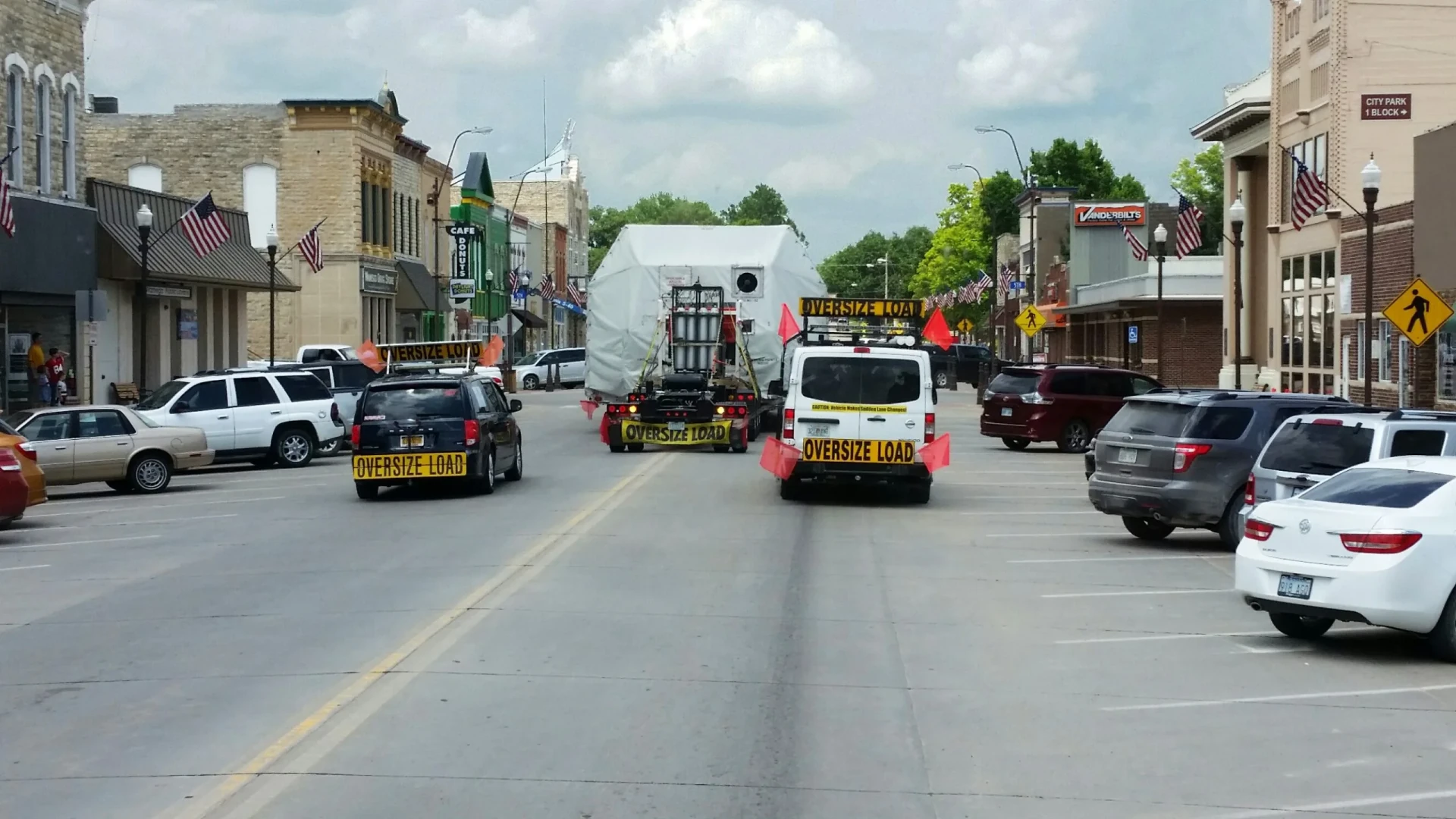

What is an escort
In oversize and heavy haul trucking, an escort is a vehicle and operator assigned to accompany a load, warn other road users, and help the transport team manage the hazards of the move. The familiar pickup or SUV with an OVERSIZE LOAD sign is a private pilot or escort vehicle. Some movements also need police, utility crews, or other specialized support.
The word can describe the service, the vehicle, or the person providing it. When a dispatcher says a shipment “needs two escorts,” the next questions are which types, in which positions, and over which part of the route. Two ordinary pilot cars, a high-pole car plus a rear escort, and two police vehicles are different arrangements.
This guide covers U.S. road transport, with examples for shippers, forwarders, dispatchers, and readers learning the industry. The Federal Highway Administration’s pilot/escort training introduction explains the common safety purpose and the substantial differences between state rules. The issued permits and applicable jurisdiction’s requirements determine the actual escort plan.
Understanding the terminology
Several expressions refer to the same basic service, while others identify a particular assignment. Understanding the difference helps you read a quote or discuss a movement without booking the wrong support.
| Term | Meaning in a road transport discussion |
|---|---|
| Escort or escort service | The general accompaniment service; ask what personnel and equipment it includes |
| Pilot car or pilot vehicle | Common names for a private escort vehicle; the name alone does not specify front or rear placement |
| Pilot/escort vehicle operator, P/EVO, or PEVO | The person operating the escort vehicle |
| Lead or front escort | A pilot vehicle assigned ahead of the load |
| Rear escort or chase car | A pilot vehicle assigned behind the load |
| High-pole or height-pole escort | A front escort equipped for overhead-clearance warning |
| Police or law-enforcement escort | An officer and authorized vehicle assigned to the movement |
| Utility escort | Utility personnel supporting a move where their infrastructure requires attention |
Treat these as roles that can be combined in one movement, rather than a choice of mutually exclusive packages. A high-pole operator is still a pilot/escort operator. “Front” describes the position; “high pole” describes an additional function and equipment requirement.
FHWA’s pre-trip safety meeting guidance treats lead, rear, height-pole, flagging, and trailer-steering assignments separately. The team should agree who performs each task before departure.
Other meanings of escort in logistics
At a marine terminal, an escort may instead mean security access accompaniment. For example, the Maryland Port Administration’s TWIC guidance explains escorted access for visitors and vendors who do not have a TWIC, including facility authorization requirements. That service addresses access to secure areas. It does not establish that someone is qualified or equipped to escort an oversize truck on public roads.
A quote should therefore identify the purpose: road pilot car, high pole, police, utility support, or terminal access. “Escort included” leaves too much unanswered when more than one meaning applies.
The main types of road escort
The load’s risks determine the work. Width creates lateral-clearance problems; height creates overhead-clearance problems; length changes turning and overhang behavior. Road layout and traffic introduce further requirements.
Lead and rear pilot cars
A lead escort travels ahead of the truck and provides information about what the load is approaching. That can include a narrowing roadway, stopped traffic, a work zone, or a turn that needs special coordination. The useful warning is specific enough and early enough for the truck driver to act.
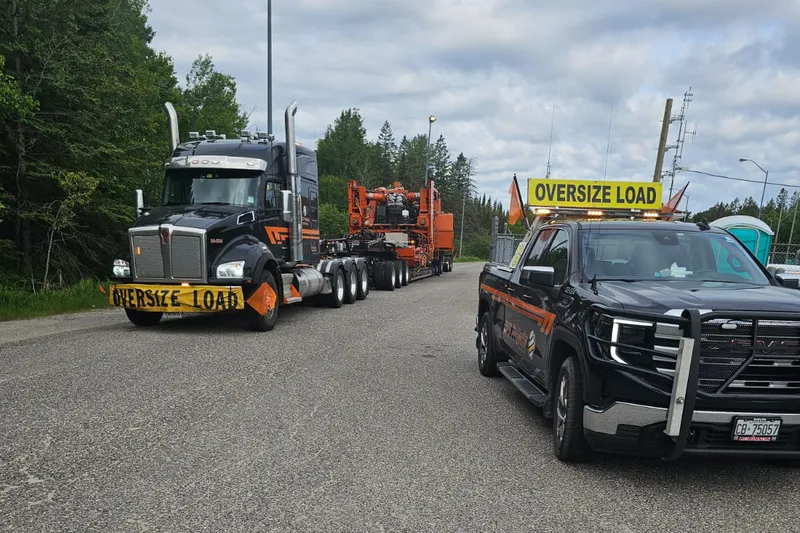
The front position lets the lead escort assess the road ahead and relay warnings to the truck driver.
A rear escort monitors the movement from behind. It helps warn approaching traffic and reports conditions the truck driver may have difficulty seeing. The rear operator can also spot visible problems such as a shifting load, a failed tire, or loose securement. FHWA describes these duties in its load movement guidance.
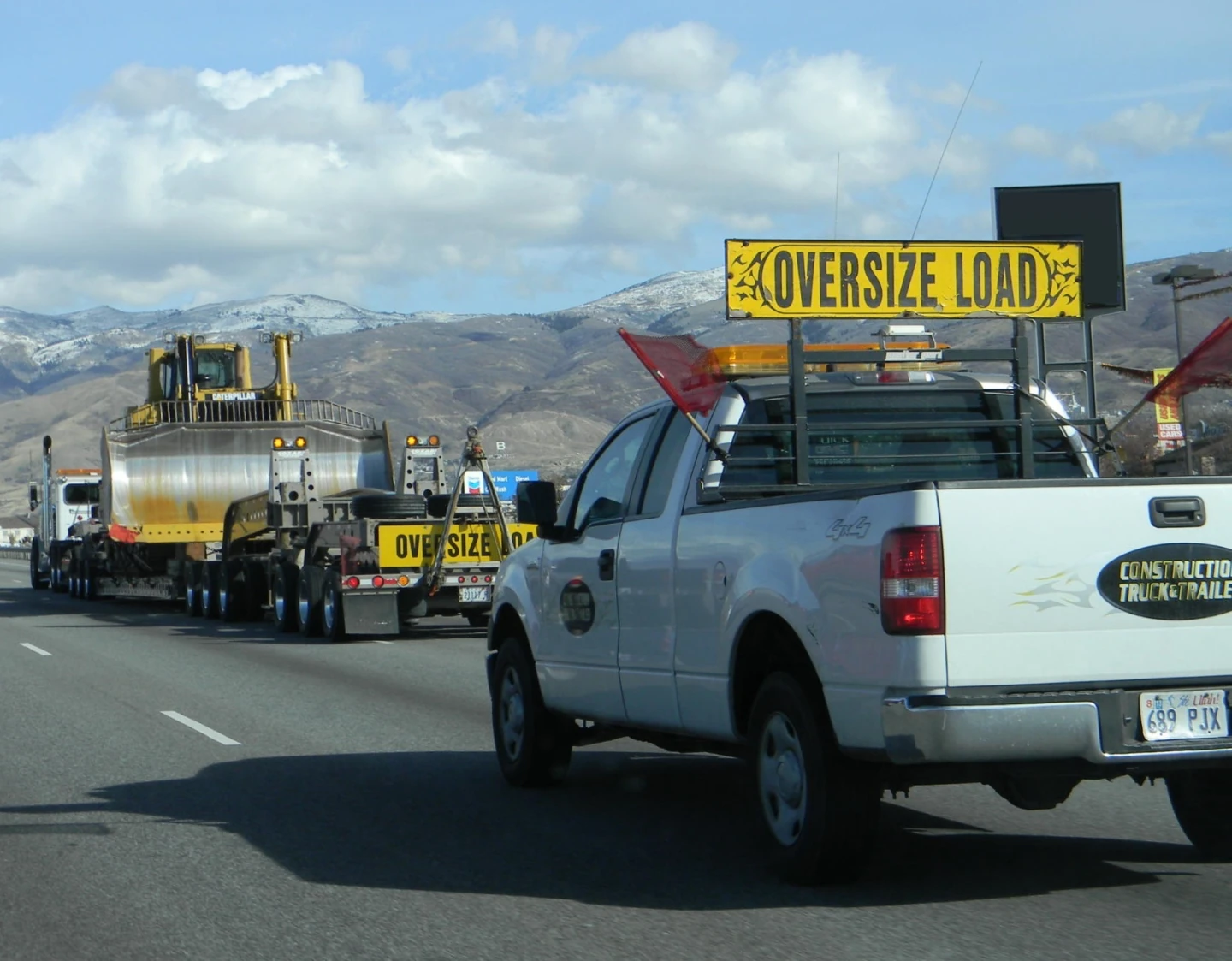
The rear position gives the escort a view of the trailer, its projections, and traffic approaching from behind.
Front and rear are not permanent job titles for a particular pickup. They are assignments for the permitted movement. Placement can change with the road segment and applicable instructions; a driver should not improvise a position simply because another one seems more convenient.
The escort’s sign warns motorists that an unusual vehicle is nearby. It does not give the truck an unrestricted right of way or give a private operator general police powers. Where traffic must be stopped or directed, the team needs the authority, training, and procedures required for that location. FHWA’s traffic-control guidance specifically distinguishes flagging procedures from the authority to perform them.
High-pole or height-pole escorts
A high-pole escort is a lead vehicle carrying an upright clearance pole, usually mounted at the front. You may also hear height pole, clearance pole, or height indicator. It provides advance warning of an overhead obstruction that could conflict with the load’s travel envelope.
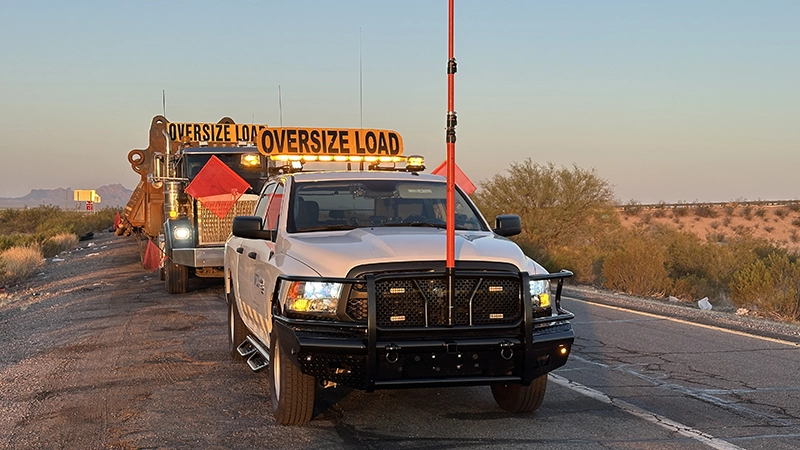
The distinction matters when booking. A regular front escort is not automatically a high-pole service: the operator needs suitable equipment, a confirmed setting, and a clear understanding of the load’s height and intended path.
FHWA’s trip operations training explains that the lead vehicle must be far enough ahead to report an obstruction in time for the load to stop. That distance depends on the operating situation. A fixed following-distance rule copied from another state or another load may be unsuitable.
The pole setting starts with the actual loaded vehicle. Cargo height by itself is insufficient. The trailer deck, packing, saddles, protrusions, and highest point of the transport configuration all matter. Confirm the final measurement after loading and use the setting required by the jurisdiction and permit.
For a concrete example, Washington’s WAC 468-38-100 requires the pole to extend 3 to 6 inches above the maximum vehicle or load height and specifies front mounting on the lead escort. Its equipment provisions call for a nonconductive, nondestructive device with a flexible upper portion. This is a Washington rule, not permission to assume the same setting everywhere.
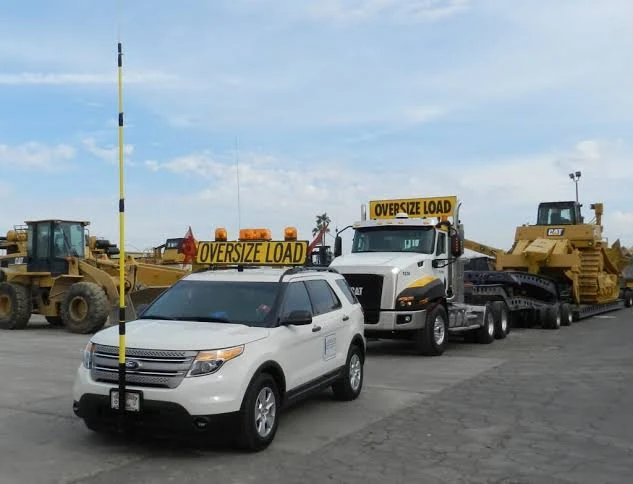
The reference height comes from the complete transport configuration, including the trailer and cargo supports.
A high pole is an early-warning device, not a clearance guarantee. The escort and truck must be considering the same path beneath an obstruction. Road crown, lane position, grades, and changes in the vehicle’s configuration can matter. The pole also does not authorize anyone to lift or push aside wires. A possible utility conflict needs the utility owner’s coordination and an approved plan.
FHWA discusses overhead obstacles and pole calibration in its special challenges guidance. A route survey, current route restrictions, correct measurements, and active communication remain necessary parts of the plan.
Police and highway patrol escorts
A police escort is law-enforcement support assigned to the move. Depending on the jurisdiction and movement plan, officers may help manage intersections, coordinate traffic restrictions, or support passage through a constrained segment. The need for police can arise from the route and maneuver, as well as the load’s size.
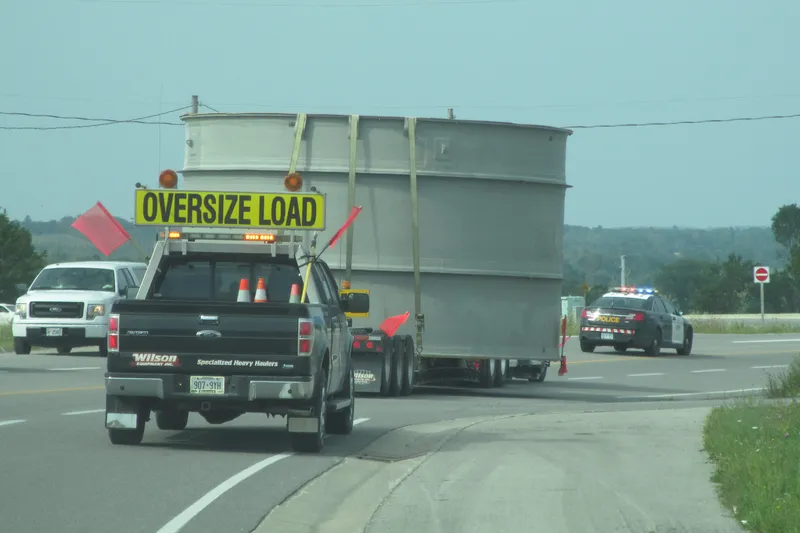
A private pilot car and police vehicle can support the same movement while performing different duties.
Police do not automatically replace the required private pilot cars. Read the permit for the actual combination, number, placement, and segment of service. The photo illustrates why “police escort” and “rear pilot car” should be separate entries in the movement plan.
FHWA’s law-enforcement escort guidance calls for permit review, load verification, route planning, and coordination with the other participants. It also notes that state permit authority may not cover city streets. Local access and police arrangements therefore need attention before the truck reaches the final delivery area.
For California, the Caltrans transportation permit FAQ directs carriers to the pilot-car maps, route-specific information, and special conditions. When a permit requires a California Highway Patrol escort, the permittee must coordinate with CHP to schedule it. Issuance of the transportation permit and confirmation of the police appointment are separate items to resolve.
Utility escorts and infrastructure support
A utility escort involves personnel responsible for infrastructure along the route, particularly where a tall or unusually shaped load conflicts with overhead facilities. Their work may require advance investigation, scheduling, and an approved method for dealing with the obstruction.
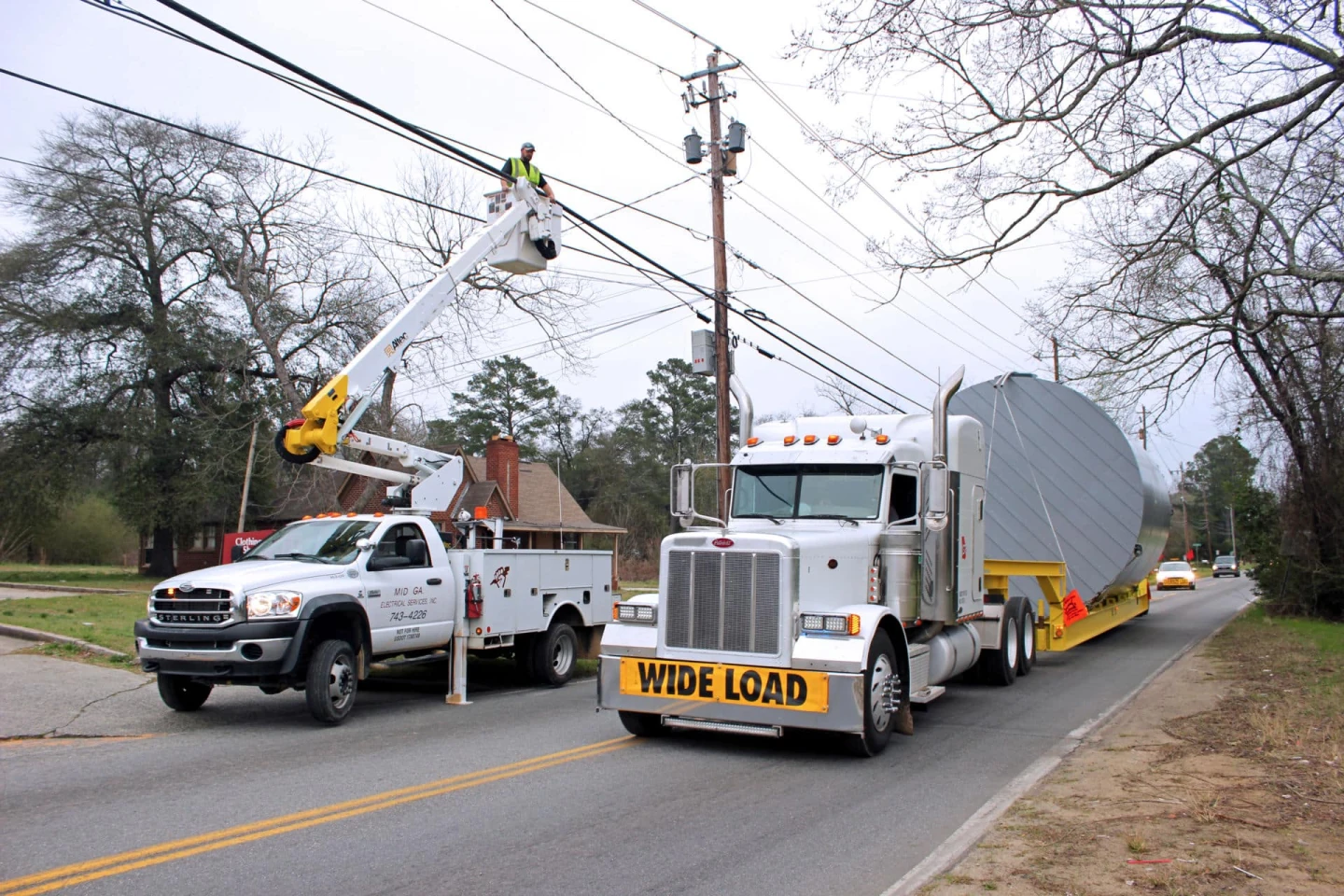
The bucket truck illustrates utility support beside a tall load. The line owner must determine what work is authorized.
Keep utility work explicit in the scope. Identify the owner, location, required action, responsible coordinator, and agreed timing. A pilot-car company’s presence does not establish approval to interfere with power lines, communications cables, traffic signals, or other assets.
For example, NCDOT’s published movement guidance describes arrangements and owner approval for removing and replacing obstructions, including utility lines and traffic signals. The practical lesson for a shipper is to confirm the infrastructure work itself, rather than assume it is covered by an ordinary escort booking.
Related specialists and services
Some people and services work closely with escorts without performing the same job. A clear scope keeps a route inspection, a trailer-steering assignment, and an escort vehicle from being mistaken for interchangeable items.
Route survey or route inspection. This is an advance assessment of a proposed path for the particular vehicle and load. It can identify low structures, narrow passages, difficult turns, railroad crossings, and places to stop. A survey vehicle may carry a height pole, but a survey completed before departure is different from an escort accompanying the truck during movement. FHWA’s route planning module explains the survey’s purpose and contents.
Tillerman or steerman. This person steers an axle of an articulated trailer. That is a vehicle-control function, rather than simply observing the trailer from a chase car. FHWA’s trip operations module distinguishes this role. Specify it separately where the equipment requires it.
Site spotter or banksman. A person helping with a plant entrance, yard maneuver, or unloading area addresses a local task. Do not count that person as the road escort unless the assignment, qualifications, vehicle, and permit conditions support both roles.
For equipment context, compare the flatbed trailer types. Choosing between a standard flatbed, step deck, lowboy, or extendable changes the loaded dimensions and maneuvering questions that the transport team must solve.
When a load needs escorts
An oversize permit and an escort requirement are related decisions, but they are not the same decision. A load can require a permit before reaching the ordinary escort threshold. A route condition can also add escorts to a movement that would need fewer on a different road.
Do not apply a single nationwide width, height, or weight number. Establish the complete configuration, identify the jurisdictions, and then read the rules and permits for each segment.
The information that changes the answer
Start with a measured load plan and the proposed route. Check:
- Width: The maximum lateral envelope, including any projections.
- Height: The highest point of the loaded vehicle measured from the road surface.
- Length and overhang: Overall length and the separate front and rear projections, measured using the applicable rule’s reference points.
- Weight and axle arrangement: Gross weight, axle loads, spacing, and any bridge-crossing instructions.
- Road type: Two-lane, divided, undivided, multilane, local streets, and constrained access roads.
- Route conditions: Narrow bridges, curves, work zones, restricted structures, and the final approach to the facility.
- Operating conditions: Authorized travel times, visibility, weather restrictions, and special maneuver instructions.
Use the OOG cargo guide to distinguish ocean-side out-of-gauge status from the road transport envelope. A flat-rack booking or ocean-carrier approval does not determine the road escorts.
Weight deserves its own review. Heavy cargo does not tell you its width or height, and a wide load is not necessarily overweight. The overweight shipment guide explains cargo weight, gross weight, and axle limits. Any escort needed for a particular bridge movement or permit condition must be confirmed from that movement’s instructions.
State examples that show why the route matters
These examples illustrate differences; they are not a substitute for a complete permit review.
Texas: For most loads and permit types, TxDMV’s escort table assigns one front escort on a two-lane highway, or one rear escort on a multilane highway, when width exceeds 14 feet but does not exceed 16 feet. Width above 16 feet requires front and rear escorts. A height exceeding 17 feet requires a front escort equipped with a height pole; above 18 feet, front and rear escorts apply. Separate rules address length, overhang, and certain commodities.
Multiple dimensions can change the result. TxDMV gives the example of a load 16 feet wide and 112 feet long requiring front and rear escorts because both dimensions trigger requirements. Read the Texas oversize guide for the broader permit and equipment context.
Washington: WAC 468-38-100 requires front and rear escorts above 11 feet wide on two-lane highways. Its front high-pole requirement begins when height exceeds 14 feet 6 inches, subject to the rule’s alternative-authorization provision. That height threshold is substantially different from the Texas example.
California: The Caltrans FAQ points to route maps and special conditions for pilot-car and CHP requirements. A dimension-only answer can miss a route restriction. The California oversize guide explains the wider planning process.
For a neighboring-state comparison, the Nevada oversize guide covers ordinary and restricted-route escort conditions. Treat each state line and change of road authority as a review point.
Pay attention to words such as exceeds, over, and up to. A threshold stated as “exceeding 14 feet” should not be rounded into “14 feet and above.” Measure accurately and resolve borderline cases before booking.
What happens before and during an escorted move
The visible convoy is only one part of the job. Preparation connects the measurements, permits, equipment, people, and route into an operating plan.
1. Confirm the assignment. Give the escort provider the load description, final dimensions, vehicle configuration, route, permits, meeting point, travel windows, and relevant contacts. Identify who arranges police, utility crews, surveys, and local permissions. FHWA’s pre-trip planning checklist provides a useful framework.
2. Inspect the actual setup. Compare the loaded truck with the plan before departure. A different trailer, extra packing, an altered attachment, or a changed transport position can affect the dimensions. Resolve discrepancies before relying on the permits or a previously selected pole setting.
3. Brief the whole team. Agree on positions, radio channels and backup communications, terminology, turns, difficult locations, stopping places, and handoffs. Establish what happens if someone reports a hazard or loses communication. FHWA’s pre-trip activities module emphasizes accurate information and clear responsibilities throughout the movement team.
4. Check escort equipment. Common items include warning signs and lights, flags, two-way radios, reflective apparel, a STOP/SLOW paddle where required, emergency warning devices, a fire extinguisher, and a height pole for the relevant assignment. Vehicle eligibility, dimensions of signs, permitted light colors, and other specifications vary. Use the applicable rules rather than treating this list as a complete equipment standard. FHWA’s operator and vehicle equipment module explains these categories.
5. Monitor and communicate during travel. Keep warnings specific: identify the location, affected lane or part of the load, and nature of the hazard. At a handoff, confirm that the incoming operator has the route and instructions. Agree in advance on the safe response to a lost connection; do not make an unresolved clearance decision through silence or guesswork.
6. Record completion and exceptions. For the commercial handoff, retain service times, any waiting, route changes, additional authorized work, and the delivery or release point. These details help reconcile the invoice and explain delays without relying on recollection.
An escort’s observation of loose securement is useful, but the escort service does not replace the cargo’s required securement system. FMCSA’s cargo securement rules address the separate duty to prevent cargo from shifting or falling.
Clearance, traffic, and emergency limits
Three problems deserve explicit discussion before dispatch: an obstruction that was not expected, a vehicle that cannot safely negotiate a crossing, and a movement that loses its authorized path.
A survey and a high pole answer different questions
The survey asks whether the proposed route can accommodate the planned configuration and what arrangements are needed. The high-pole escort provides advance overhead warning during the move. The two services can support each other, but neither turns an unresolved obstruction into an approved passage.
Texas makes the separate survey process concrete: TxDMV’s route inspection guidance requires a physical inspection and certification before permit issuance when a vehicle or load exceeds 20 feet wide, 18 feet 11 inches high, or 125 feet long. It asks applicants to submit route-inspection requests three to five days ahead of the proposed movement. That is an agency process target, not a guaranteed dispatch date for a complex project.
If construction or a closure makes the permitted route unavailable, have the carrier resolve the route and permit implications before taking an alternative. Ordinary navigation software should not decide whether a replacement bridge, turn, or local road is suitable for the load.
Low trailers still need ground-clearance checks
A lowboy can help reduce overall height while introducing a different constraint at a steep driveway or raised railroad crossing. Ground clearance, wheelbase, and the road profile need attention alongside overhead clearance.
FMCSA’s special-situations guidance calls for extra precautions with long-wheelbase, low-clearance, and specially permitted vehicles. It also explains that advance railroad notification may be required. Coordinate before the crossing becomes an immediate problem.
There must also be room beyond the tracks for the whole combination and load. FMCSA’s safe-clearance guidance explains the prohibition on entering a crossing without enough space to drive completely through without stopping. Escort presence does not remove that requirement.
Traffic control requires a plan and authority
A difficult turn may require temporary control of conflicting traffic. Identify who is authorized to perform that work, who positions the vehicles, and when the movement can proceed. Carrying a paddle or driving a vehicle with warning lights is not, by itself, evidence of unrestricted authority.
For breakdowns or incidents, use the agreed emergency plan and obtain the appropriate assistance. FHWA’s emergency procedures guidance highlights the added danger when an oversize vehicle cannot get completely off the roadway. Safe stopping locations and reliable location information belong in the plan before departure.
Booking escorts and understanding the quote
A useful booking request describes the movement precisely enough for the provider to identify the service and its boundaries. “Wide load, escort needed” is a starting message, not a complete assignment.
Information to send with the request
Give the carrier or escort coordinator:
- The commodity and transport configuration, with drawings or photographs where useful.
- Actual loaded width, height, overall length, overhang, gross weight, and relevant axle details.
- Origin and destination addresses, the specific gates, and the proposed route.
- Permit copies and attachments when available; identify pending approvals clearly.
- Requested dates, permitted travel windows, meeting point, and release point.
- The required front, rear, high-pole, police, and utility assignments by segment.
- Survey status, known obstructions, local arrangements, and responsible contacts.
- The commercial contact who can authorize additional work or waiting.
When dimensions are preliminary, say so. Ask for a provisional scope and a defined point at which the final measurements will be confirmed. That is more useful than presenting an early estimate as a dispatch-ready instruction.
Check credentials for the route. Ask about current operator certification where required, recognition of an out-of-state credential, appropriate insurance, and experience with the assigned task. For example, Minnesota’s certification rule addresses training, licensing, and reciprocity. A credential accepted in one state is not proof that every other state accepts it or that its equipment requirements are identical.
Compare the complete service price
Ask the provider to identify the charging basis and exclusions in writing. Useful comparison points include:
| Quote item | What to confirm |
|---|---|
| Base escort service | Per mile, per hour, per day, minimum charge, and included assignment |
| High-pole work | Whether the equipment and operator are specifically included |
| Mobilization and return travel | Where chargeable travel starts and ends |
| Waiting and standby | When charges begin and how delays are recorded |
| Overnight work | Lodging, additional days, and any applicable overtime terms |
| Police or utility support | Who books it, who pays it, and whether it is included or separate |
| Changes and cancellation | Treatment of revised routes, dates, dimensions, and released crews |
These are questions to settle with the supplier, rather than a universal tariff. A mileage figure alone cannot show whether two quotes cover the same service. Compare the roles, route segments, time allowance, and extra-cost triggers before comparing the totals.
Scheduling also depends on the slowest unresolved arrangement. Confirming a pilot pickup does not confirm a police slot, a utility crew, a permit, or access to the receiving site. Have the coordinator identify which commitments are confirmed and which remain provisional.
Practical examples
The following examples are planning illustrations. The actual escort count comes from the relevant rules and permits.
A wide machine on an open-deck trailer. Start with the complete loaded width and route. A rear escort may be appropriate or required on one highway segment, while a two-lane section may require a different arrangement. If changing from a standard flatbed to a lower trailer reduces height, recheck the resulting ground clearance and turning constraints rather than assuming the equipment change settles the whole move.
A tall industrial component. Confirm the final road height after supports and packing are fitted. Establish whether a survey and high-pole escort are required, identify overhead conflicts, and assign responsibility for utility coordination. If a line needs authorized work, include that work and its appointment in the movement plan.
A long wind-turbine blade. Width alone tells little about the route’s difficulty. The team must consider the load’s projections and swept path through ramps and intersections. Where the permit calls for both police and private escorts, book the separate roles and confirm their meeting and release points.
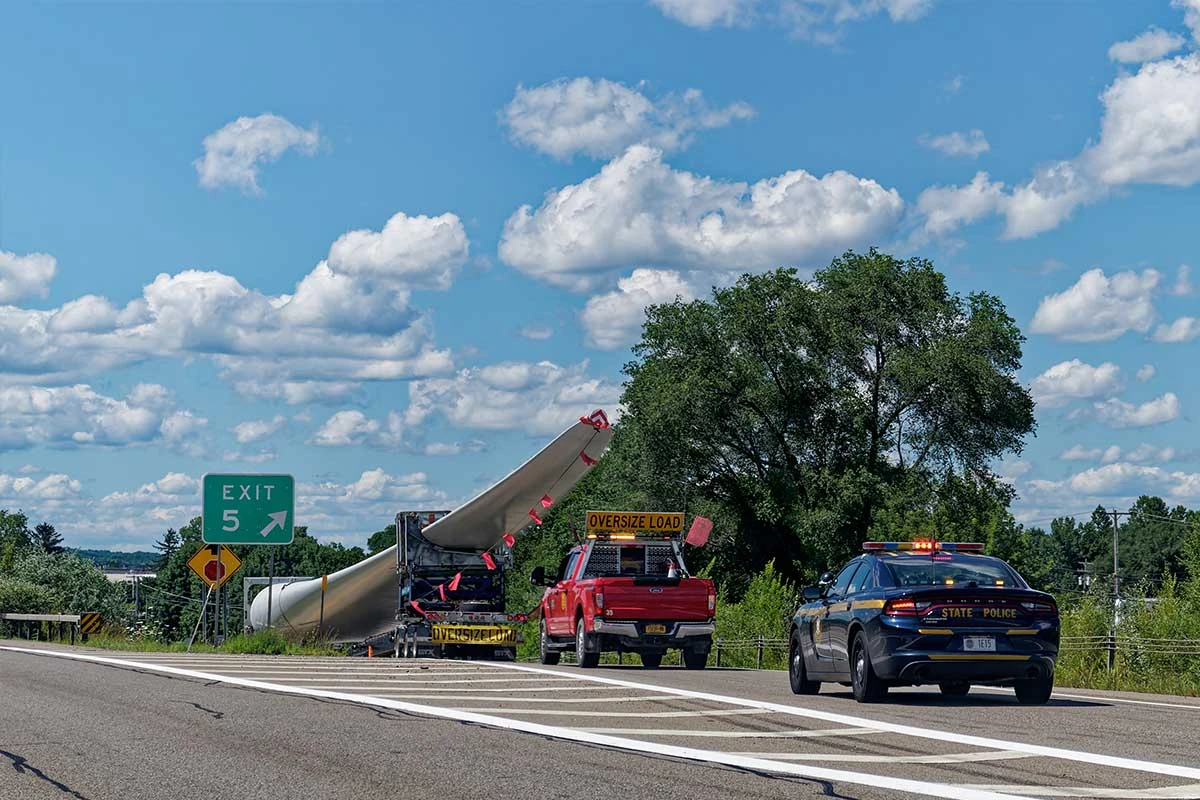
A long load can create traffic and turning constraints even where overhead clearance is not the main issue.
For a transport instruction, a clearer description is: “One front high-pole escort and one rear pilot car for the specified road segment; police and utility support arranged separately where required.” Use that wording only when it matches the approved plan. It communicates the assignment far better than “two escorts.”
Common questions about escorts
Is a pilot car always in front? No. “Pilot car” is commonly used for the private escort vehicle in either position. Use “lead,” “rear,” or “high pole” to specify the actual assignment.
Does every overweight shipment need an escort? Weight alone does not answer the question. Check the permit, bridge instructions, dimensions, route, and any special movement conditions. Do not infer an escort requirement from cargo weight alone.
Can one pilot car escort several trucks? Do not assume so. Shared-escort convoy arrangements need authorization under the applicable rules and permit conditions. Ask the coordinator to identify the provision supporting the proposed convoy rather than dividing one escort’s cost among loads without checking.
Does hiring police remove the need for a high pole? Do not make that substitution unless the movement’s authority expressly permits it. Law-enforcement support and overhead-clearance warning are different functions; confirm how both are covered.
Who is responsible for arranging the escorts? State that explicitly in the booking. A shipper, carrier, broker, or specialist coordinator may organize the service commercially, but the participants still need to satisfy their own applicable duties. Name the person who owns the final route-and-escort confirmation before dispatch.
What should “escorts included” mean in a freight quote? It should identify the number and types of vehicles, their route segments, the service period, high-pole requirements, and the treatment of police, utilities, surveys, and waiting. Once those details are written down, the term becomes a usable scope of work.