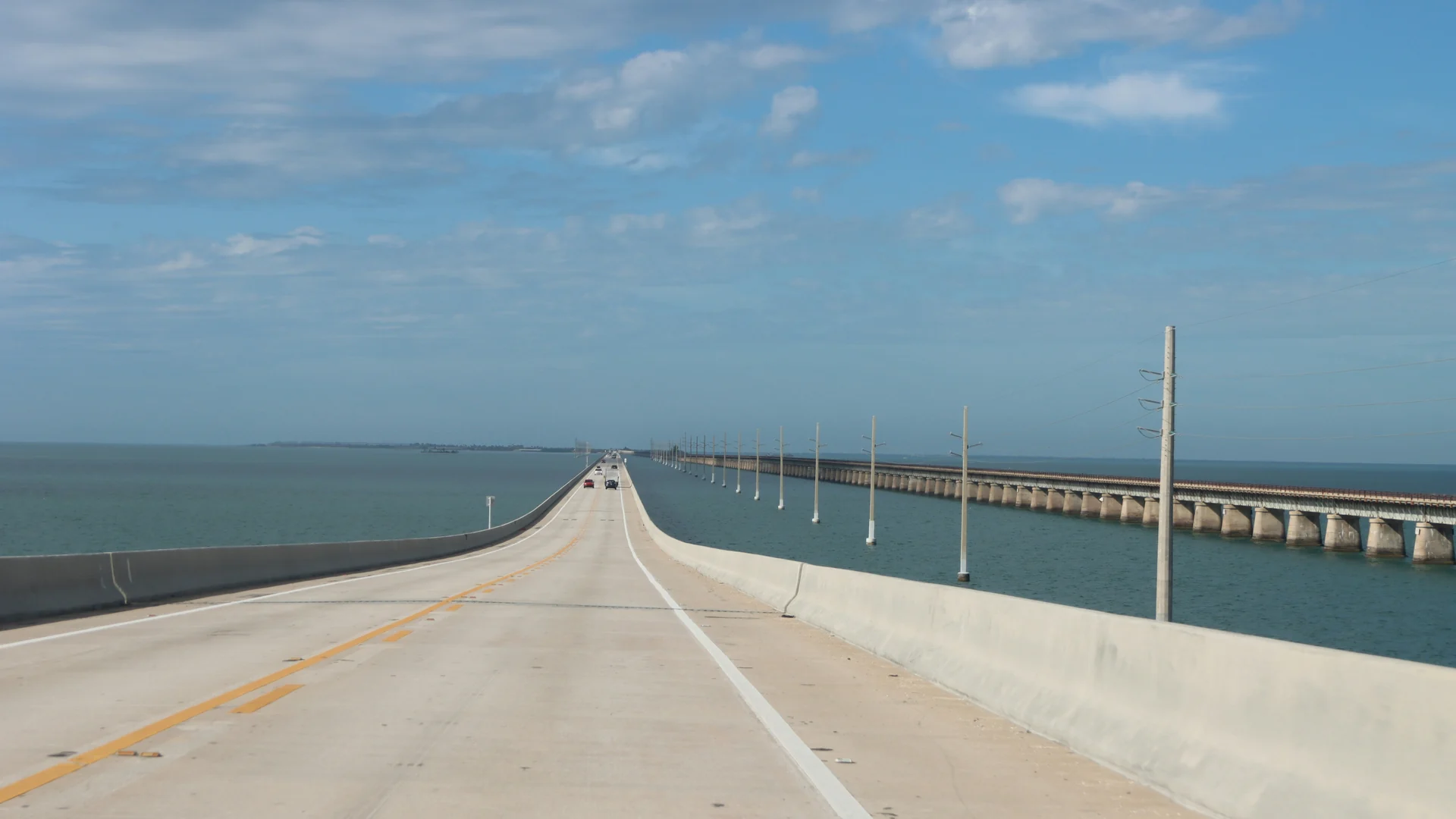

Tolls in Florida
Florida tolls depend on the road or bridge, the toll points you pass, the vehicle's axle configuration, and the payment method. There is no single Florida toll price or statewide truck multiplier. Start with the actual itinerary, identify the operators along it, and use the schedule for the vehicle and travel date you are pricing.
For a container shipment, that means looking beyond the loaded trip from the terminal to the receiver. An empty-container return, separate chassis handoff, or later collection can add tolls of its own. A car estimate or an incomplete itinerary can leave a cost outside the freight quote that only becomes visible when transactions or invoices arrive afterward.
This guide covers Florida's principal toll corridors and important local exceptions, with particular attention to trucks and drayage. Unless stated otherwise, rate examples below describe a five-axle vehicle at an individual toll point or specified movement, before separate administration fees. They are not complete shipment prices.
Find the road and the right toll authority
SunPass is a payment system used by several operators; its name on a sign does not mean one agency owns every road or applies the same tariff. The is a useful starting point for identifying participating authorities and local bridge operators.
Florida's Turnpike Enterprise publishes for its system and FDOT facilities. CFX, GMX, THEA, and county or local authorities publish additional schedules. A journey can cross these boundaries without an obvious change in the roadway.
Miami, Fort Lauderdale, and South Florida
The main corridors to check are Florida's Turnpike, including SR 821, Sawgrass Expressway/SR 869, Alligator Alley on I-75, and GMX's five Miami-Dade expressways:
- SR 836: Dolphin Expressway.
- SR 112: Airport Expressway.
- SR 924: Gratigny Parkway.
- SR 874: Don Shula Expressway.
- SR 878: Snapper Creek Expressway.
The lists these five-axle examples:
| Toll point | SunPass | By plate |
|---|---|---|
| SR 821 Okeechobee Plaza | $4.64 | $5.80 |
| Alligator Alley, one passage in the charged direction | $12.72 | $14.04 |
Alligator Alley's east and west plazas serve opposite directions; use the applicable plaza once for an ordinary through passage.
GMX has its own classification and payment structure. Its holds SunPass charges for four or more axles at the three-axle amount, while plate charges increase with additional axles. At SR 836's 97th Avenue mainline point, five axles cost $1.32 with SunPass or $5.28 by plate. That is one toll point, not the cost of driving the entire Dolphin Expressway. Check the directional mainline and ramp entries encountered by the chosen route.
For freight, confirm whether the origin is a PortMiami terminal, an FEC facility in Hialeah, or a different yard. The explains those locations. For Broward County freight, use the separate . Substituting one origin for another can change the toll roads required.
PortMiami Tunnel has no road toll. Its also prohibits placarded hazardous materials. A toll-free tunnel does not make the surrounding Miami itinerary toll-free or establish access for every cargo.
Local causeways need separate checks. Miami-Dade operates the . Bay Harbor Islands publishes a separate , listing $23 with SunPass or $28.75 by plate for five axles. These are meaningful costs for a delivery that actually uses the crossing, not charges to add to every Miami shipment.
Orlando, Central Florida, and the Space Coast
Central Florida combines CFX roads with Turnpike/FDOT sections and a separately priced county road. Relevant corridors include SR 408, SR 417, SR 429, SR 414, SR 453, SR 528, SR 538, Polk Parkway/SR 570, Osceola Parkway, and Florida's Turnpike. Use the and the to identify the portions on the route.
The lists these five-axle amounts:
| CFX toll point | Electronic | By plate |
|---|---|---|
| SR 417 Boggy Creek Main Plaza | $3.78 | $7.56 |
| SR 417 Curry Ford Main Plaza | $3.11 | $6.22 |
| SR 528 Beachline Main Plaza | $3.21 | $6.42 |
| SR 429 Forest Lake Main Plaza | $3.78 | $7.56 |
SR 528 is particularly easy to miscalculate. Beachline West Main Plaza includes Turnpike and CFX components collected together. The lists a five-axle total of $6.55 with SunPass or $7.75 by plate, effective July 1, 2026. The CFX component alone is $3.11 under either payment method at this particular plaza; it is not the full charge. Once using the combined total, do not add the components again.
That distinction matters when pricing an Orlando–Space Coast itinerary. Read each schedule's footnotes instead of applying a general CFX plate premium to a combined-agency charge.
Osceola Parkway is separate from Poinciana Parkway/SR 538. Osceola County's lists $10.38 by transponder or $20.76 by plate for five axles at Shingle Creek Plaza. Its Poinciana Boulevard ramp table lists $1.31 or $2.62, respectively, for the displayed axle classes. Use the toll points on the actual movement rather than treating every row as a mandatory charge.
Tampa Bay and West Central Florida
Check Selmon Expressway/SR 618, the I-4 Connector, Veterans Expressway and Suncoast Parkway/SR 589, Sunshine Skyway/I-275, the Pinellas Bayway, and Gateway Expressway when those facilities appear in the itinerary. The identifies the individual toll points.
For five axles, Sunshine Skyway lists $4.64 with SunPass or $6.48 by plate per crossing. Its north and south plazas serve opposite directions; use the applicable directional plaza once.
The I-4 Connector has three distinct movements. Its five-axle schedule lists:
| Movement | SunPass | By plate |
|---|---|---|
| S: I-4 east side ↔ Selmon west side | $4.52 | $5.64 |
| Z: I-4 west side ↔ Selmon east side | $2.28 | $3.36 |
| T: I-4 ↔ Port Tampa/22nd Street | $1.13 | $1.41 |
The port-truck T movement has the same listed charge across two through five axles. Selecting the correct movement matters more than applying a generic multiplier.
THEA separately publishes , with current rates effective July 1, 2026. Its static webpage table is explicitly for two-axle vehicles. Use the calculator's axle setting for a truck, and distinguish a Selmon charge from a separate Connector charge.
The distinguishes Port Tampa Bay, SeaPort Manatee, rail facilities, and equipment locations. A move described simply as “Tampa port” is not precise enough to choose the final crossing or port approach.
Jacksonville and Northeast Florida
First Coast Expressway/SR 23 has a . Five-axle examples include $2.60 with SunPass or $3.68 by plate at Argyle Forest Plaza, and $6.48 or $7.56 at Sandridge Plaza. These are separate toll points, not a flat charge for every SR 23 journey.
Use FDOT's to distinguish the open road from remaining construction toward St. Johns County. A proposed or unfinished connection should not be treated as an available bypass merely because it appears on a project map.
Likewise, First Coast Expressway tolls do not automatically belong in every JAXPORT quote. Establish the actual terminal and inland route. The distinguishes Blount Island, Dames Point, Talleyrand, rail ramps, and neighboring origins.
Farther south, the publishes its own cash/card tariff and Express Card program. The listed five-or-more-axle charge is $6 by cash/card or $3 through its Express Card program. Do not assume a statewide transponder substitutes for a separately operated bridge account.
Southwest Florida and the Keys
Lee County's Cape Coral, Midpoint Memorial, and Sanibel crossings use :
| Crossing | Tag | Plate + fee |
|---|---|---|
| Cape Coral or Midpoint | $8.00 | $11.00 |
| Sanibel | $15.00 | $18.00 |
The specifies a $3 administration fee per toll without a compatible prepaid transponder. That fee structure differs from a monthly or invoice-level charge elsewhere.
For Gasparilla Island/Boca Grande, check the directly. It accepts cash, cards, digital wallets, and its own GIBA Toll Pass; it explicitly says SunPass, E-ZPass, LeeWay, and rental-car toll passes are not accepted. Its truck-weighing requirements also need attention before a commercial delivery.
For the Upper Keys alternative through Card Sound Road, lists three axles at $4.17 with SunPass or $6.27 by plate, plus $1.39 or $2.09 for each additional axle. A five-axle passage therefore calculates to $6.95 or $10.45, before the monthly $2.50 plate administration fee. Its commuter discount programs are for qualifying two-axle vehicles, not an ordinary tractor-trailer.
The Panhandle and Tallahassee area
Garcon Point Bridge/SR 281 uses the : $9.20 with SunPass or $11 by plate for five axles.
The prices Mid-Bay Bridge and Spence Parkway separately. Its published three-axle charge plus additional-axle amounts produce $16 for a five-axle bridge crossing using cash or SunPass, and $8 for the separate five-axle Spence Parkway passage using SunPass or plate billing. A journey using both encounters both charges. The operator's lower two-axle SunPass and frequent-user prices do not apply to that five-axle combination.
Also check Bob Sikes Bridge to Pensacola Beach and Orchard Pond Parkway near Tallahassee when relevant. The Turnpike's includes both; Escambia County provides a separate . Use the individual operator's current tariff and charged direction rather than transferring Garcon Point or Mid-Bay rates to another crossing.
Understand truck classification and lane access
The toll category describes the vehicle passing the toll point. Permission to operate that vehicle on the road is a separate check. Establish the truck configuration, dimensions, cargo, and route before treating a published amount as a usable travel option.
Count the complete tractor and chassis combination
A three-axle tractor pulling a two-axle chassis has five total axles. A three-axle tractor pulling a three-axle chassis has six. Container length, container quantity, or the number of axles on the tractor alone does not establish the combination's toll class. The explains the equipment behind those configurations.
An empty box on the same tractor and chassis still travels on the same combination. A bobtail movement, chassis swap, or different equipment arrangement needs its own classification. For lift axles or unusual configurations, confirm the operator's treatment rather than assuming that an axle will be ignored.
Florida's Turnpike explains that its . Read the applicable tariff rather than reusing a class number or multiplier from a different operator. The GMX, CFX, and Mid-Bay examples above illustrate why that distinction matters.
Keep ordinary toll roads, express lanes, and Thru Lanes distinct
The word “express” in a road name does not tell you whether a tractor-trailer can use a particular lane. Check the named facility and its posted restrictions:
- I-4 Express: The operator excludes vehicles with three or more axles, apart from designated emergency vehicles. A normal container truck must use an eligible alternative. See .
- 95 Express: Two-axle trucks may pay to use it; trucks with three or more axles and trailers are prohibited except for the stated emergency exception. See the .
- 595 Express: FDOT's excludes vehicles with three or more axles and passenger vehicles pulling trailers. Older descriptions of its former multi-axle pilot should not be used as current permission.
- Turnpike Thru Lanes: These charge the same road toll as the other lanes but require a compatible transponder and exclude ordinary vehicles with three or more axles. Specified buses and vanpools are exceptions. See the .
These restrictions should not be transferred to every facility containing the word “Expressway.” Tampa's port-truck Connector movement, for example, is a different facility with a published truck tariff.
For a heavy, oversized, or hazardous load, also check current road, bridge, tunnel, and permit restrictions. FDOT publishes . The explains the difference between cargo weight, gross combination weight, axle distribution, and equipment capacity. Paying an additional-axle toll does not grant an overweight permit.
Choose the correct payment basis
Payment method affects both the road charge and the way it reaches the account holder. When comparing estimates, establish the actual transponder and account arrangement instead of assuming every truck receives the lowest advertised commuter price.
SunPass, E-PASS, and other transponders
An active, properly mounted compatible transponder normally allows electronic deduction from a prepaid account. Maintain sufficient funds and current vehicle records. says trailer and tag information must be added when towing; it also warns that multiple active transponders can cause duplicate charges. Shield or remove additional portable devices according to the issuer's instructions.
E-ZPass is accepted on Florida toll roads in the interoperable network. CFX states that E-ZPass receives the standard electronic rate on its roads. Its also distinguishes the ordinary E-PASS sticker from the multi-state Uni device. For local exceptions such as GIBA, use the bridge operator's rules above.
Buying SunPass PRO is not a complete interstate-truck recommendation. SunPass's directs vehicles with more than two axles traveling outside Florida to NC Quick Pass for the appropriate three-plus-axle transponder. Confirm that the carrier's device and account match the vehicle and states on the itinerary.
Transponder acceptance and special discount eligibility are different questions. CFX's uses monthly transactions per transponder and applies to specified CFX facilities. Card Sound and Mid-Bay have their own two-axle program limitations. Do not subtract a fleet, resident, or volume rebate from a customer quote before confirming eligibility and how the carrier prices it.
TOLL-BY-PLATE and Pay By Plate
Without a detected compatible transponder, participating electronic facilities photograph the plate and bill the registered owner. The plate tariff can be higher than the electronic tariff, and an administration charge may be separate. It is a payment method, not evidence that a violation has already occurred.
Florida's Turnpike . CFX has its own Pay By Plate rates; its explains the higher rate structure and separate invoices from different authorities. LeeWay instead specifies a $3 fee per toll. Check the operator rather than adding $2.50 to every crossing statewide.
Plate billing is also not a general fallback for Florida Managed Lanes. The Turnpike's plate guidance says those lanes require a SunPass or another accepted transponder. Vehicle eligibility still applies even when a compatible device is installed.
Cash, cards, and third-party fees
CFX says its system is now , and many other Florida facilities use all-electronic collection. A calculator option labeled TBP/CASH does not establish that a particular plaza accepts roadside cash.
Local arrangements remain important: Hammock Dunes publishes cash/card and Express Card rates, while GIBA accepts several direct payment methods and its own pass. Establish the accepted method before reaching a crossing.
If the truck or trailer is leased, or a toll-management service handles the account, check that agreement as well. A management or forwarding fee is a separate commercial charge from the road toll. Ask which entity receives the original transaction and what documentation will accompany any later pass-through charge.
Calculate tolls for the complete shipment
A reproducible manual calculation is useful for a new lane, a quote comparison, or a billing investigation. Keep the route assumptions beside the figures so another person can understand what the estimate includes.
1. Establish every required stop and trip.
For an import, record the loaded pickup terminal, receiver's commercial entrance, and authorized empty-return destination. For an export, record the empty pickup, shipper, and loaded receiving terminal. Include separate chassis transactions and any later collection after a container drop.
For example, terminal → receiver → authorized empty depot can have a different toll total from terminal → receiver → terminal. A generic port name or delivery ZIP code may leave the relevant ramp or crossing unresolved.
2. Confirm the combination and a usable truck route.
Record total axles, overall dimensions, gross weight, and cargo restrictions. Have the carrier confirm the operating route and receiving entrance. A toll calculator prices road usage under its selected inputs; an axle selector alone does not certify clearance or cargo permission.
3. Identify the charged facilities on each leg.
Follow the selected itinerary and list each mainline plaza, charged ramp, bridge, and separate connector. Note travel direction and actual entry/exit points. Do not add every toll shown on a regional map; add those encountered by the movement.
For a shared collection point such as Beachline West, use the combined charge once. For separate facilities such as Mid-Bay Bridge and Spence Parkway, retain both when both are used.
4. Use the operator's tool with the correct payment and axles.
The describe choosing payment type, axle count, and start/end regions, facilities, and exits. For Central Florida, the provides payment, axle, and entry/exit selections. THEA's also includes axle and payment settings.
Match the result's roads to the route the carrier will use. Check local bridges separately when the tool does not establish their charge. Read table headings carefully: a two-axle example is not a tractor-trailer estimate.
5. Price the other legs and retain the evidence.
Calculate the empty return and equipment movements separately. Double the outbound amount only after establishing that the return uses the same charged movements, category, and payment basis. Include out-of-state charges when the shipment leaves Florida.
For each leg, retain the vehicle, facility or entry/exit pair, direction, payment method, amount, source, and effective date. Check the date inside the schedule: an upload filename or recently retrieved page does not necessarily mean every tariff in it changed that year. Treat an unavailable amount as unresolved rather than zero.
6. Settle how tolls enter the freight price.
Confirm whether the total includes tolls, carries an estimated allowance, or passes actual transactions through afterward. Keep administration fees and other accessorials distinct. Do not add a calculation again when the same expense is already included.
The explains how service scope, assumptions, and adjustment terms affect a price comparison.
Worked examples for five-axle shipments
These examples isolate specified toll movements to show the arithmetic. They assume the same five-axle combination on the loaded and empty passages. They do not establish a dispatch route or include every approach road, ramp, equipment trip, or administration fee in a real shipment.
Miami: one GMX mainline point in each direction.
Assume the selected outbound and return paths each pass the applicable SR 836 mainline toll point at 97th Avenue, once. Using the , the two-passage subtotal is:
- SunPass: $1.32 + $1.32 = $2.64.
- Plate tariff: $5.28 + $5.28 = $10.56.
Other Dolphin Expressway toll points and ramps remain separate. This example demonstrates why both payment method and the actual gantries matter; it is not a PortMiami-to-warehouse route total.
Tampa: the port-truck Connector movement twice.
Assume the itinerary uses the I-4 Connector T movement toward the port and once on return. The gives a subtotal of $2.26 with SunPass or $2.82 by plate for the two passages. Add any separately encountered Selmon or other tolls. Using the S-movement tariff would price a different connection.
Alligator Alley: a loaded passage and an empty return.
Assume the truck crosses the tolled Alligator Alley corridor in one direction and returns over it with the empty container on the same combination. Using the :
| Movement | SunPass | By plate |
|---|---|---|
| Loaded passage | $12.72 | $14.04 |
| Empty-return passage | $12.72 | $14.04 |
| Road-toll subtotal | $25.44 | $28.08 |
For an assumed pair of transactions on one ordinary Turnpike plate invoice, adding the invoice's single $2.50 administration fee would make that example $30.58. The fee belongs to the billing period, not automatically to each shipment or passage. Actual allocation between shipments needs the account records and freight agreement.
Handle delayed invoices and unexpected charges
A shipment's delivery date and a toll operator's billing cycle do not necessarily align. Calculate the expected expense before booking, then reconcile later transactions against the movement and agreed price.
Understand who receives the bill.
Plate invoices go to the vehicle's registered owner. That can be a different party from the freight customer. A carrier, lessor, or account service may subsequently allocate the expense to a shipment. Whether the shipper owes an additional amount depends on the freight agreement and what was already included or paid.
Because Turnpike invoices group a 30-day period, the first paper bill need not arrive immediately after the truck moves. CFX also . Receiving one bill does not establish that all toll systems used on the journey have finished billing. Avoid promising one universal Florida invoice-arrival deadline.
Match the transaction before accepting an extra line.
Ask for the operator's transaction or invoice detail and compare:
- Vehicle and plate: Does the record belong to the tractor/trailer used for this job?
- Date and time: Does it fit the pickup, delivery, return, or later collection?
- Facility and direction: Was that charged movement part of the actual itinerary?
- Axle category and payment: Does the tariff match the combination and account used?
- Commercial treatment: Was the expense included, paid directly, credited, or already billed?
- Additional fees: Which amount is the road toll, which is account administration, and which is a penalty or service fee?
A monthly account fee covering several trips should not be presented as though it were the tariff for a single gantry. Likewise, a carrier's toll line and the authority's transaction may use different presentation formats; compare their scope before declaring a duplicate.
Keep the explanation and supporting record beside the charge. The explains how to review rates, quantities, reasons, and attachments against the shipment's agreed terms.
Investigate a plate bill despite having a transponder.
Possible causes include a device that could not be read, an account without available funds, outdated plate information, or an account that was not in good standing at travel. CFX's identifies these problems and explains when to contact CFX versus the transponder issuer. Have the invoice, plate, transponder number, and travel dates available.
For duplicate electronic transactions, compare both account statements for the same passage. SunPass's provides a process for reporting duplicates. Do not simply ignore one invoice on the assumption that the other account settled it.
Resolve the notice through the named authority.
Use the official operator's website or the contact details independently obtained from it. For Turnpike invoices, the directs payment through SunPass and explains escalation after nonpayment. It warns that unpaid amounts can reach collections or lead to a vehicle-registration stop. Other authorities have their own processes and deadlines; follow the actual notice.
Common questions about Florida tolls
How much does it cost to drive Florida's Turnpike?
There is no single full-trip price for every vehicle or itinerary. Select the actual entry and exit, total axle count, and payment basis in the official calculator, then add separately operated facilities on the rest of the journey. A short mainline segment and a long trip through South and Central Florida are different purchases.
Are Florida's toll roads all cashless?
Many are, including CFX's current system, but local bridges have their own arrangements. Check the specific operator before travel. Paying cash to fund an account at a service center is different from handing cash to an attendant on the road.
Does E-ZPass work in Florida?
It works throughout Florida's interoperable toll-road network. Check independent local crossings, the vehicle's account configuration, and discount eligibility separately. GIBA explicitly excludes E-ZPass and SunPass, so “works in Florida” should not be read as “accepted at every bridge.”
Does an empty container return still incur tolls?
Yes, when it uses a charged facility. Empty cargo status does not by itself remove the tractor or chassis axles. Calculate the actual return destination and combination, especially if the empty depot differs from the loaded pickup terminal.
Can a truck avoid tolls by using the regular interstate lanes?
On a corridor with separately tolled managed lanes, an eligible general-purpose alternative may avoid that managed-lane charge. That does not make every interstate segment toll-free: Alligator Alley is a tolled I-75 segment, and Sunshine Skyway is a tolled I-275 crossing. Check the actual road and lane, not just the interstate shield.
Is avoiding tolls always cheaper?
Compare the full operating cost of permitted alternatives. Extra mileage, fuel, driver time, and appointment risk can exceed the avoided toll. A route that saves a few dollars at a gantry can become more expensive if it creates a missed terminal window or an additional truck visit.
Why do two toll estimates disagree?
Compare exact stops, roads, ramps, direction, axle count, payment account, discount assumptions, and tariff dates. Check whether both include the return and whether a combined charge or administration fee has been counted twice. A different total often reflects different inputs rather than different arithmetic.
Are tolls automatically included in a drayage price?
Only the quote and booking terms establish that. Check the breakdown and ask whether tolls are included, estimated, or passed through at actual cost. The same applies to fees attached to leased equipment or a third-party toll account.
What changes if the empty-return location changes?
Review the route and price again. A newly assigned depot can add a toll facility, remove one, change the direction, or require more driving. Keep the revised location and any agreed price adjustment with the shipment record.
See estimated tolls in the quote
Portmate calculates estimated tolls automatically for the selected drayage itinerary, combines the loaded and empty legs, and shows the amount in the quote's Tolls line. This saves the work of tracing toll points and checking separate agency schedules, and brings the expected cost into the pricing decision before delivery. The shows where to find it.
Review the quoted locations, equipment, and included service so the estimate reflects the intended move. Calculating an expected toll cost and paying the road operator are separate processes; any later adjustment follows the shipment's agreed terms.