
Tolls in New York
New York tolls depend on the road or crossing, the vehicle, the direction of travel, the payment account, and sometimes the time of day. For a commercial shipment, calculate the complete truck itinerary, including the empty return and any equipment stops. Add Manhattan congestion pricing only when the route triggers it.
There is no single statewide truck toll rate. A five-axle tractor-trailer entering New York over the Goethals Bridge, crossing the Verrazzano-Narrows Bridge, and returning over the same bridges encounters different operators and collection rules within one short harbor trip. An E-ZPass that works at every crossing may still qualify for different prices at each one.
This guide is for truckers, dispatchers, shippers, and forwarders planning New York movements, with passenger-vehicle comparisons and payment guidance useful to other drivers. Rates and operating information were checked on October 25, 2026. Use the linked operator schedules for the actual travel date, particularly for work extending into 2027.
Start with the operator and the complete trip
Separate a facility toll from a congestion-zone charge before comparing prices. A bridge can be free to cross while the streets reached afterward are inside a charging zone.
| System | Where it matters |
|---|---|
| Port Authority of New York and New Jersey | George Washington, Goethals, and Bayonne bridges; Outerbridge Crossing; Lincoln and Holland tunnels. |
| MTA Bridges and Tunnels | Verrazzano-Narrows, Robert F. Kennedy, Bronx-Whitestone, Throgs Neck, Henry Hudson, Cross Bay, and Marine Parkway bridges; Queens Midtown and Hugh L. Carey tunnels. |
| New York State Thruway Authority | Thruway road segments and toll gantries, including the Governor Mario M. Cuomo Bridge and Grand Island crossings. |
| New York State Bridge Authority | Bear Mountain, Newburgh-Beacon, Mid-Hudson, Kingston-Rhinecliff, and Rip Van Winkle bridges. |
| Manhattan Congestion Relief Zone | A separate MTA charge for entering the zone's local street network south of and including 60th Street. |
The , , and help identify the relevant operator.
For a container import, write down the terminal, receiving entrance, authorized empty-return location, and any separate chassis pickup or return. The return may use another road or occur in another pricing period. For an export, begin with the empty pickup and include the loaded terminal delivery.
Keep three questions separate:
- May this truck use the route? Check access, dimensions, weight, cargo restrictions, and current signs.
- What toll applies? Match the operator's vehicle class, direction, payment basis, and time band.
- Who bears the expense? Establish whether the shipment price includes tolls or passes them through separately.
E-ZPass acceptance and discount eligibility
E-ZPass is a payment system. It does not establish one universal discounted tariff across all participating roads.
The account issuer can change the price
At Port Authority crossings, discounted E-ZPass rates require a New York or New Jersey E-ZPass customer-service account. MTA's lower bridge and tunnel rates require a New York Customer Service Center account, often abbreviated NYCSC. A New Jersey account can therefore qualify for Port Authority discounts while paying MTA's non-NYCSC rate. See the and .
The Thruway also distinguishes NY E-ZPass from non-NY E-ZPass. Its adopted standard structure places non-NY E-ZPass and Tolls by Mail rates 75% above the NY E-ZPass base rate, subject to the actual class, facility, and rounding in the schedule. That is a premium above the base, not a 75% saving off the higher bill. The explain the distinction.
Check the issuing customer service center in the account records. A New York registration plate alone does not establish the tag's discount eligibility, and an out-of-state plate does not by itself establish the account issuer.
A plate match may prevent a separate bill without preserving the lowest rate
Mount the correct tag as instructed, maintain a usable balance or replenishment method, and keep vehicle plates current. These are separate controls.
At MTA and Port Authority crossings, eligible account transactions processed through plate identification can fall into a higher Mid-Tier category. On the Thruway, an unread tag can result in the Tolls by Mail rate, even if the plate is linked and the charge posts to an E-ZPass account. The describes this explicitly.
For a fleet, recurring Mid-Tier or plate-based charges deserve investigation. Compare tag assignments, vehicle configuration, mounting, account standing, and statement details before treating every higher charge as a tariff increase.
Bridge and tunnel rates around New York City
Use the truck's configuration at the crossing. Container length, cargo weight, and the word empty do not substitute for the operator's classification rules.
Port Authority crossings between New Jersey and New York
The six Port Authority crossings collect tolls toward New York only. There is no Port Authority crossing toll toward New Jersey. All six are cashless.
The lists these standard truck charges. The discounted column assumes a properly read tag on an eligible NY/NJ account; it excludes special plans.
| Truck axles | E-ZPass peak | Tolls by Mail |
|---|---|---|
| 2 | $45.34 | $51.34 |
| 3 | $68.01 | $77.01 |
| 4 | $90.68 | $102.68 |
| 5 | $113.35 | $128.35 |
| 6 | $136.02 | $154.02 |
For a five-axle truck, the other standard categories are $108.35 off-peak, $100.85 during the truck overnight period, and $120.85 Mid-Tier. Additional axles beyond six have their own charges.
The defines the pricing periods:
- Peak: Weekdays, 6–10 a.m. and 4–8 p.m.; Saturdays and Sundays, 11 a.m.–9 p.m.
- Truck overnight: Sunday through Thursday nights, 10 p.m.–6 a.m. the following morning.
- Off-peak: Other times, outside the applicable truck overnight category.
These are crossing times, not delivery-appointment times. Friday and Saturday nights do not automatically qualify for the special truck overnight rate.
A standard two-axle passenger vehicle with single rear wheels is a different class: $16.79 peak or $14.79 off-peak with eligible E-ZPass, $19.55 Mid-Tier, or $23.30 by mail. Two-axle vehicles with dual rear wheels can fall into the much higher truck category. Check the table before pricing a rental moving truck, heavy pickup, or recreational vehicle as a car.
MTA bridges and tunnels
MTA's regular truck schedule is based on axle count for its heavier-vehicle categories. Its distinguishes vehicles above 7,000 pounds maximum gross weight from the lighter two-axle category and includes specific exceptions. An unloaded truck does not become a car merely because its current scale weight falls.
The following took effect January 4, 2026. They apply at the Verrazzano-Narrows, RFK, Bronx-Whitestone, and Throgs Neck bridges, and the Queens Midtown and Hugh L. Carey tunnels.
| Axles | NYCSC E-ZPass | NYCSC Mid-Tier | Mail / non-NYCSC E-ZPass |
|---|---|---|---|
| 2 | $13.49 | $18.87 | $24.07 |
| 3 | $22.10 | $31.00 | $39.62 |
| 4 | $28.26 | $39.08 | $49.54 |
| 5 | $36.84 | $51.19 | $65.10 |
| 6 or more | $42.98 | $59.26 | $75.00 |
Cross Bay and Marine Parkway have a separate, lower truck schedule; for example, a five-axle vehicle is $18.43 with NYCSC E-ZPass, $25.61 Mid-Tier, or $32.55 by mail/non-NYCSC E-ZPass. Henry Hudson is restricted to vehicles authorized to use parkways. A listed charge for unauthorized use is not permission to take a truck across it.
The Verrazzano charges in both directions. Include its return crossing in a round-trip estimate. The confirms the change implemented in December 2020; older one-direction explanations can produce a wrong estimate today.
For ordinary passenger cars, the provides this comparison:
| Crossing group | NYCSC E-ZPass | Mid-Tier | Mail / non-NYCSC |
|---|---|---|---|
| Six major crossings listed above | $7.46 | $9.79 | $12.03 |
| Henry Hudson | $3.42 | $5.42 | $8.87 |
| Cross Bay / Marine Parkway | $2.80 | $4.42 | $6.02 |
Resident rebates and special plans have eligibility rules. Do not apply a Staten Island or Rockaway passenger-vehicle benefit to a commercial shipment simply because its destination is nearby.
Toll-free bridges still have access rules
NYC DOT charges no bridge toll on the Brooklyn, Manhattan, Williamsburg, or Queensboro bridges. Crossing one can still lead into the Manhattan congestion zone.
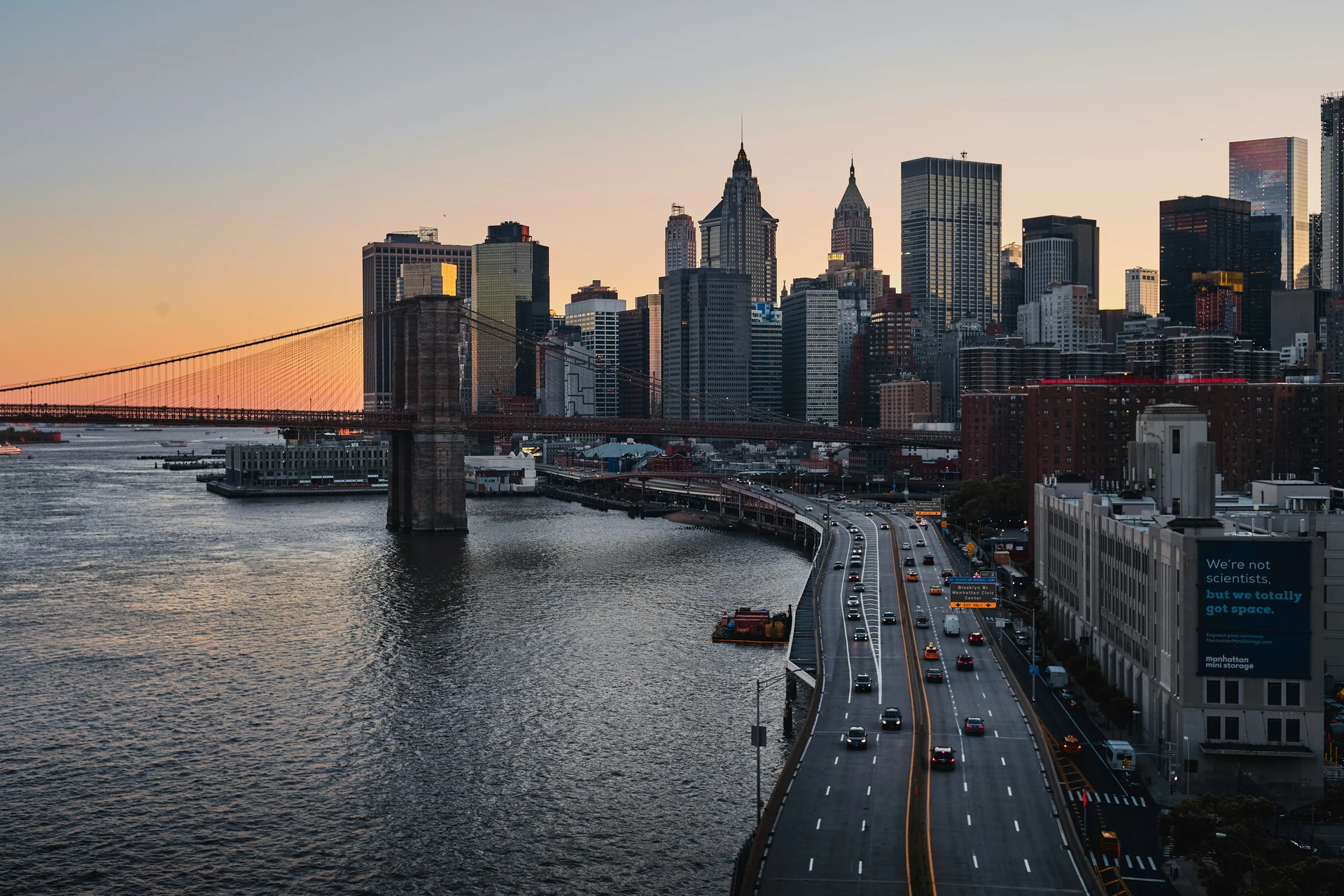
The background photograph shows the Brooklyn Bridge, which has no bridge toll and restricts commercial vehicles. Check the city's and before treating a free crossing as a truck alternative.
New York State Thruway and Hudson Valley tolls
For a statewide movement, price the actual Thruway entry, exit, and vehicle class. A bridge-only estimate does not cover the highway journey approaching it.
Thruway vehicle classes and the toll calculator
The uses the height over the first two axles and the total axle count, including trailers. Vehicles below 7 feet 6 inches are low-profile; those at or above that height are high-profile. A typical five-axle tractor-trailer is 5H. A two-axle passenger car is generally 2L.
Use the for the selected entry and exit, with the actual class and payment account. Keep the individual gantry charges and calculate the return separately. Different toll points have different collection directions.
For example, the calculator's shows $29.91 with NY E-ZPass and $52.35 with non-NY E-ZPass or Tolls by Mail. That is a specified Class 2L journey, not a truck price or a toll for every road between those places.
Governor Mario M. Cuomo Bridge and incentive pricing
The Governor Mario M. Cuomo Bridge, often still called the Tappan Zee crossing, collects its toll toward Westchester, in the Thruway's southbound direction.
The , lists $70.32 peak, $35.16 off-peak, and $123.06 for non-NY E-ZPass/Tolls by Mail for a Class 5H vehicle. Standard Class 2L passenger rates are $7.25 with NY E-ZPass or $12.69 with non-NY E-ZPass/by mail.
The matters for truck timing. At the Cuomo Bridge, the weekday high period is 7–8:59 a.m., with graduated rates on either side. Qualifying NY E-ZPass 3L–7H vehicles receive the chart's lowest time-band rate on weekends. Spring Valley has a different schedule, with its weekday high period at 4–5:59 p.m., and collects northbound.
Do not reuse the Port Authority's peak hours for these gantries. A movement using the Cuomo Bridge one way and Spring Valley on the return needs both checks.
The five New York State Bridge Authority crossings
Bear Mountain, Newburgh-Beacon, Mid-Hudson, Kingston-Rhinecliff, and Rip Van Winkle share the . It lists $15.25 with E-ZPass or $20 by mail for a five-axle commercial vehicle, compared with $1.65 or $2.15 for its ordinary two-axle passenger category.
These bridges collect tolls eastbound only through E-ZPass or Tolls by Mail, as described in the state's .
That lower posted bridge price does not establish a cheaper complete truck route. Compare the added road tolls, legal approaches, mileage, time, and receiving appointment before choosing a more distant crossing.
Independent crossings on Long Island and the Canadian border
Some New York crossings use separate tariffs and payment arrangements. Do not extend the Thruway or NYC rules to them automatically.
- Atlantic Beach Bridge: The Nassau County Bridge Authority's lists its own vehicle and weight categories, including passenger cash and E-ZPass rates. Check its for local plans and operating changes.
- Peace Bridge: The collects Canada-bound tolls and accepts E-ZPass or debit/credit payment at the lanes.
- Niagara Falls crossings: Use the commission's and . Lewiston-Queenston permits commercial trucks; Rainbow and Whirlpool Rapids do not.
- Thousand Islands: Its lists separate U.S. and Canadian fares and accepts E-ZPass, cash, and major credit cards.
- Seaway International: Check its , including its commercial-vehicle axle requirements.
For a cross-border quote, record the charged direction and currency as well as the vehicle class. Border clearance and permission for a particular load require their own checks.
Rates for work extending into 2027
The Thruway's adopted plan includes a 5% base-rate increase on January 1, 2027 outside the Cuomo Bridge, with a separate Cuomo adjustment. Its standard NY E-ZPass passenger bridge rate becomes $7.75. Recalculate a shipment crossing the tariff change instead of carrying a 2026 estimate forward. The separate the applicable years.
Manhattan congestion pricing for commercial deliveries
The Congestion Relief Zone is an additional charge, separate from any bridge or tunnel toll. .
Where the charge applies
The zone covers Manhattan's local streets and avenues south of and including 60th Street. The FDR Drive, West Side Highway/Route 9A, and specified Hugh L. Carey Tunnel connections to West Street are excluded. Leaving an excluded road for a zone street can trigger the charge. Some connections between crossings and excluded roads require local-street travel; use the .
A congestion-pricing exclusion is not truck-access permission. NYC DOT prohibits commercial vehicles on the FDR Drive and many parkways. Do not suggest an excluded roadway as a freight bypass without checking whether the vehicle may use it.
A Brooklyn, Queens, Bronx, or Staten Island delivery does not automatically incur this Manhattan charge. Nor does crossing the George Washington Bridge automatically mean entering the zone. Trace the actual onward streets.
Base rates and charge frequency
The distinguishes passenger vehicles, single-unit trucks, and multi-unit trucks. Articulated trucks with trailers, including typical container tractor-trailers, belong in the multi-unit category. Modified pickups and high-roof vans can have a different classification from ordinary passenger vehicles.
With E-ZPass
| Vehicle category | Peak | Overnight |
|---|---|---|
| Passenger / qualifying small commercial | $9.00 | $2.25 |
| Single-unit truck | $14.40 | $3.60 |
| Multi-unit truck | $21.60 | $5.40 |
With other payment media
| Vehicle category | Peak | Overnight |
|---|---|---|
| Passenger / qualifying small commercial | $13.50 | $3.30 |
| Single-unit truck | $21.60 | $5.40 |
| Multi-unit truck | $32.40 | $8.10 |
Peak is 5 a.m.–9 p.m. weekdays and 9 a.m.–9 p.m. weekends. The remaining hours use overnight rates. These periods differ from Port Authority bridge and tunnel peak periods.
Passenger vehicles and motorcycles have a once-per-day entry cap. Trucks are generally charged for every entry, so a second delivery run into the zone can create another charge. A truck remaining inside for several delivery stops is a different itinerary from one leaving and re-entering. See the .
These are base rates. Check current notices for the travel date; the tariff reserves special adjustments, including a possible Gridlock Alert Day increase.
Tunnel credits reduce the zone charge
Eligible E-ZPass tunnel crossings during the peak period can receive a credit against congestion pricing. The distinguishes the tunnel groups:
| Vehicle | Lincoln / Holland entry | Queens Midtown / Hugh L. Carey entry or exit |
|---|---|---|
| Passenger category | $3.00 | $1.50 |
| Single-unit truck | $7.20 | $3.60 |
| Multi-unit truck | $12.00 | $6.00 |
There is no overnight crossing credit. Apply the credit to the zone charge; the underlying tunnel toll remains payable. The tariff also limits passenger-category daily credits. Use the actual crossings and eligibility conditions when combining transactions.
The describes credits as amounts up to a maximum. That does not mean every tunnel gives a car $3 or every truck $12. A typical tractor-trailer also cannot use the Holland Tunnel, even though the general tariff lists multi-unit credits for the Hudson tunnel group.
For a simple passenger example, assume one peak entry through the Lincoln Tunnel, with a properly read NYCSC tag and no other relevant transactions: $16.79 tunnel toll + $9 zone toll − $3 credit = $22.79. This is an inbound example; it excludes other roads, parking, and the return itinerary.
Discounts and exemptions need eligibility and enrollment
Ordinary freight deliveries do not receive a blanket exemption. The cover defined cases, including qualifying disability transport, authorized emergency vehicles, certain buses, and specialized government vehicles.
The Low-Income Discount Plan provides qualifying enrolled owners a 50% discount on eligible peak trips after the first ten trips in a calendar month. Discount and exemption plans require annual recertification. Confirm the applicable vehicle and account conditions before subtracting a benefit from an estimate.
Truck access comes before toll savings
A published truck rate does not mean every truck, trailer, or load is allowed. Before dispatch, check the precise combination's overall height, width, length, weight, axle configuration, and cargo.
The identifies several critical limits:
- George Washington Bridge: All trucks must use the upper level.
- Holland Tunnel: No tractor-trailers, three-axle dual-unit trucks, or trucks with four or more axles; only two- and three-axle single-unit trucks are permitted, subject to the other restrictions.
- Lincoln Tunnel: Trucks cannot use the center tube; the guide lists a 13-foot height limit for the facility.
- Oversize movements: Obtain the facility's required approval and escort arrangements before travel.
For city streets, use , current traffic rules, and posted signs. DOT lists truck-route changes effective October 4, 2026 alongside its 2022 map while a replacement map is being prepared. An old saved map alone is insufficient.
Most NYC parkways prohibit trucks and commercial vehicles, including roads a car-routing app may offer. Toll avoidance settings do not verify clearance or legal access. Ask the carrier to validate a truck-appropriate route to the actual commercial entrance, including the empty-return approach.
Worked examples for shipment planning
These examples show how to assemble charges. They are tariff calculations for stated assumptions, not dispatch instructions or quotes for a particular load.
New Jersey to Brooklyn and back through Staten Island
Assume a five-axle truck enters New York over the Goethals Bridge during the Port Authority peak period, crosses the Verrazzano to Brooklyn, and returns through those bridges with the same axle configuration. It does not enter the Manhattan congestion zone.
The E-ZPass column assumes an eligible NYCSC account and correctly read tag, qualifying for both operators' lower standard rates.
| Movement | Eligible E-ZPass | Tolls by Mail |
|---|---|---|
| Goethals toward New York | $113.35 | $128.35 |
| Verrazzano toward Brooklyn | $36.84 | $65.10 |
| Verrazzano toward Staten Island | $36.84 | $65.10 |
| Goethals toward New Jersey | $0.00 | $0.00 |
| Bridge subtotal | $187.03 | $258.55 |
The subtotal combines the and . It excludes the New Jersey Turnpike and any other toll facilities. Add those using the actual entry/exit pair and the .
A New Jersey E-ZPass account would not qualify for the MTA NYCSC figures simply because it qualifies at Goethals. That account detail can materially change the combined expense.
A truck making two Manhattan delivery runs
Assume a multi-unit truck makes two separate peak entries into the zone, without qualifying tunnel credits or an exemption. Its base zone charges are 2 × $21.60 = $43.20 with E-ZPass, or 2 × $32.40 = $64.80 with other payment media.
Add any bridge, tunnel, and highway tolls separately. If the truck stays inside the zone between two stops, do not invent a second entry solely because it serves a second customer. If it leaves and returns, do not apply the passenger-car daily cap. The distinction follows the .
Comparing a detour with a tolled route
Evaluate total operating cost, not just the toll line. Suppose a permitted alternative saves $30 in tolls but adds 20 miles and 40 minutes. Using illustrative internal costs of $0.90 per additional mile and $45 per additional driver hour, the added cost is $18 + $30 = $48. The detour costs $18 more before any appointment consequences.
Those are example operating assumptions, not New York market rates. Use the carrier's own costs and service constraints when comparing options.
Paying tolls and resolving a delayed or incorrect bill
At the major cashless systems discussed above, keep moving through the toll point as signed. Payment occurs through E-ZPass or plate billing. Cashless collection does not make the journey free when a tag is absent or fails.
Find and pay the right transaction
For the NY customer-service system, start at or the official Tolls NY app. Existing E-ZPass customers can review their accounts; drivers with a mail bill can use the , including search and pay for a lost bill. The service also lists phone, mail, and participating retailer options.
For an account issued elsewhere, also review that issuer's statement and support instructions. A single trip may generate transactions from more than one operator or account system.
The says bills are mailed to the registered owner 30–45 days after travel. That is its stated billing window, not a universal deadline for every New York facility. Check that the vehicle's registration address is current and retain the trip details if a charge has not appeared.
For a shipment, distinguish the operator's later transaction from the carrier's invoice. Whether that toll becomes an additional customer charge depends on the agreed freight terms and what was already included.
Late payment can add much more than the original toll
The shows a first bill with 30 days to pay, followed by a second bill with a $5 late fee. Unpaid transactions can escalate to violations and collections. It lists a $50 fee per transaction for MTA and Port Authority, versus $50 per notice for Thruway and Bridge Authority transactions.
Follow the actual notice and its due date. If a charge is wrong, contact customer service promptly and ask how the dispute affects the amount due; submitting a question does not by itself establish an extension or fee waiver.
Build a useful dispute record
Match the questioned charge to the vehicle and trip before deciding why it differs:
- Identify the transaction: Operator, facility, date, time, direction, plate, tag, and invoice or transaction reference.
- Check classification: Tractor and trailer configuration, axle count, and the operator's applicable height or weight category.
- Check the account basis: Issuer, tag-read status, plate association, account standing, and approved discount plan.
- Compare the billed amount: Separate the road toll, zone charge, credit, penalty, and any rental-company or carrier service fee.
- Preserve evidence: Save statement entries, payment receipts, dispatch records, relevant notices, and the customer-service case reference.
Explain the specific mismatch rather than asking only why the toll was expensive. For example: This five-axle transaction posted as six axles or This plate-billed charge appears to duplicate this paid tag transaction.
If normal customer service cannot resolve a Thruway issue, its can review eligible cases after prior resolution attempts. It handles Thruway travel only and has separate instructions for registrations facing suspension. Use the responsible operator's process for other facilities.
Rentals, temporary vehicles, and scam messages
Before driving a rental or replacement vehicle, establish who handles tolls, which tag will be used, and whether the rental agreement adds administrative fees. Avoid leaving a temporary plate associated with an account beyond the period for which you are responsible.
E-ZPass NY offers a for drivers without E-ZPass, including rental-vehicle use. Confirm the covered facilities, vehicle dates, and rental provider's terms before relying on it. A temporary account is a payment arrangement; it is not a promise of the lowest E-ZPass tariff everywhere.
An unexpected payment-demand text is not proof of a toll debt. advises against following suspicious links. Open the official account or payment site independently and check there. Opt-in informational notifications and an unsolicited demand for card details are different things.
Fleet discounts and shipment-cost controls
Recurring New York work deserves an account review as well as a route review. Check whether the fleet's issuer and approved plans match the facilities it actually uses.
The offers tiered volume discounts to eligible accounts. Its published monthly tiers are no volume discount on the first $1,000, 10% on the next $1,000, 15% on the next $1,000, and 20% on charges above $3,000. Do not subtract 20% from the entire bill simply because it exceeds $3,000.
The same page states that the Toll Management Service Provider commercial charge program ended August 27, 2026; the standard commercial program remains. A provider's historical discount arrangement is not evidence of current eligibility.
For qualifying Staten Island terminal work, investigate the . It covers specified Staten Island connectors and requires registration and supporting E-ZPass statements. The terminal warns that tags must read at its gate; plate recognition there is not a substitute. Confirm participation and the reimbursement basis before building a customer price around it.
For each shipment, retain the priced itinerary, tariff date, equipment, account assumptions, and included movement legs. Agree whether tolls are included, estimated, or passed through at cost, and keep administration fees distinct. The explains how to establish those boundaries.
New York Highway Use Tax is a separate topic. Paying a toll does not settle every motor-carrier obligation. The explains its mileage basis, including the exclusion for toll-paid Thruway mileage.
Get the toll estimate as part of the drayage quote
Working through every bridge, turnpike, vehicle class, time band, and return leg takes time. Portmate calculates estimated tolls automatically for the selected shipment route and includes the amount in the quote's cost breakdown, covering the loaded and empty legs in the quoted itinerary. The shows where to find the Tolls line.
Provide the terminal, delivery address, container and cargo details, and authorized empty-return location when known. You can review the expected expense while comparing the shipment price, without reconstructing the route across government toll schedules or first discovering the cost after delivery.
Check the itinerary and included scope with the quote. The amount is an estimate for that movement; carrier account discounts, actual crossing conditions, or a changed return destination can produce a different transaction total. Confirm any revised price when the operating plan changes, and check whether a later billed toll was already covered before paying it again.