
What is a tanker endorsement
A tanker endorsement is an additional qualification on a commercial driver's license that allows the driver to operate a qualifying tank vehicle. In the United States, the tank vehicle endorsement is identified by N. When the driver needs both tank vehicle and hazardous materials qualifications, the combined endorsement is X.
For shippers, the important detail is that the requirement can apply to liquid totes inside an ordinary trailer or ocean container. It can also apply to nonhazardous cargo. The shape of the truck and the word “hazmat” on a shipment request do not, by themselves, establish whether the driver needs it. explains the license codes.
This guide focuses on U.S. commercial freight and container drayage. It explains the capacity thresholds, practical shipment examples, the difference between tanker and hazmat qualifications, and the information to provide before arranging the truck.
When a tanker endorsement is required
Start with the vehicle's licensing requirements, then examine the tanks carrying the cargo. The federal rule concerns liquid or gaseous material transported in qualifying tanks, rather than every shipment that contains some liquid.
Check the CDL requirement first
The tank endorsement is part of the CDL framework. Class A covers qualifying vehicle combinations; Class B covers qualifying heavy single vehicles. Certain smaller vehicles require a Class C CDL because of their passenger use or the hazardous materials they transport. A vehicle below 26,001 pounds is therefore not automatically outside CDL requirements.
Establish the appropriate license class for the actual truck and trailer before considering the endorsement. provide the federal starting point. Special exemptions and state requirements need to be checked for the particular operation.
Apply both tank-capacity thresholds
The federal uses these conditions:
- The tanks carry liquid or gaseous material.
- Each tank counted toward the threshold has an individual rated capacity greater than 119 U.S. gallons.
- Those tanks have a combined rated capacity of at least 1,000 U.S. gallons.
- They are permanently or temporarily attached to the vehicle or chassis.
Both capacity thresholds matter. An individual 275-gallon tank exceeds 119 gallons, but it does not reach the aggregate requirement on its own. One tank rated at 1,000 gallons can satisfy both thresholds.
The boundaries are precise: exactly 1,000 gallons meets the aggregate threshold; exactly 119 gallons does not exceed the individual threshold. Do not substitute “more than 1,000” or “119 or more” when checking the load.
Use rated capacity, not just the fill quantity
Rated capacity describes how much the tank is designed to hold. The amount of product currently inside it is a separate shipment fact.
For example, four 275-gallon totes each containing 100 gallons of liquid have only 400 gallons of product, but their combined rated capacity is 1,100 gallons. Reducing the fill level does not reduce the tanks' ratings. Empty and residue-only returns have a separate exception, discussed below.
Use the manufacturer's capacity information for the actual packaging. A commercial description such as four totes, a photograph, or the liquid quantity on an invoice may leave the rated capacity unresolved. explains the rated-capacity requirements and the driving concerns behind them.
Tote and drum examples
The following examples apply the federal capacity test to loaded liquid tanks on a vehicle subject to CDL requirements. A “No” result concerns the tank endorsement threshold only; hazmat, weight, packaging, and other requirements still need their own review.
| Cargo configuration | Tanker capacity test |
|---|---|
| Three 275-gallon totes | No: 825 gallons of combined capacity |
| Four 275-gallon totes | Yes: 1,100 gallons of combined capacity |
| Three 330-gallon totes | No: 990 gallons of combined capacity |
| Four 250-gallon totes | Yes: exactly 1,000 gallons of combined capacity |
| One loaded 1,000-gallon tank | Yes: the single tank meets both thresholds |
| Twenty separate 55-gallon drums | No: each drum is below the individual threshold |
These are worked applications of the rule. FMCSA explicitly confirms that .
Mixed packaging needs a selective calculation. Three 275-gallon totes plus five 55-gallon drums have 1,100 gallons of total packaging capacity. However, the tanks above 119 gallons contribute only 825 gallons to the tanker calculation. Adding smaller drums does not turn that figure into 1,100 qualifying gallons.
Metric labels need conversion. A tank marked 1,000 L is not a 1,000-gallon tank. Four tanks rated at 1,000 liters each have approximately 1,057 U.S. gallons of combined capacity and meet the aggregate threshold. Keep the original capacity and its unit in the shipment request so the calculation can be checked. provide the U.S. gallon-to-liter conversion.
Which equipment and cargo can be affected
People often picture a cylindrical road tanker when they hear “tanker endorsement.” In container shipping, the relevant tank may be part of the cargo inside the box.
IBC totes in trailers and ocean containers
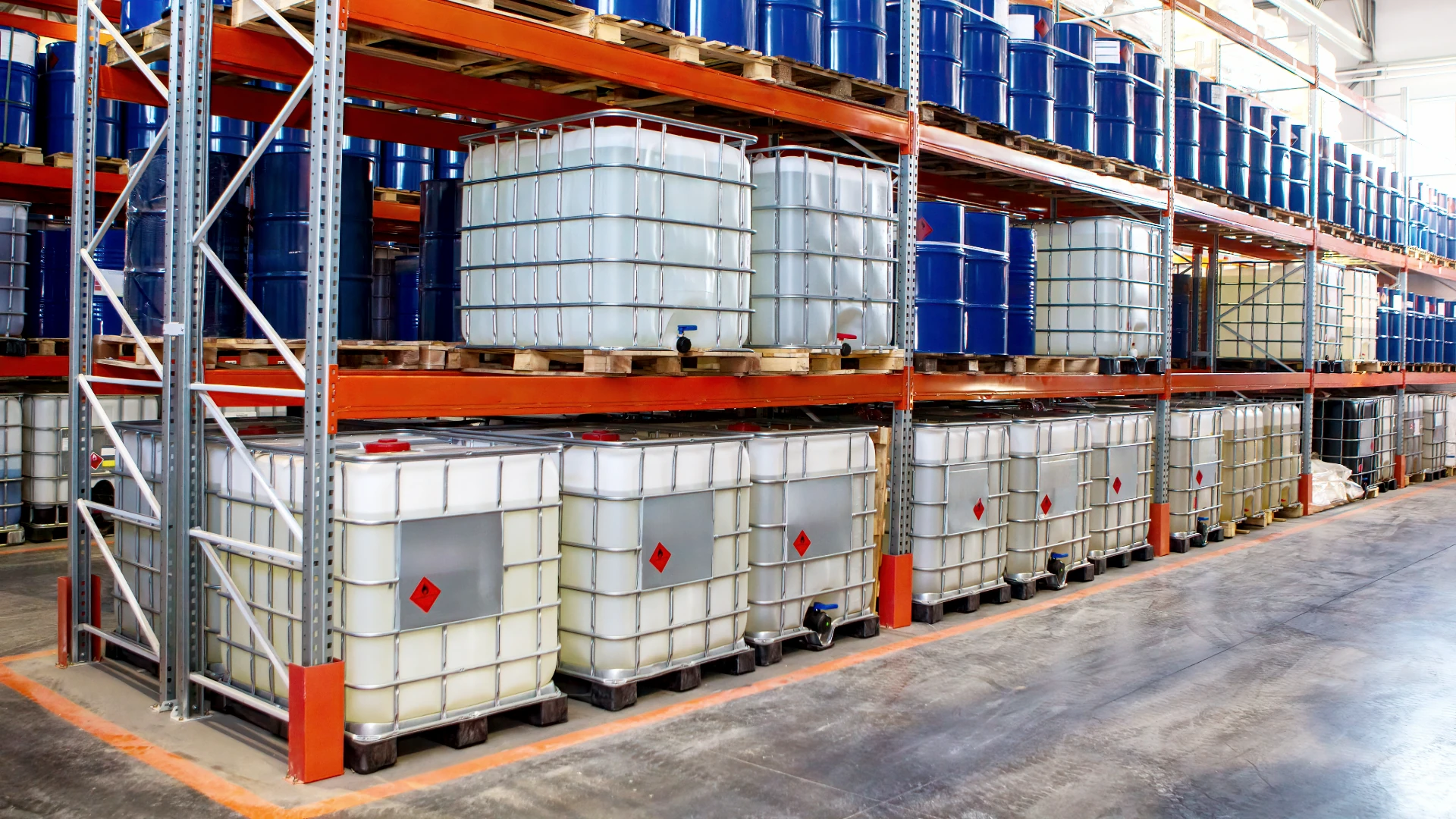
IBC stands for intermediate bulk container. For a shipment of liquid totes, identify each capacity, the number of loaded units, and their shipping condition. Do not decide from the outer container's equipment code alone.
A request stating 40HC, nonhazardous liquid in totes gives the carrier a useful warning, but it leaves the capacity calculation open. A more complete description is 40HC containing eight loaded IBCs, each rated at 275 U.S. gallons, with nonhazardous liquid.
The U.S. road leg needs to be planned using those cargo details even when the same sealed container has already traveled by vessel or rail. For background on the port-to-door segment, see .
Tank containers and flexible tanks
An ISO tank container and a dry container holding separate IBCs are different equipment arrangements. Describe which one is involved, then check the cargo, tank ratings, driver qualifications, and equipment requirements for that move. The explains why tank-container drayage needs additional equipment and service review.
Flexible construction does not automatically remove the endorsement requirement. FMCSA confirms that . For a flexitank shipment, provide the tank specification and capacity instead of describing it only as a dry container.
Food products, water, and dry bulk
Nonhazardous liquids can meet the tanker criteria. Food-grade status or a description such as water, juice, or edible oil does not replace the tank-capacity check. The official expressly states that the liquid or gas does not have to be hazardous.
Conversely, a trailer used only for dry solid cargo does not fall within the federal liquid-or-gas tank definition merely because people call it a “dry bulk tanker.” Use the equipment's actual design and intended use when reviewing an unusual configuration.
Tanker and hazmat endorsements are different
A tanker endorsement addresses the operation of a qualifying tank vehicle. A hazardous materials endorsement addresses a separate licensing requirement for the goods being transported. A shipment can require one, both, or neither.
| Required qualifications | Endorsement |
|---|---|
| Tank vehicle qualification without a hazmat endorsement requirement | N |
| Hazmat qualification without a tank vehicle endorsement requirement | H |
| Both tank vehicle and hazmat qualifications | X |
The treat tank vehicles and hazardous materials as distinct categories.
The includes goods requiring placards and specified select agents or toxins. The broader fact that a product is regulated as hazardous material does not answer every licensing question. FMCSA explains the .
Consider two different shipments:
- Nonhazardous liquid in four 275-gallon totes: The tank-capacity test is met even though the product is not hazmat.
- A hazardous material requiring a placarded vehicle in one 275-gallon tote: The load can require hazmat qualification without meeting the 1,000-gallon tank threshold.
Classification, packaging, quantity, and applicable exceptions determine the hazmat outcome. Obtain the relevant transport information rather than guessing from a product name. The guide to explains SDS information and shipping descriptions; explains the hazard categories.
An endorsement also does not establish that every carrier accepts the commodity or has suitable equipment. Confirm acceptance for the actual cargo and operation before dispatch.
Empty tanks and residue returns
A return load of empty totes needs a different review from a load of partially filled product. Establish what remains inside and how the shipment is documented.
The FMCSA empty-tank exception
FMCSA's excludes transported empty IBCs or other tanks when the bill of lading identifies them as empty or residue and they are actually empty or contain only residue. A tank still carrying a partial product load does not become empty through its paperwork description.
The federal definition also excludes an empty storage tank that is not designed for transportation, has a rated capacity of at least 1,000 gallons, and is temporarily attached to a flatbed trailer. This is a specific storage-tank situation, rather than a blanket exemption for anything called an empty tanker.
Tell the provider whether the shipment consists of new empty packaging, cleaned used tanks, or packaging with residue. Provide the previous contents and supporting documents when relevant. The outbound product load and the return packaging load should each have an accurate description.
Hazmat residue rules must be checked separately
An exception from the tank endorsement definition does not, by itself, remove hazardous-material requirements.
Since September 3, 2026, a specific PHMSA exception can provide relief for certain residue-only IBC movements. It covers eligible steel, rigid plastic, or composite IBCs no larger than 550 gallons, with specified packing group II or III materials in Classes or Divisions 3, 4.1, 5.1, 6.1, 8, or 9.
Conditions include:
- A residue limit of 0.3 percent by weight of the IBC's total capacity.
- Transportation in a fully enclosed vehicle or freight container.
- Movement to a reconditioning, remanufacturing, requalification, disposal, or repair facility.
- An accompanying document stating
Residue IBC(s)and the counts by hazard class or division. - Continued package marking and labeling, with transportation limited to road or rail.
When all conditions are satisfied, the rule provides specified shipping-paper, placarding, and identification-number relief. Check the complete before relying on the exception.
Why the driver needs additional knowledge
Liquid can move within a tank as the vehicle accelerates, brakes, or turns. This movement, often called surge, affects vehicle handling. The tank's construction, fill condition, and product density influence the driving task.
Federal tanker knowledge requirements cover surge, braking with different fill levels, baffled and compartmented tanks, road grades and curves, emergency systems, and other operating practices. See .
For a shipper, this explains why the requirement should be resolved before the truck arrives. Dispatch needs enough information to assign an appropriately qualified driver. Discovering the tote configuration at pickup can force a change to the transport plan.
Before dispatch, confirm packaging condition, cargo securement, legal weights, and loading or unloading arrangements alongside driver qualification. FMCSA's is a separate resource for the securement requirements.
How a driver obtains a tanker endorsement
A driver applies through the state driver licensing agency and passes the tank vehicle knowledge test. The federal endorsement requirement is a knowledge test, rather than an additional tanker-specific road test. Obtaining the underlying CDL or changing the vehicle class can involve other tests. sets out the endorsement testing requirements.
A practical preparation sequence is:
- Confirm the appropriate CDL class and the state's application process.
- Study the tank vehicle section of the current state CDL manual.
- Complete the required knowledge test and license transaction.
- Check that the issued license records the required endorsement before taking the applicable load.
Adding N alone to an existing CDL is not one of the federal Entry-Level Driver Training triggers. First-time Class A or B licensing, certain upgrades, and first-time H, P, or S endorsements have their own training requirements. explains the distinction.
For a combined X endorsement, the hazardous-material qualification adds its own process, including the applicable training, knowledge test, and TSA security clearance requirements. provides an official example; use the licensing agency for the driver's state to confirm its procedure and fees.
What to provide when arranging the shipment
A good shipment description lets the provider establish the requirement before selecting a driver and preparing the price. Send the packaging facts with the initial request, even when the cargo is nonhazardous.
1. Identify the cargo and its physical form. Give the commodity and state whether it is liquid, gas, or dry material. Provide the relevant transport classification and current SDS information for hazardous or uncertain products.
2. List packaging quantities and rated capacities. Separate different tote or tank sizes. Write six IBCs rated at 275 U.S. gallons each, rather than only six pallets of liquid. Include the units on metric specifications.
3. State the fill condition. Distinguish loaded product, partially filled tanks, empty packaging, and residue-only returns. If an exception is being used, supply the facts and documents supporting it.
4. Describe the transport equipment and lane. Specify whether the cargo is in a dry ocean container, an ISO tank container, a trailer, or another arrangement. Include the pickup terminal or location, destination, and intended service dates.
5. Include weight and handling requirements. Capacity determines the tanker calculation, but the shipment still needs a workable weight and equipment plan. Supply cargo weight, loading or unloading instructions, and any required transfer equipment or facility arrangements. The guide to covers that separate decision.
6. Obtain confirmation for the described move. Ask the provider to confirm the required driver qualification, cargo acceptance, equipment, and treatment of related charges in the quote. Keep that confirmation attached to the actual shipment description.
For example:
Please quote a 40HC from the Port of Savannah to our Atlanta warehouse. It contains eight loaded IBCs, each rated at 275 U.S. gallons, with nonhazardous liquid. Cargo weight is 24,000 lb. The receiver will unload the totes by forklift during a live unload. Please account for the required tanker endorsement and identify any associated charge in the total.
This example identifies the tank ratings, quantity, cargo status, equipment, weight, and unloading method. The price still needs the exact locations, dates, and other details requested by the provider. For the broader cost review, see .
How tanker requirements affect a freight quote
The driver's license endorsement and a shipment's tanker charge are different things. A licensing agency's application or test fee belongs to the driver's licensing process. A tanker item on a freight quote is a commercial charge associated with providing the required service.
Do not assume the requirement is included merely because the provider has quoted a container move. Make the cargo configuration clear and review whether the offer includes any tanker-related charge, lists it separately, or leaves it to be confirmed. Where hazmat qualification is also required, establish how both requirements are reflected in the same offer.
A useful question is: “Does this quoted total include a properly endorsed driver and any tanker-related charge for the cargo and tank capacities described?” An accessorial rate sheet shows available charges; the shipment quote establishes which ones have been priced. The explains how to read those rates and billing units.
For supported moves, Portmate can account for applicable tanker-driver pricing in the quote using the shipment requirements you provide, reducing the need to calculate the charge separately. Include the cargo description, tote quantities, and rated capacities when requesting an , then review the breakdown and assumptions before booking. ISO tank containers and other special equipment may need manual review.