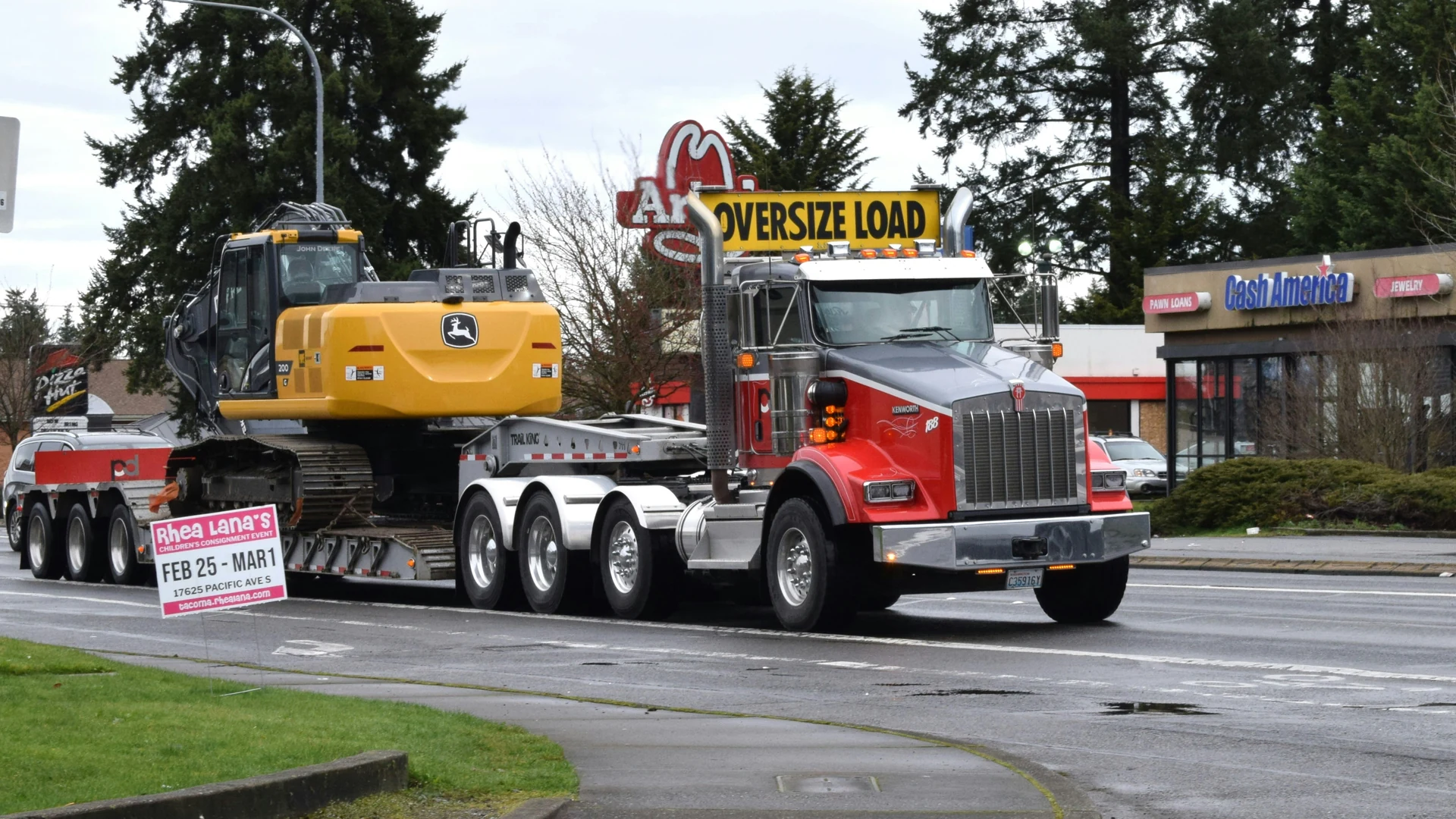

What is OOG cargo
OOG means out of gauge. In container shipping, OOG cargo has a loaded profile that exceeds the carrier's accepted length, width, or height limits for the equipment carrying it. Think of a machine projecting above an open top container or a wide industrial unit extending beyond a flat rack's frame.
People also use OOG more loosely to mean oversized freight that needs special transport planning. That shorthand tells you the shipment needs attention, but it does not tell you which dimension is excessive, whether the cargo is overweight, or how it will move inland.
The most useful follow-up is: out of gauge against which equipment or operating limit, and by how much? This guide explains the terminology, the measurements behind it, and the decisions a shipper or forwarder needs to make before requesting a workable transport plan.
What the industry means by OOG
In ocean-container operations, the gauge is the dimensional envelope used to classify and plan the loaded equipment. Cargo outside that envelope can interfere with adjacent container positions, overhead space, lifting equipment, or the vessel's internal structures.
distinguishes in-gauge cargo, out-of-gauge cargo, and breakbulk. In its OOG category, cargo exceeds the flat rack or open top's dimensions but can still travel as a containerized unit. This is the most useful starting point when someone describes an import as “one OOG flat rack.”
The same three letters can refer to different operational questions along the journey:
| Where the term appears | What to clarify |
|---|---|
| Ocean quotation or booking | Which equipment is proposed, and what are the accepted loaded dimensions? |
| Terminal handling instruction | Can the unit use ordinary lifting and gate procedures, or does it need special handling? |
| Trucking conversation | What are the complete vehicle-and-load dimensions, and does the route support them? |
| Rail planning | Does the proposed loaded rail configuration need clearance review? |
An “OOG container” usually means a container or flat rack carrying OOG cargo. It does not necessarily mean that the container itself was built to nonstandard dimensions.
Also ask whether a carrier is describing overheight, overwidth, overlength, or a combination. Those conditions create different handling problems. “OOG, dimensions to follow” is a preliminary description, not enough information to select equipment or confirm a rate.
OOG, overweight, breakbulk, and project cargo
These terms often appear together because the same machine can fall into several categories. They answer different questions.
| Term | What it describes |
|---|---|
| OOG | Dimensions outside the accepted gauge for the proposed equipment or operation. |
| Overweight | Weight above an applicable equipment, service, axle, or road allowance. |
| Oversize | Excess dimensions; in road transport, usually relative to the applicable vehicle-and-load limits. |
| Breakbulk | Cargo handled as individual units outside ordinary single-container carriage; a container line may use a bed of flat racks. |
| Project cargo | A broader shipment or logistics program that can include OOG, heavy, breakbulk, and ordinary freight. |
| Heavy lift | A lifting or transport requirement involving substantial weight, assessed against the equipment and operation. |
For example, a wide but relatively light fiberglass housing can be OOG without presenting a heavy-haul weight problem. A dense load inside a closed dry container can be in gauge while creating an overweight road move. A large transformer can present both problems.
The explains the weight side, including cargo weight, loaded-container weight, axle distribution, and equipment ratings.
OOG is not another word for misdeclared. A correctly declared, approved OOG shipment is a planned special-cargo movement. Misdeclaration happens when the actual cargo, dimensions, weight, or configuration differs from what was declared. Maersk's explains how those discrepancies can lead to rejected loading, revised charges, or disrupted stowage plans.
How to tell whether cargo is out of gauge
Start with the actual shipping configuration and the equipment proposed by the carrier. A machine's sales brochure and a generic container-size chart are useful leads, but neither establishes the final classification.
Special equipment can still be in gauge
A flat rack or open top is an equipment type. OOG is a description of the loaded profile.
A machine may need top loading because it cannot be maneuvered through a container door. Once inside an open top, it may remain within the accepted gauge. Similarly, a flat rack may be chosen for side access or the cargo's support requirements even when nothing projects outside the permitted envelope.
Hapag-Lloyd makes this commercial distinction explicit: its allows certain special equipment for in-gauge shipments while directing OOG cargo to its special-cargo quotation process.
For a comparison of the equipment itself, see .
Interior fit, loading access, and gauge are separate checks
A cargo piece can be too wide for a particular door or roof opening without exceeding the external gauge of the equipment eventually selected. Conversely, a piece that rests securely on a flat rack can extend beyond its accepted gauge.
There is a further detail that often causes confusion: the flat rack's floor can be narrower than its outer frame. Hapag-Lloyd's explains that cargo may overlap the floor and still be in gauge. Its overwidth assessment uses the outer corner-post reference, with protruding cargo and lashing materials included.
The practical question is therefore not simply whether something hangs over the wooden deck. Confirm the carrier's reference boundary and whether the cargo remains properly supported.
There is no universal OOG size table
Do not treat one published container specification as a worldwide booking limit. Equipment varies, and carriers apply their own acceptance criteria. Even Hapag-Lloyd's says its published figures are examples and can vary by manufacturer.
Check three things together:
- The assigned equipment: Usable dimensions, openings, tare, payload, supporting structure, and end-wall configuration.
- The carrier's gauge and acceptance rules: The limits and measurement method used for the actual booking.
- The proposed journey: Vessel, connecting services, terminals, lifting arrangements, and inland transport.
The provides background for ordinary equipment. Use shipment-specific confirmation when planning special cargo.
Which equipment can carry OOG cargo?
Equipment selection starts with the cargo's shape, weight, support points, and loading method. The largest nominal payload or longest available platform does not automatically produce the best plan.
Open top containers retain side walls and end structures but provide access through the roof. They are useful for suitable top-loaded cargo and approved overheight shipments. The roof opening, door header, walls, and lifting clearances still constrain what can be loaded; removing the roof does not turn the unit into an unrestricted platform.
Flat racks provide a base and end structures without full side walls or a roof. They can accommodate suitable wide, tall, or irregular cargo. Some have collapsible end walls, but the proposed up-or-down configuration must be declared and accepted. Folding the ends changes the handling and stowage arrangement.
Platforms provide an open base for suitable cargo that cannot use the end structures of an upright flat rack. The carrier must confirm the actual equipment offered and its lifting and securing method.
CMA CGM's explains these practical constraints, including access to corner castings, collapsed end walls, cargo support, and load distribution.
When a single containerized unit is unsuitable, the alternatives may include breakbulk on a container vessel, a multipurpose or heavy-lift vessel, or roll-on/roll-off transport. RoRo is not limited to self-propelled vehicles: that suitable static cargo can travel on wheeled handling equipment.
Compare the complete route, handling exposure, sailing options, and inland requirements before choosing among those alternatives. A mode that works at the loading port must also work at discharge and delivery.
How to measure and describe an OOG shipment
The review team needs a physical description of what will actually arrive. Separate the unpacked product, the packed cargo, the loaded ocean equipment, and the road vehicle instead of giving one unexplained set of dimensions.
Measure the complete shipping envelope
Include the outermost points of the actual configuration:
- Crates, protective covers, skids, pallets, saddles, and other packaging or supports
- Parts that remain attached during transport, including pipes, brackets, handles, or projecting machinery components
- Blocking, bracing, and lashing equipment that projects beyond the cargo
- Any intended overhang, with the cargo's position on the equipment shown
Maersk's specifically identifies protruding lashing gear, dunnage, packing materials, and end-wall configuration as details that affect the declaration.
Use explicit units and label the order: for example, 6.20 m long × 3.20 m wide × 3.10 m high. State whether those are final packed measurements or preliminary estimates. For multiple pieces, list each piece separately and show the proposed arrangement.
For height, identify the reference point. “3.10 m high” could mean the bare machine, the packed assembly above the flat-rack deck, or the complete loaded unit from its underside. Those measurements cannot be substituted for one another.
A dimensioned drawing should make the origin of each measurement clear. Photos help explain shape and condition, but they cannot reliably replace measurements or establish weight and center of gravity.
Report total dimensions and each overhang
Suppose the carrier confirms an accepted gauge width of 2.44 m for the proposed configuration. The actual loaded width, including protrusions, is 3.20 m.
The total excess is:
3.20 m − 2.44 m = 0.76 m
If the load is centered symmetrically, that is 0.38 m on each side. These are illustrative measurements, not a universal flat-rack allowance.
If the cargo is offset, dividing by two gives the wrong answer. One side might extend 0.20 m and the other 0.56 m. Report the actual left and right projections, identify the viewing direction on the drawing, and state front and rear overhang separately.
For irregular cargo, show where the widest and tallest points occur. A narrow base with a wide upper assembly presents a different shape from a rectangular crate of the same maximum dimensions. The carrier may need that detail for lifting clearance and stowage.
Keep the weight figures distinct
Provide the weight of each shipping piece, including its packing and supports, and distinguish it from the weight of the loaded container or flat rack. Also identify the center of gravity, support footprint, and lifting and securing points. requests dimensions, gross weight, lifting and lashing points, and center of gravity.
VGM, or Verified Gross Mass, concerns the packed container: cargo, packing and securing materials, plus container tare. It does not include the road tractor and chassis. sets out the verification methods and shipper's responsibility.
Being below the flat rack's total payload rating does not settle the loading assessment. A concentrated load on a few small feet needs different support from the same weight distributed along the base. CMA CGM's technical brochure provides separate load charts for different support arrangements. The actual unit, contact points, and approved bedding plan matter.
Why ocean approval does not settle inland transport
An ocean carrier's acceptance answers one part of the journey. It does not establish that the same unit can leave the terminal on any chassis or clear every road to the receiver.
Trucking uses the complete vehicle-and-load profile
For road transport, check the actual overall width, height, length, overhang, axle loads, and gross combination weight. The ocean equipment and road equipment become part of that calculation.
In the United States, explains the 102-inch width framework on the National Network and reasonable access routes, with specified exceptions. It also explains that there is no single federal commercial-vehicle height limit; states set height restrictions, and individual routes can have lower clearances.
This means an ocean OOG classification does not, by itself, tell you whether an oversize road permit is required. The equipment gauge and road limits are different reference points. Equally, an in-gauge container is not a guarantee of legal weight or clearance on a particular road.
For a U.S. oversize or overweight move, identify the permits and operating conditions needed for every affected jurisdiction. explains that permits are issued by states, rather than the Federal Government. The plan may also need local permissions, escorts, travel windows, or route and utility coordination. Permit availability must be established for the actual load and route.
A lower-deck transload can change the route options
The important vertical measurement is:
Overall loaded height = ground-to-supporting-deck height + loaded cargo height above that deck
For a flat rack on a chassis, the supporting height includes the chassis and the flat-rack structure. Include the skid, bedding, and highest projecting component in the cargo height above the deck, counting each item once.
Consider an illustrative cargo assembly 3.10 m high above its supporting deck, including its packing and bedding:
| Proposed configuration | Illustrative overall height |
|---|---|
| Flat rack on chassis, supporting deck 1.50 m above ground | 4.60 m |
| Cargo transferred to a trailer with a supporting deck 0.55 m above ground | 3.65 m |
Those assumed deck heights demonstrate the calculation. They are not equipment specifications or statements that either configuration is legal. A real transfer can change bedding, support, securement, axle distribution, and clearance requirements.
If the intact unit cannot use a viable route, transferring the cargo onto suitable lower equipment may be necessary. That transfer must happen at an accessible, capable facility; the first trip from the terminal to that facility still needs a workable plan.
Use to compare the movement plans, and to understand the available deck arrangements.
Rail requires its own acceptance
Do not assume an OOG flat rack can travel through an ordinary double-stack intermodal service. Ask the railroad or service provider to assess the proposed unit and route.
A separate dimensional rail movement may require different equipment and clearance work. includes loading and securement review, main-line clearance, first- and last-mile clearance, and inspection. That is a shipment-specific process, not blanket acceptance of every ocean OOG unit.
How an OOG shipment gets approved and moved
Plan the chain before committing the cargo to a sailing. The following sequence helps keep the ocean, terminal, trucking, and unloading arrangements consistent.
- Establish the cargo facts. Obtain the final shipping dimensions, piece weights, drawings, center of gravity, support points, and handling restrictions. Clearly identify anything still estimated.
- Develop the equipment and route plan. Compare containerized OOG, alternative ocean modes, direct inland delivery, and any transfer. Check origin and destination access early.
- Request the appropriate quotation and acceptance. Supply the proposed configuration and handling plan. Ask whether connecting vessels and transshipment terminals have also been considered.
- Confirm packing, lifting, and securing requirements. Agree who designs and performs the work, what surveys or reports are required, and who checks the completed unit.
- Coordinate terminal and inland execution. Confirm releases, cutoffs, special-handling arrangements, suitable trucking equipment, permits where required, and receiver readiness.
- Verify the final loaded configuration. Measure after packing and securing. Reconcile the results with the booking and transport plan before dispatch; obtain revised acceptance if anything material changes.
CMA CGM's illustrates why details matter: it calls for piece dimensions and a loading plan, notes equipment availability constraints, and sets different reporting requirements by loading location. Those are carrier- and trade-specific instructions, not universal deadlines for every OOG shipment.
Confirm the terminal's special-cargo procedure
An ordinary container appointment may not cover the move. For example, direct import and export OOG customers to its customer service team for appointment assistance rather than its normal Gate Link scheduling process.
For the actual terminal, confirm handling capability, receiving or pickup arrangements, lifting access, documentation, and charges. A terminal's ability to handle standard flat racks does not establish acceptance of every loaded profile.
Treat securement and unloading as planned work
The provides a global code of practice for packing and securing cargo across sea and land transport. It is a non-mandatory code; applicable laws, carrier requirements, and transport-specific rules must also be addressed.
For U.S. trucking, includes requirements for intermodal containers and for particular cargo such as heavy machinery. If cargo changes equipment during the journey, the new configuration needs its own appropriate securement assessment.
At delivery, confirm the receiver's lifting capacity at the required reach, rated lifting points, access, ground conditions, unloading space, and appointment. “Forklift available” is not enough to establish that a large machine can be removed safely.
What makes an OOG quote more expensive?
OOG pricing reflects the space, equipment, handling, and coordination needed for the particular move. There is no single surcharge that explains the whole cost.
Ocean space can be lost around the unit. A wide load can prevent use of neighboring positions; a tall load can occupy space above it. These are often called lost slots or voided space. shows how overwidth and overheight affect space occupation. Its examples should not be treated as a universal multiplier for another vessel or carrier.
Other items to clarify in the quotation include:
- Special container supply, positioning, use, and empty return
- Packing, bedding, blocking, bracing, lashing, and technical drawings
- Survey, inspection, or certification work required for that shipment
- Special terminal lifts, handling equipment, labor, or storage arrangements
- Trucking equipment, permits, escorts, route work, and restricted operating hours
- Any transload, crane work, intermediate storage, and onward transport
- Waiting, failed collection, changes, and applicable demurrage or detention terms
Ask which costs are fixed, which remain estimated or payable at actual cost, and what the rate assumes about dimensions, weight, routing, and timing. Also confirm exclusions, validity, free time, and who pays each supplier.
When comparing offers, use the same final cargo configuration and scope. A port-to-port OOG rate and a door-delivery plan with lifting and permits are different services. If cargo must transfer, the explains the additional handoffs and cost components.
Information to have ready for review
A complete starting description helps specialists identify the questions that actually need work. Gather the following in one place:
- Shipment and route: Import or export, origin and destination, ocean carrier and routing if known, exact terminal, delivery address, and whether a transfer is proposed.
- Cargo: Commodity, piece count, packed dimensions and weight of each piece, any dangerous-goods status, and whether parts can be removed or repositioned.
- Equipment and loaded profile: Proposed container or platform, end walls up or down, final overall dimensions, measurement reference points, and separate projections on each side and end.
- Technical details: Drawings, center of gravity, support footprint, lifting and securing points, handling restrictions, and available packing or securement plans.
- Timing: Cargo readiness, sailing or arrival information, receiving cutoffs, free-time deadlines, and required delivery date.
- Origin and receiver capability: Loading and unloading method, suitable lifting equipment, access restrictions, working hours, and the person coordinating the operation.
- Requested scope: Ocean movement, terminal work, direct delivery or transload, onward transport, permits, surveys, and empty return as applicable.
If something is unknown, identify it explicitly. A marked estimate is more useful than an apparently precise measurement that later turns out to describe the unpacked machine.
Common questions and avoidable mistakes
Most preventable problems begin when an assumption survives from the first inquiry into the final booking. Resolve the points below before the cargo reaches a gate.
What if the load is only a few centimeters outside the declared size? Report the change. Small projections can affect lifting clearance or planned vessel space. Do not assume an undeclared tolerance; have the carrier confirm the revised configuration before tendering it.
Could a high cube or a different orientation avoid OOG? Possibly, if the complete packed cargo can be loaded, supported, and secured within the selected equipment's accepted limits. Confirm actual openings as well as interior space. Rotation or removal of components also needs the cargo owner's approval and a revised handling plan.
Can a rate be requested before packing is finished? A preliminary inquiry can help compare options, but identify estimated dimensions and ask what remains conditional. Reconcile the final packed and secured measurements with the quote, booking, and inland plan. CMA CGM's process guide specifically tells customers to update the quotation when dimensions change.
Does a permit solve an equipment-capacity problem? No. Road permission does not increase the container's payload, the trailer's structural capacity, the lifting gear's rating, or the available physical clearance. Each part of the proposed operation still has to support the load.
What if the container has arrived but the direct road move will not work? Pause dispatch and establish the actual loaded profile. Coordinate with the carrier, terminal, specialized trucker, and any transfer facility to develop a feasible alternative. Include the first terminal-to-facility leg, new handling requirements, available time, and storage costs in that review.
A simpler review process with Portmate
With Portmate, you can describe the shipment in chat and keep the details in one conversation. When an OOG request needs specialist review, Portmate can automatically forward the shipment details and conversation context for manual review, so you do not have to copy and paste the same request into a separate email or start another inquiry.
You can also to help provide the information already available. Missing details can be clarified in the conversation, and support follows up by email after the handoff.
OOG pricing and acceptance still depend on the actual cargo, equipment, terminal, and route. Portmate simplifies getting the request to the team that can review those details.