
How to calculate tolls for a route
To calculate tolls for a commercial truck route, establish the complete itinerary, identify the truck's toll classification, and price every charged crossing or road segment using the applicable direction, payment method, and time band. For drayage, include the equipment return as well as the loaded delivery. Portmate calculates estimated tolls automatically as part of the quote and shows the amount in the cost breakdown.
That matters before you give a customer a price. A short container move can involve several toll facilities, and checking the driving route, finding each operator's schedule, and interpreting its truck rates takes time. An overlooked return crossing can leave a substantial expense outside the original quote.
The Newark-to-Brooklyn example in this guide shows $271.70 in tolls within a $1,448.70 quote: approximately 18.8% of the total. These figures illustrate the quote shown here; prices for a new request depend on its details. The walkthrough explains how to find the toll line, while a separate calculation below uses published bridge rates to show why New York–New Jersey tolls can add up so quickly.
Why truck tolls take more than a map lookup
An origin and destination are only the starting point. A useful estimate must describe the vehicle and the movement closely enough to apply the right tariffs.
The truck configuration determines the class. Count the axles on the tractor and chassis combination being used. A 20-foot container does not imply a two-axle vehicle, and an empty container does not turn a tractor-trailer into a passenger car. Equipment changes can affect the class; our explains the main drayage configurations.
Classification rules vary by agency. The considers vehicle height and total axles, together with distance traveled. The asks for axle count and height profile. Use each operator's definitions rather than transferring a class number from another road.
The route determines which charges apply. A route through Staten Island and a route through Manhattan can involve different facilities. Turnpike charges may depend on the particular entry and exit. The delivery entrance, chassis handoff, or empty-return location can change the itinerary again.
Payment and account eligibility affect the rate. An electronic tag may be accepted at a crossing without qualifying for that operator's lowest published rate. Account issuer, tag reading, discount eligibility, and payment method need to match the tariff you use.
The return deserves its own calculation. An import commonly involves a loaded leg from the terminal to the consignee and an empty leg to the authorized return location. The second leg may use a different road, direction, or time band. Doubling the outbound toll is an unreliable shortcut.
Why an ordinary Google Maps route is insufficient
Google says its consumer and may lead onto car-only roads. A car route and its displayed toll estimate do not establish the route or toll cost of a container truck.
Google separately offers large-vehicle routing through its developer platform to a limited set of customers. Its explicitly excludes truck toll prices. Truck routing and truck toll pricing therefore remain separate capabilities.
For a manual check, start with a route suitable for the actual vehicle, then apply the operators' tariffs to that route.
How to calculate route tolls manually
The following process is useful when checking a new lane, investigating a quote difference, or estimating a movement before you have an automated result.
1. Write down every shipment stop.
For an import, identify the loaded pickup terminal, delivery facility, and authorized empty-return location. For an export, identify the empty pickup, shipper, and loaded receiving terminal. Add any separate chassis pickup or return that belongs in the quoted service.
Use the exact terminal and the receiver's commercial entrance when available. A ZIP code can support an early estimate, but it does not identify the final loading dock. If the terminal is still uncertain, review and correct the assumption when the release details arrive.
2. Confirm the vehicle and a permitted truck route.
Establish the combination's axle count, overall dimensions, loaded weight, and any hazardous-cargo restrictions. Ask the carrier to confirm the route against current restrictions and posted signs. A toll price does not establish permission to use a crossing.
include route guidance and parkway restrictions. They also link changes effective October 4, 2026; check those alongside the older city truck map. For weight-sensitive moves, the helps distinguish equipment support from the cargo weight used in a quote.
3. List the toll facilities on each leg.
Follow the selected route and record each charged bridge, tunnel, road segment, and applicable congestion-zone entry. For a road priced by journey, note the actual entry and exit. Keep the loaded and empty legs separate until each has been checked.
These official resources are useful for the Northeast example:
| Operator | Resource to use |
|---|---|
| Port Authority of New York and New Jersey | |
| MTA Bridges and Tunnels | |
| New Jersey Turnpike Authority | |
| New York State Thruway Authority | |
| Pennsylvania Turnpike Commission |
Use the corresponding operator's resources for other states. Check that the schedule covers the intended travel date, especially when a quote will remain open across a tariff change.
4. Apply the correct payment and timing assumptions.
For each facility, select the vehicle category, charged direction, payment method, and applicable time band. Confirm the tag issuer and any discount conditions. If a discount depends on a fleet's enrollment or volume, establish eligibility before including it in a customer price.
An appointment time is not necessarily the bridge-crossing time. Allow for the terminal visit and road journey when assessing time-based tolls. Where timing or payment remains unknown, state the basis used for the estimate instead of quietly choosing the cheapest category.
5. Add the legs and preserve the calculation.
For each charge, retain the facility or entry/exit pair, vehicle class, direction, payment basis, rate, and source effective date. Add the loaded and empty movements, then account for any applicable zone charge or credit separately.
Mark an unresolved amount as unresolved. A missing rate is not evidence that a crossing is free. If one leg has been priced and another remains uncertain, keep that distinction visible when presenting the estimate.
6. Check how tolls enter the freight price.
Confirm whether the quoted total includes tolls, allows an estimated amount, or passes actual tolls through separately. Do not add your calculation again if the same expense is already included. Keep any administrative fee distinct from the toll itself.
Specialist tools can reduce the manual work. offers truck and toll-tag settings; document truck-route toll reports. Whichever tool you use, make sure its stops, vehicle, route, and payment assumptions describe the movement you are pricing.
Why New York–New Jersey tolls deserve close attention
Harbor drayage can combine charges from different operators within a relatively short trip. The terminal, borough, and equipment return all matter. The helps distinguish the Newark, Elizabeth, and Port Jersey facilities before you price the road journey.
A five-axle bridge example
For illustration, assume a five-axle truck travels from New Jersey through the Goethals Bridge and Verrazzano-Narrows Bridge to Brooklyn, then returns through those same bridges. This is a pricing illustration, not a dispatch route or a reconstruction of the screenshot's quote.
The published schedules checked on October 25, 2026 list the following rates, effective January 4, 2026. The E-ZPass column assumes an eligible, properly read tag and a peak-period Goethals crossing.
| Movement | E-ZPass | By mail |
|---|---|---|
| Goethals into New York | $113.35 | $128.35 |
| Verrazzano into Brooklyn | $36.84 | $65.10 |
| Verrazzano back toward Staten Island | $36.84 | $65.10 |
| Goethals into New Jersey | $0.00 | $0.00 |
| Bridge subtotal | $187.03 | $258.55 |
The charges only toward New York and limits its E-ZPass discounts to NY/NJ customer-service accounts. require a New York Customer Service Center account; other E-ZPass accounts pay its mail-rate category. The Verrazzano has .
These subtotals exclude the New Jersey Turnpike and any other facilities. Add those using the actual entry/exit pairs and payment basis. Even before those additions, the example shows why a few bridge crossings can materially change a drayage price.
Keep bridge tolls, congestion pricing, and truck access separate
A Brooklyn delivery does not automatically incur Manhattan congestion pricing. The covers Manhattan's local streets and avenues south of and including 60th Street, with specified roadway exclusions.
The lists a multi-unit truck charge of $21.60 at peak or $5.40 overnight with E-ZPass, and $32.40 or $8.10 using other payment media. Trucks are generally charged each entry; do not apply the passenger-car daily cap. Check applicable tunnel credits and any special adjustments against the full schedule. Add a zone charge only when the itinerary actually triggers it.
Some prominent bridges have no bridge toll. identifies its Brooklyn, Manhattan, Williamsburg, and Queensboro bridges as toll-free. Their access rules and any subsequent congestion-zone entry still need checking.
Likewise, a published tariff does not mean every truck may use the facility. The Port Authority prohibits tractor-trailers in the Holland Tunnel and requires trucks to use the George Washington Bridge's upper level. Consult its truckers' guide when evaluating a crossing. For last-mile planning, our explains why the receiving entrance and harbor origin need to be established together.
How to see tolls automatically in a Portmate quote
You can obtain the estimated toll amount while requesting the drayage price. The example below uses an import from Port Newark Container Terminal to Brooklyn, NY 11232, for one 20-foot dry container. The covers the wider quoting workflow.
Open the site and chat
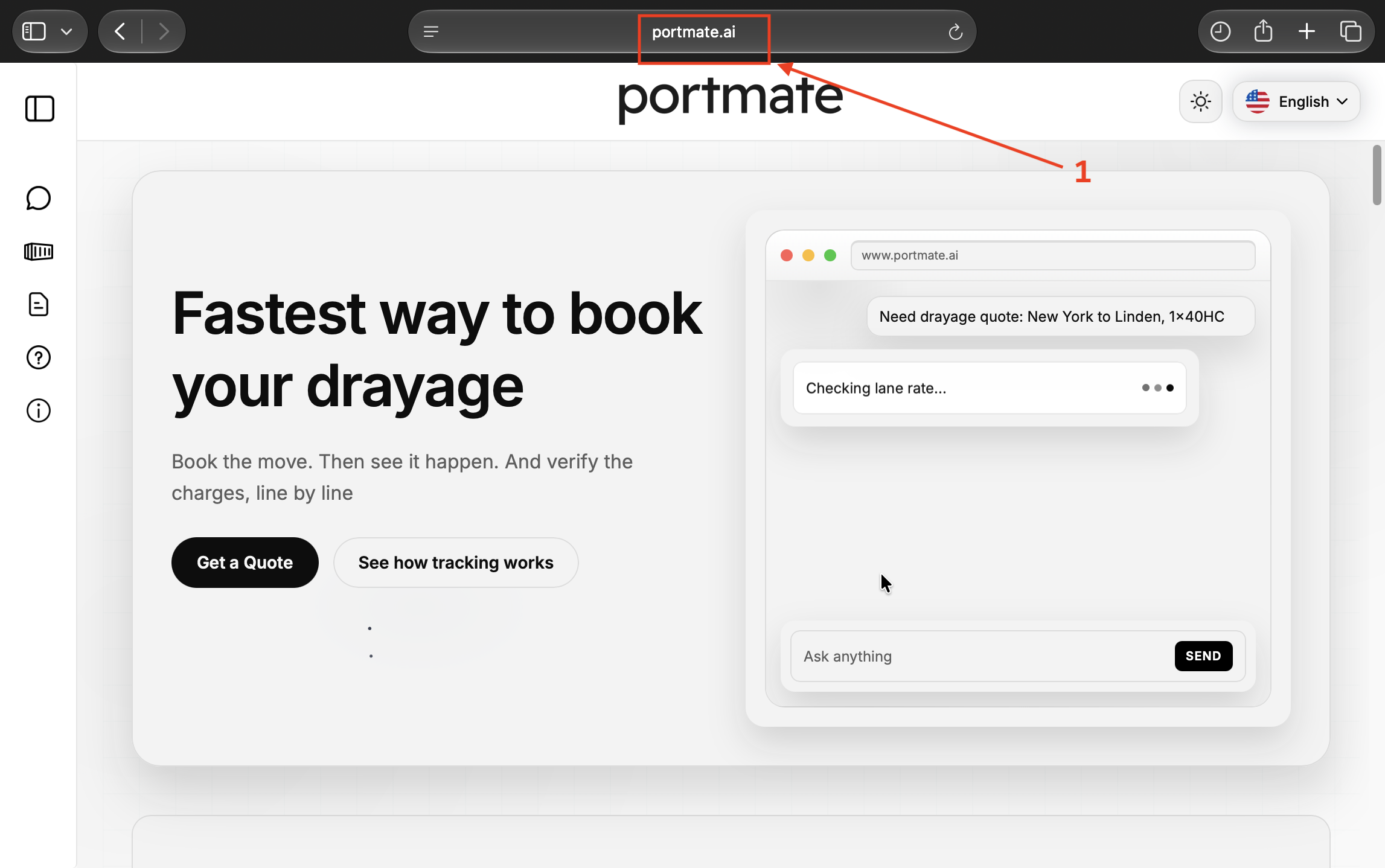
Step 1. Visit Portmate.
Open in your browser. The first screenshot highlights the site address.
Step 2. Select Chat.
Use the speech-bubble icon in the left navigation. This opens the conversation where you can describe the shipment.
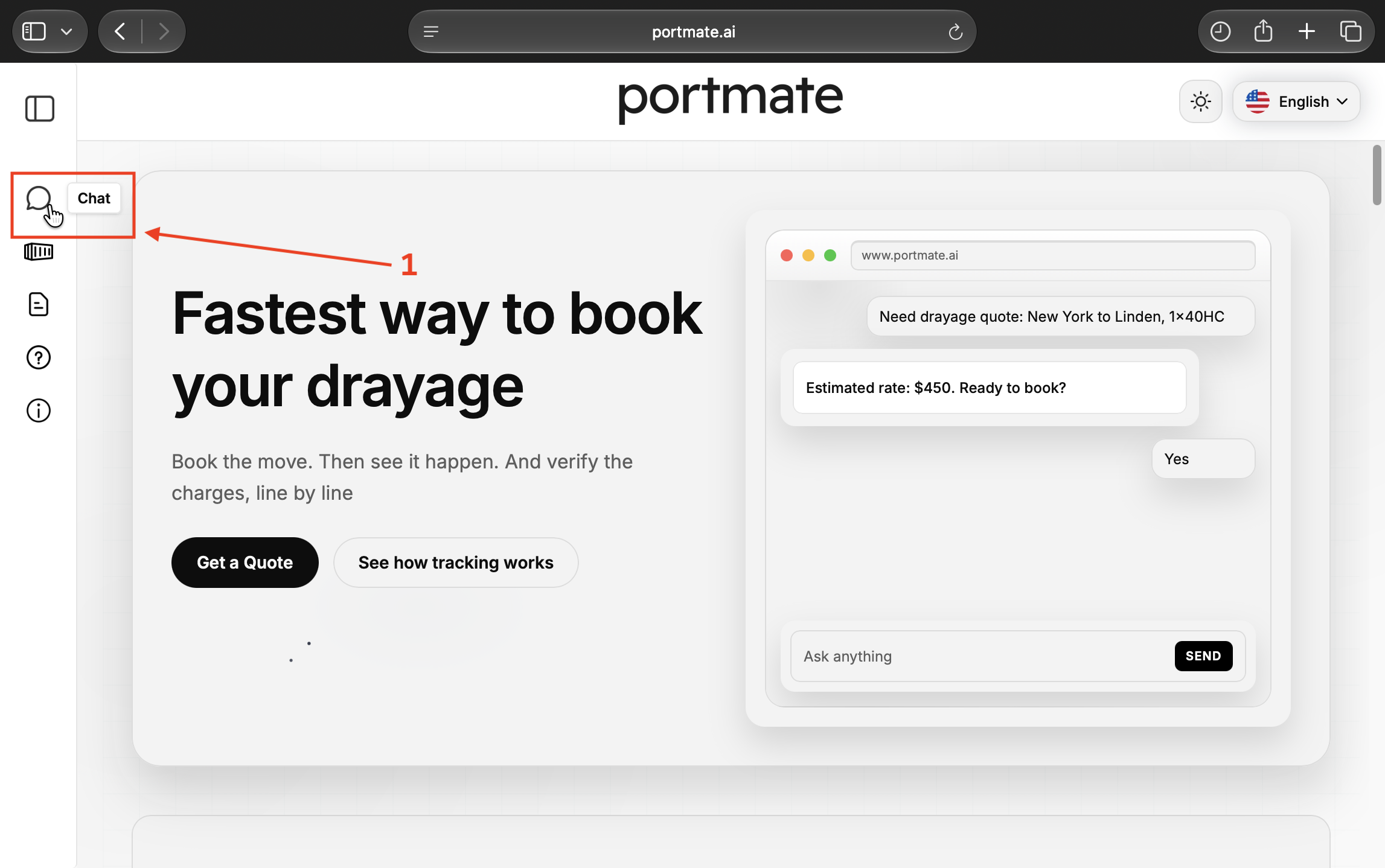
The homepage's sample conversation illustrates the product; use the result returned for your own shipment when reviewing prices.
Describe and submit the shipment
Step 3. Enter the quote request.
Select the Ask anything field and describe the move in ordinary language.
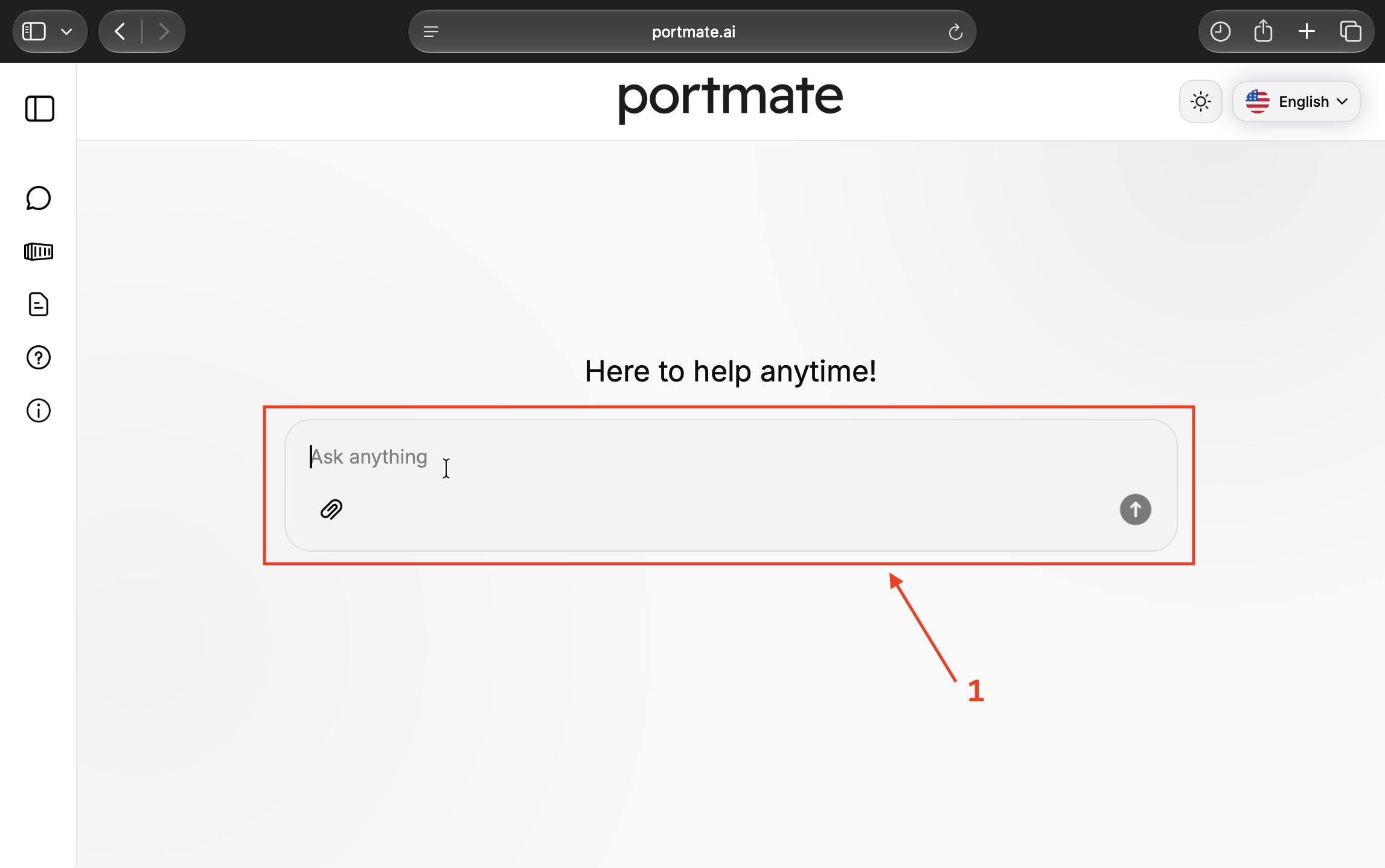
The example uses:
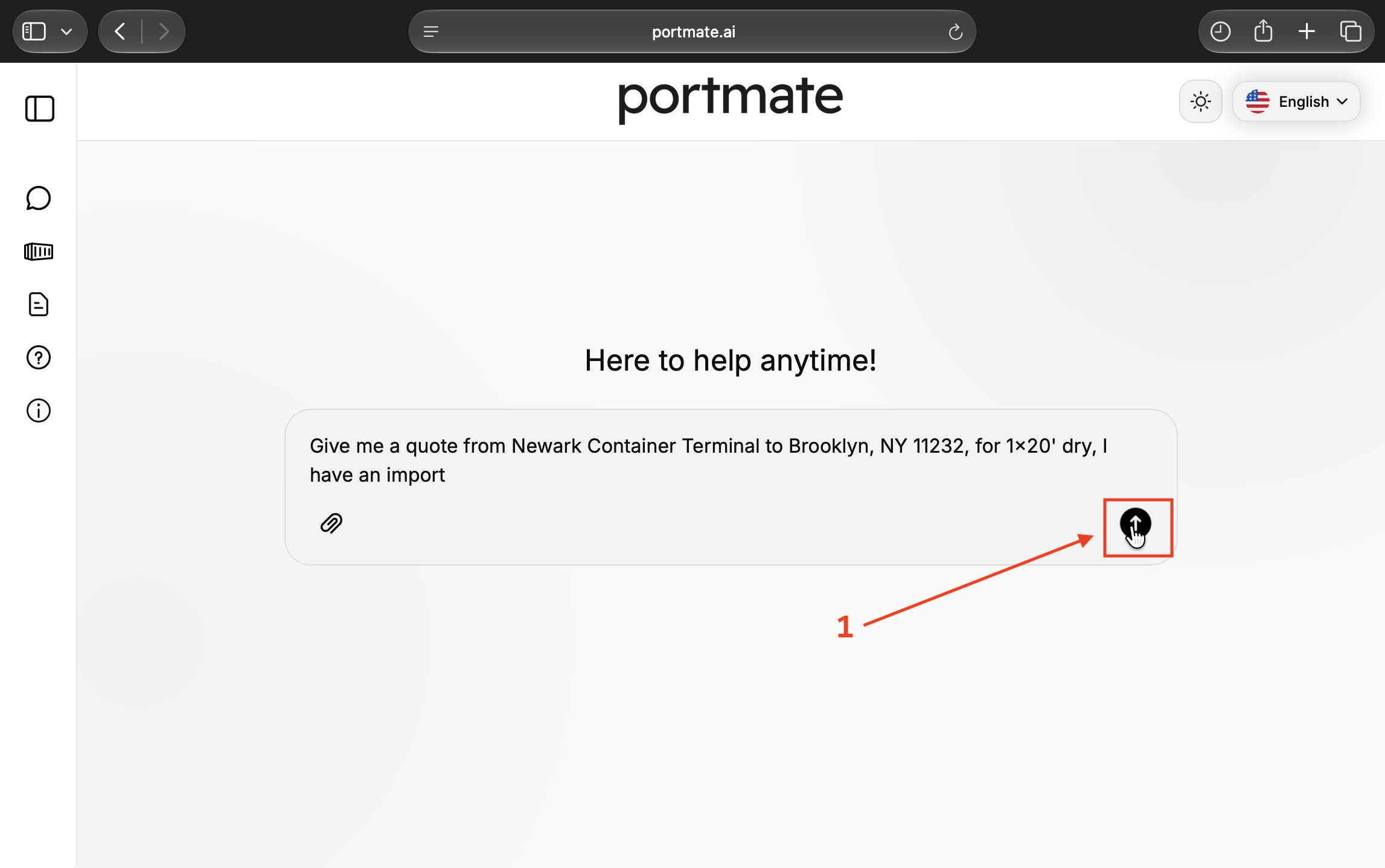
Give me a quote from Newark Container Terminal to Brooklyn, NY 11232, for 1×20' dry, I have an import
For your shipment, add the full delivery address, cargo weight and commodity, known equipment requirements, and the authorized empty-return location when available. Review any assumptions used when details are missing. Follow an authentication prompt if the chat asks you to sign in.
Step 4. Send the request.
Select the upward-arrow send button. Check that the submitted message contains the intended terminal, destination, container, and move type.
Review the locations and toll line
Step 5. Check the identified terminal.
As Portmate processes the request, the example's activity panel shows it identifying Port Newark Container Terminal. Review the selected facility when the result appears, particularly if you entered a shortened name or a broad port location.
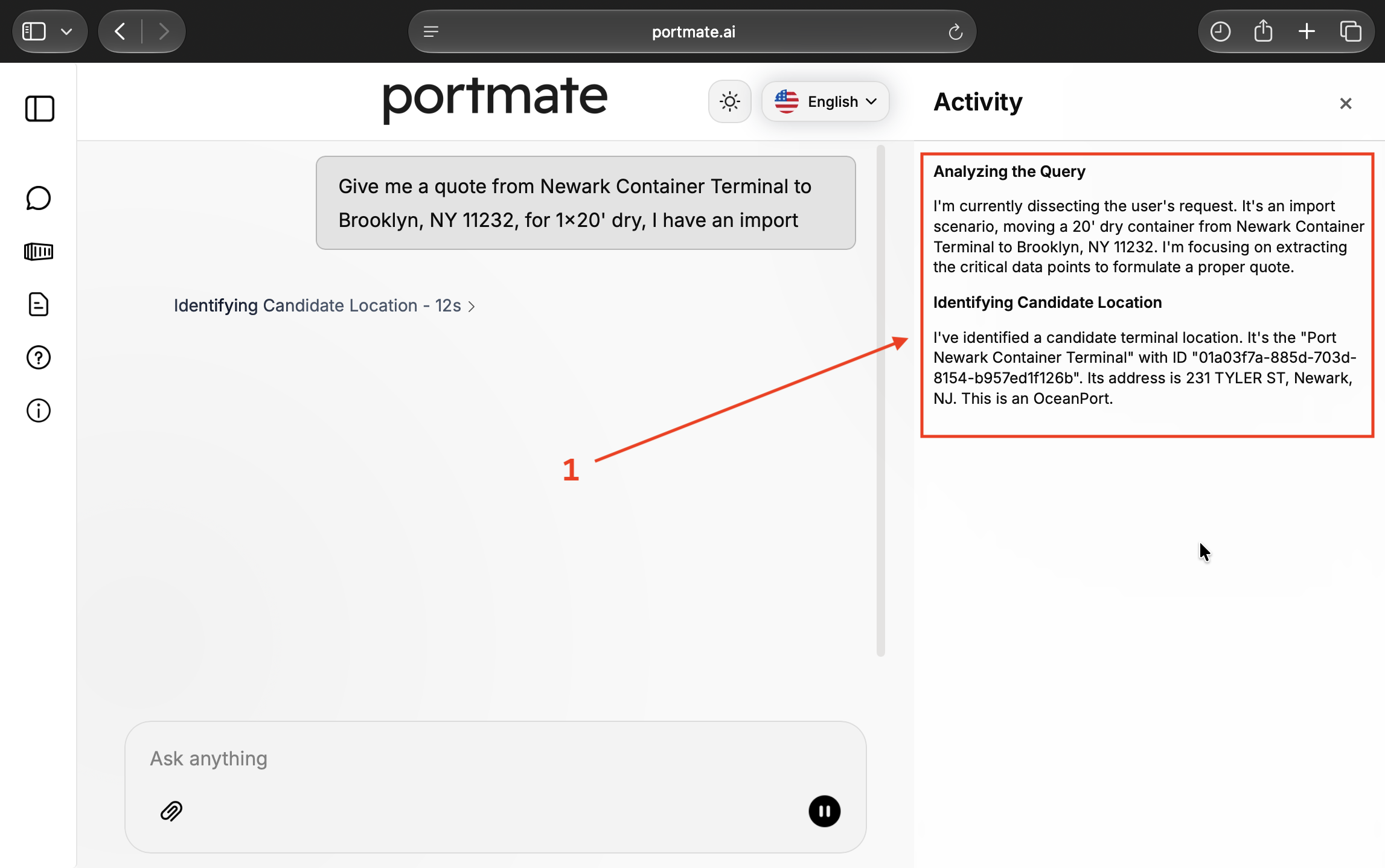
The screenshot displays a terminal reference at 231 Tyler Street. lists 241 Calcutta Street. Confirm current truck-access instructions before dispatching; a displayed facility reference is not a substitute for the operator's gate directions.
Step 6. Find Tolls in the cost breakdown.
Review the itinerary and scroll to Cost Breakdown. This result shows Tolls: $271.70 alongside line haul, fuel surcharge, and chassis.
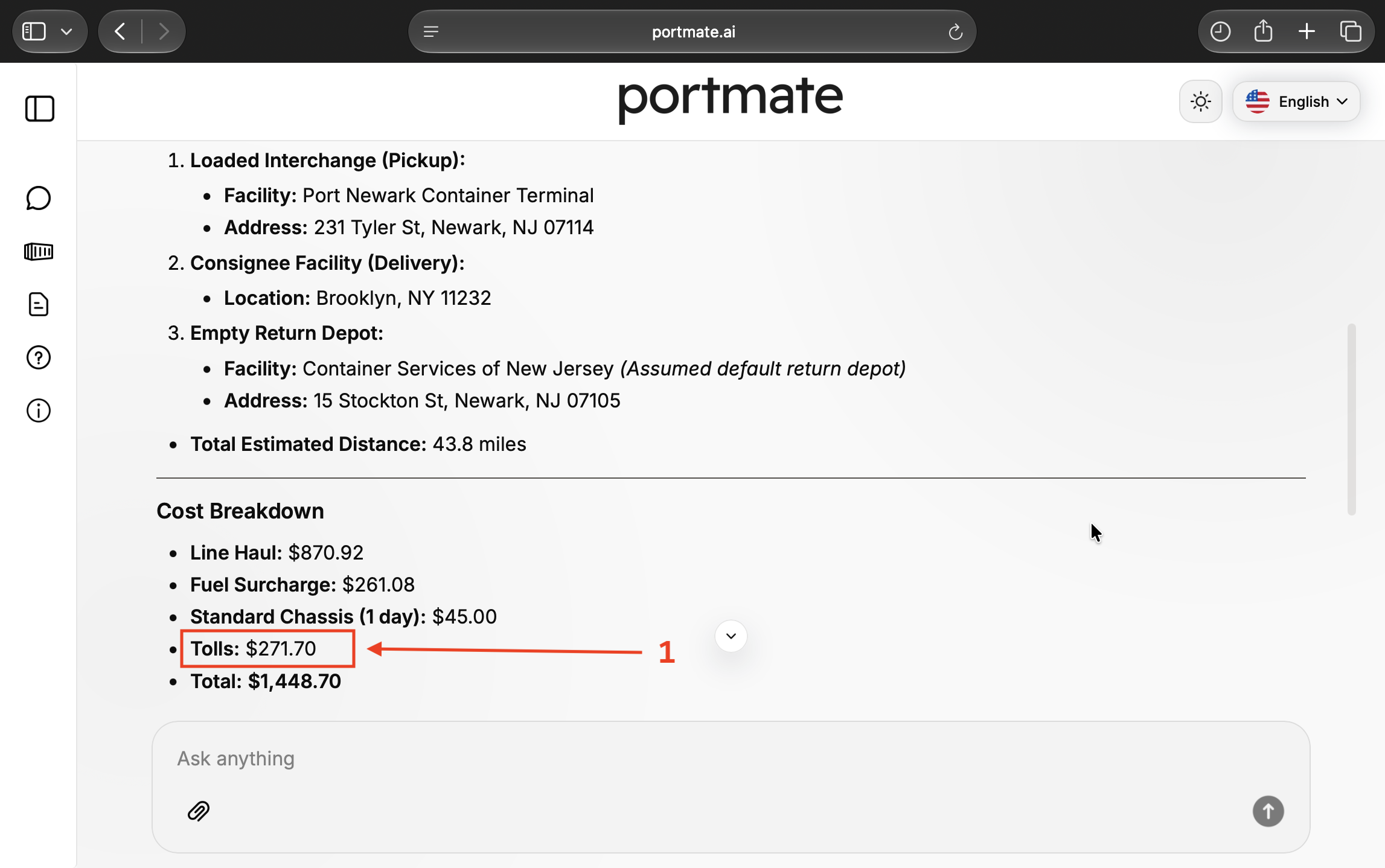
The demonstration contains these charges:
| Quote item | Displayed amount |
|---|---|
| Line haul | $870.92 |
| Fuel surcharge | $261.08 |
| Standard chassis, one day | $45.00 |
| Tolls | $271.70 |
| Total | $1,448.70 |
The itinerary also shows a 43.8-mile total estimated distance and Container Services of New Jersey as an assumed empty-return depot. Read the distance with the complete displayed itinerary; do not treat it as the loaded one-way mileage.
Confirm the container owner's return instruction before relying on that depot assumption. illustrates how acceptance varies by shipping line and equipment type. A changed return destination can change the route and toll estimate.
Use the $271.70 as an example of where to find the charge. The separate bridge calculation above illustrates published tariffs and is not an itemized breakdown of this quote.
Understand what the automatic amount represents
Portmate calculates estimated tolls for the selected shipment route using the equipment profile and combines the loaded and empty legs into the quote's toll amount. This makes the expected expense visible while you are evaluating the shipment price.
The calculation generally starts with the applicable published cash or mail tariff. Where crossing time is unknown, it uses the highest regular time band for that movement and payment basis; some facilities use transponder-based rules or other estimates. A carrier's actual discounted account transactions can therefore differ from the quote estimate.
Review the locations, equipment, service scope, and assumptions alongside the total. The quote supports a pricing decision; the carrier must still confirm the operating route and current restrictions.
Check the price before booking and reconcile it afterward
Before accepting a quote, settle the questions that can otherwise become a later billing discussion:
- Included amount: Is the toll line included in the displayed total, and how do the booking terms treat later adjustments?
- Movement covered: Does the itinerary include the required loaded, empty, and equipment-handoff legs?
- Location assumptions: Are the terminal, receiving entrance, and authorized return destination correct?
- Equipment: Does the quoted configuration match the truck and chassis needed for the cargo?
- Other charges: Are separately quoted accessorials distinct from the toll amount already included?
The helps you research other possible charges. A published accessorial schedule and a quote's included charges answer different questions, so read them together.
A delayed toll bill is plausible even after delivery. The says its mail bills are sent to the vehicle's registered owner 30–45 days after travel. That timing is specific to its system; other operators have their own processes. Whether a carrier subsequently passes a charge to the customer depends on the agreed freight terms.
When reconciling a charge, match the facility, travel date, direction, vehicle class, payment basis, and shipment leg. Separate the road toll from a service fee or penalty, and check whether the same expense was already included or paid. The explains how to review recorded charges and supporting information alongside the quote and invoice.
Common questions about route tolls
Does an empty container return still incur truck tolls?
Yes, where the return uses a charged facility. Apply the classification for the actual returning combination. Removing the cargo does not itself remove the tractor or chassis axles, and the return destination may differ from the pickup terminal.
Can I save money by avoiding tolls?
Compare the complete operating cost of permitted alternatives. A toll-saving detour can add mileage, fuel, driver time, or appointment risk. Check the route with the carrier before treating it as a saving. Portmate's toll amount prices the selected route; it is not a promise that the route has the lowest possible tolls.
Why do two calculators show different totals?
First compare the inputs: exact stops, loaded and empty legs, selected roads, axle class, payment account, crossing time, and tariff date. One result may use a discounted tag rate while another uses mail rates, or one may omit the return. Resolve those differences before comparing the totals.
Does calculating tolls also pay them?
The calculation supplies an estimated cost. Toll collection occurs through the applicable operator's payment process. Review the shipment's commercial terms to understand how that expense is included or settled.
What if there is no Tolls line in my quote?
Ask for confirmation of the route and toll treatment if you expected a charge. The absence of a separate line alone does not establish that every part of the movement is toll-free or that a toll is not included elsewhere.
What should I do if the terminal or empty return changes?
Update the shipment details and have the price reviewed before using the earlier total. Once the itinerary, equipment, and included charges match the intended move, follow the using the confirmed quote.