
How to track current fuel costs
For U.S. container drayage, tracking fuel costs means checking the latest published diesel benchmark, the fuel charge in your quote, and the date that quote expires. A pump price or an oil-market headline alone cannot tell you what your shipment will cost.
Portmate handles the benchmark tracking automatically. It follows regional U.S. Energy Information Administration (EIA) diesel data and uses the applicable fuel input when preparing supported drayage quotes. You can request a move in Chat, review the separate fuel surcharge, and check the quote's validity without maintaining a fuel-price spreadsheet yourself.
This guide explains what those numbers mean, why they change, and how to use them when pricing a container move. The walkthrough follows an import from Port Newark Container Terminal to Brooklyn, New York, using a complete example with line haul, fuel, chassis, and tolls.
Why fuel costs need regular attention
Diesel prices respond to more than the amount of crude oil being produced. Refinery availability, inventories, international trade, transportation costs, taxes, and seasonal demand all affect what fuel costs at the pump. EIA's describes how supply interruptions and low stocks can push prices higher, and why prices differ between regions.
How Iran and Russia affect the diesel market
The conflicts involving Iran and Russia matter to freight because they can interrupt both oil supplies and the production and movement of refined diesel. More crude oil moving through a shipping route does not necessarily mean that diesel supplies have recovered by the same amount.
In its , published October 14, the International Energy Agency described continued Middle East supply disruptions and damage to Russia's refining system. It estimated that combined net diesel/gasoil exports from the Middle East and Russia were 1.3 million barrels per day lower in September than a year earlier. Other exporters replaced part of the loss, but diesel markets remained under pressure.
Policy announcements can also change expectations. The described measures intended to increase energy supplies and lower gasoline and diesel prices. Those are announced measures and expected outcomes; the published fuel data show what has actually happened to the benchmark used for pricing.
For a shipper or forwarder, the useful response is to check the applicable price and quote terms when a move is needed. Trying to predict the next diplomatic announcement is a poor substitute for knowing the basis of the rate you are accepting.
A dated example of changing prices
The following EIA observations show how fuel can move in either direction over a short period. Prices are in dollars per gallon and include taxes.
| Observation date | U.S. diesel average | Central Atlantic diesel average |
|---|---|---|
| October 5, 2026 | $6.199 | $6.485 |
| October 12, 2026 | $6.179 | $6.471 |
| October 19, 2026 | $6.276 | $6.508 |
The national average fell by 2 cents, then rose by 9.7 cents the next week. The Central Atlantic benchmark moved by different amounts. These were the latest observations available when checked on October 25, 2026; they are historical examples, not a standing statement of today's price. Use the for subsequent releases.
Read the right EIA fuel benchmark
EIA's weekly on-highway diesel price is a useful reference because it gives pricing teams a consistent public benchmark. Understanding its fuel type, geography, and dates helps you compare quotes correctly.
Diesel, region, and observation date
For diesel-powered drayage trucks, look at on-highway diesel, rather than the gasoline table that appears on the same EIA page. The survey measures retail cash, self-service ultra-low-sulfur diesel prices, including taxes. It produces volume-weighted averages, so the result is a benchmark for an area, not a promise about the price at a particular truck stop.
Keep these details together when recording an index:
- Series and region: Is the pricing based on the national average or a particular regional series?
- Observation date: Which week's prices does the value represent?
- Units: EIA reports these prices in dollars per gallon.
- Pricing rule: How does the provider use that observation to calculate the shipment's fuel charge?
A national index and a regional index are different references. A provider can use either under its pricing terms; compare quotes using the basis actually specified. Portmate's supported pricing uses the EIA region assigned to the origin terminal.
A weekly observation is different from a live pump price
EIA collects the weekly prices as of 8 a.m. local time on Monday. Its current methodology states that it publishes the estimates around 10 a.m. Eastern on Tuesday, with holiday exceptions. The identifies those exceptions.
For example, an observation dated Monday, October 19, 2026 was published on Tuesday, October 20. Seeing a Monday date on a later day does not by itself mean the data are out of date. Check whether a newer observation has actually been released.
Fuel can change at individual stations between releases. “Current EIA fuel index” therefore means the latest available published weekly benchmark, not a continuously updating reading from every pump.
If you maintain fuel records manually, use the same series consistently, record each new observation date and price, and keep the applicable surcharge rule with the quote. EIA also offers to help you follow releases. A recent time stamp on your spreadsheet is useful only if the underlying observation has also been checked.
Understand how the index becomes a fuel surcharge
An index price is expressed in dollars per gallon. A fuel surcharge is the amount applied to the freight service under the provider's pricing method. They are related, but they are not interchangeable.
EIA explicitly states that it . Providers and customers establish their own methods. There is no single EIA-mandated percentage that every drayage quote must use.
Methods can include a percentage of specified transportation charges or a per-mile adjustment. The Department of Energy's , for example, lists percentage and per-mile charges for its applicable transportation tenders. Those tender rates illustrate different methods; they are not Portmate's rates or a general drayage tariff.
When checking any provider's quote, establish:
- Which benchmark and observation date apply.
- How the benchmark affects the surcharge, including any table, formula, or effective-date lag.
- Which charges or miles are eligible for the adjustment.
- Whether fuel is already included in an all-in amount.
- How long the offered price remains valid.
For a simple percentage illustration, an $800 eligible transportation charge with a 25% fuel surcharge produces a $200 fuel charge. That is arithmetic using assumed inputs, not a way to derive a universal 25% rate from EIA data.
The percentage also needs a defined base. Applying it to line haul can produce a different result from applying it to a total that includes chassis, tolls, or other services. The helps distinguish those charge categories.
What Portmate handles automatically
Portmate synchronizes regional EIA diesel observations in the background. When you request a supported quote, pricing uses the latest usable observation in that synchronized data for the origin terminal's assigned region, together with the lane and shipment inputs.
The pricing calculation produces a base transportation rate and a fuel-surcharge fraction. The fuel amount is calculated from those values and presented separately in the quote breakdown. This saves you from copying a published diesel price into a spreadsheet and maintaining your own version of Portmate's fuel calculation for each request.
Automatic tracking follows EIA's publication cycle. It does not create a new EIA observation between releases, and an update may take time to become available in the quoting data. The pricing process also checks whether its fuel input is usable; missing, invalid, or overly old data can prevent an automatic quote.
Fuel is one input to the shipment price. Locations, distance, equipment, cargo weight, tolls, chassis use, and requested services can also affect the result. The guide to explains the broader pricing approach.
You still need to describe the actual move and review the returned assumptions. Automatic fuel tracking removes repetitive benchmark work; an accurate operating plan makes the complete quote more useful.
Request a quote and review its fuel charge
The following example requests an import move for one 20-foot dry container from Newark to Brooklyn. The prices and route details belong to this example; request your own quote for the current shipment and pricing.
Open Chat and enter the move
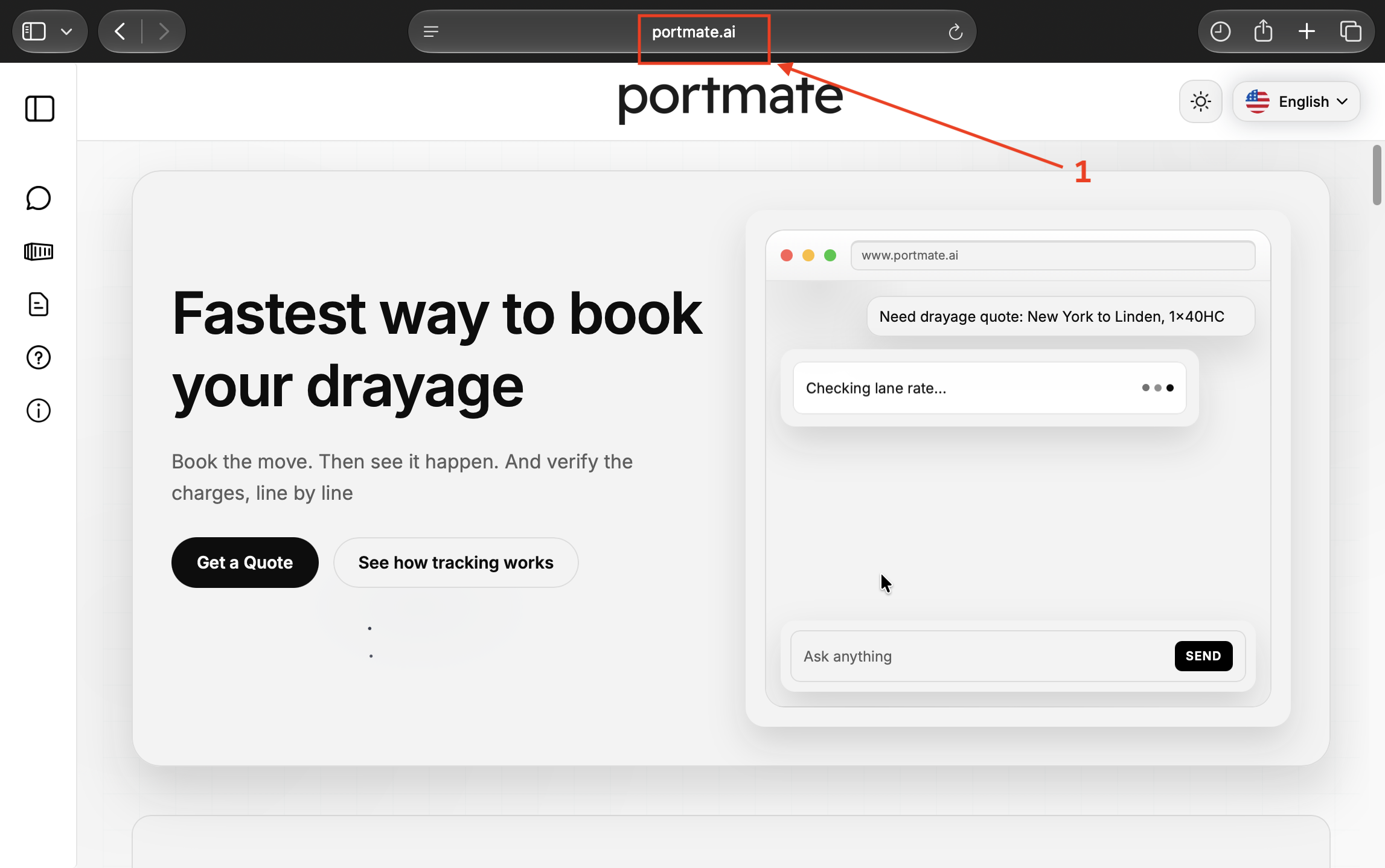
Step 1: Open Portmate. Visit in your browser.
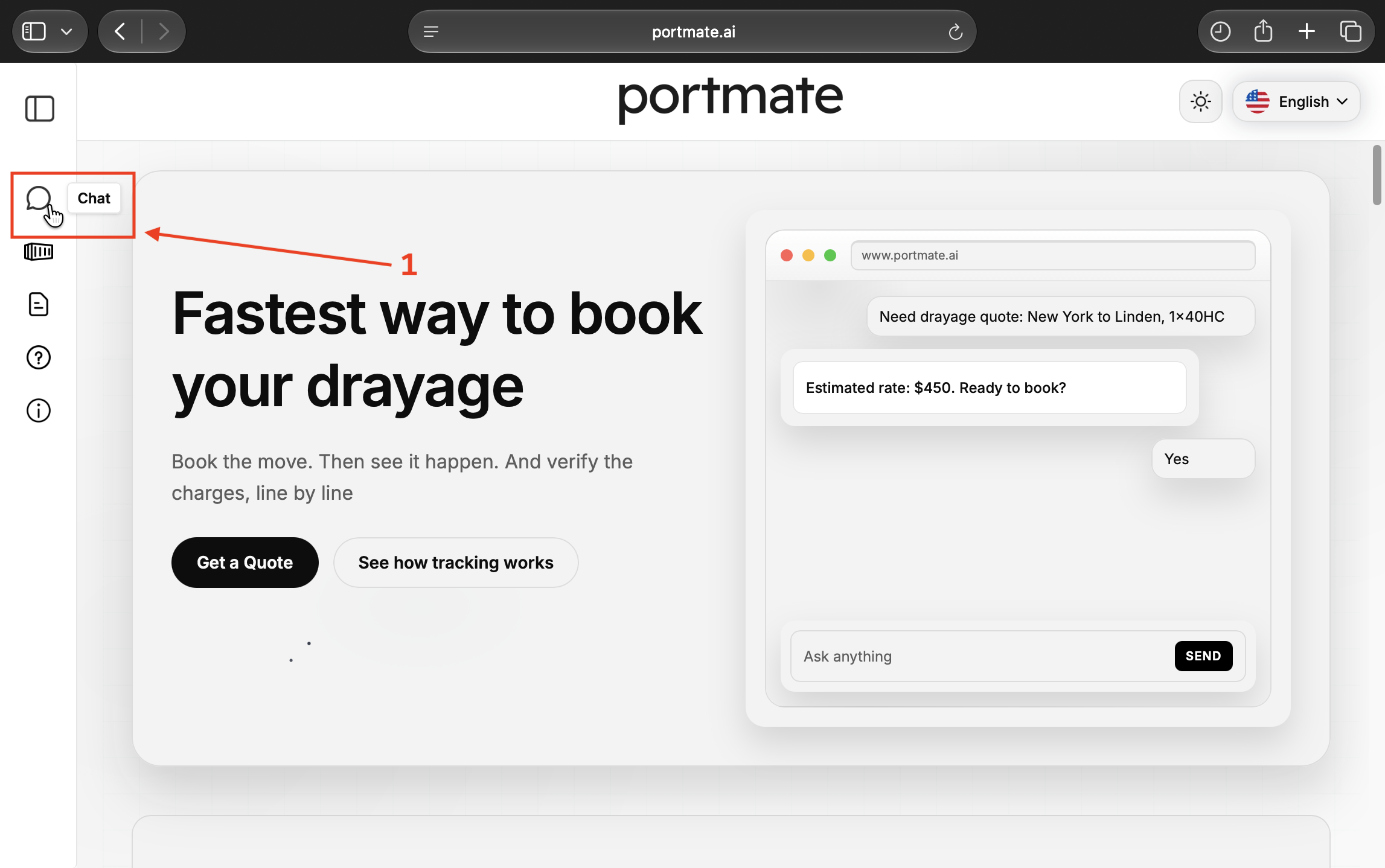
Step 2: Select Chat. Click the speech-bubble icon in the left navigation. Complete sign-in if prompted when requesting the quote.
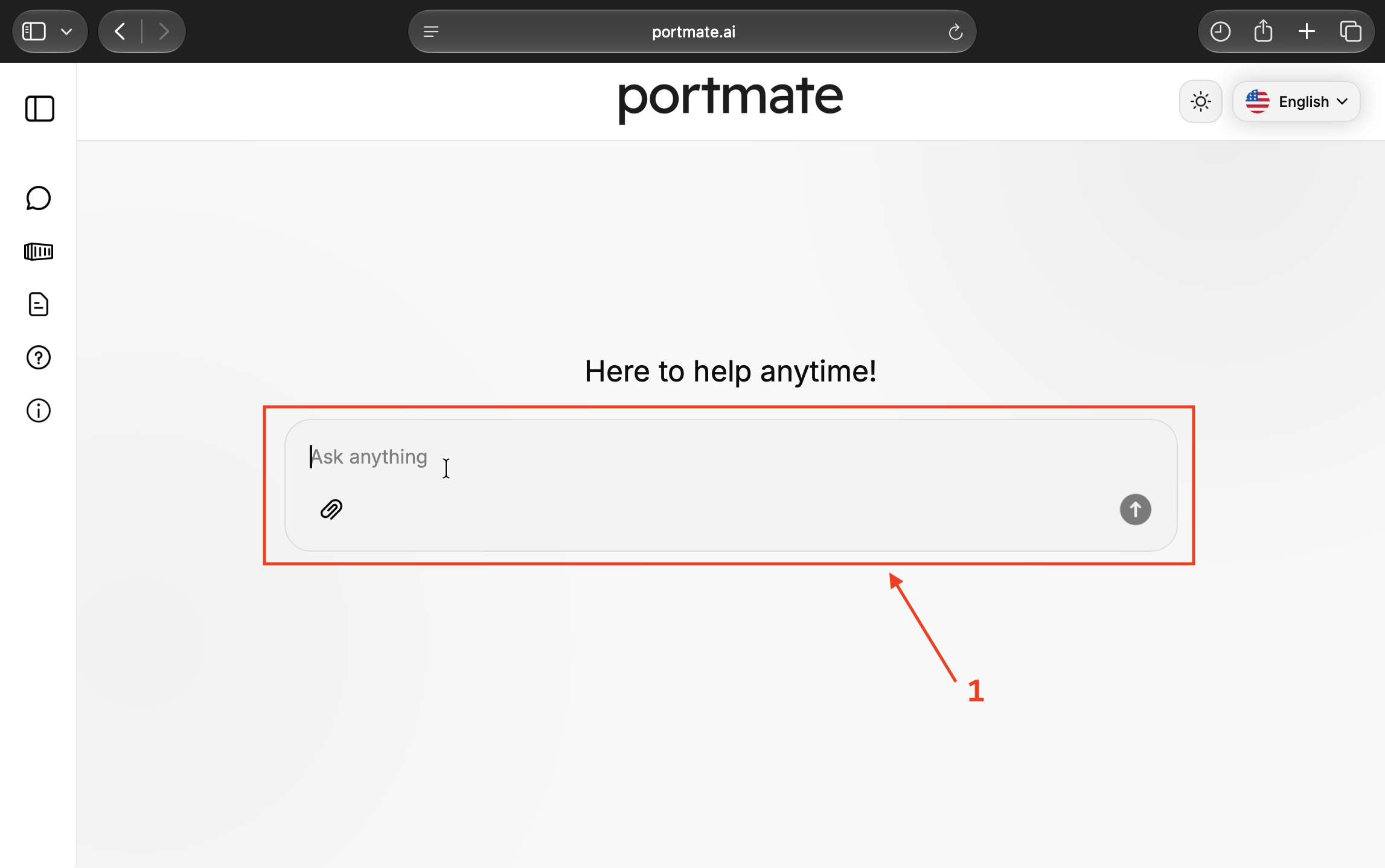
Step 3: Start your request. Use the Ask anything message box to describe the shipment in ordinary language.
Step 4: Submit the lane and container details. The example uses this request:
Give me a quote from Newark Container Terminal to Brooklyn, NY 11232, for 1×20' dry, I have an importSelect the upward-arrow send button to submit it.
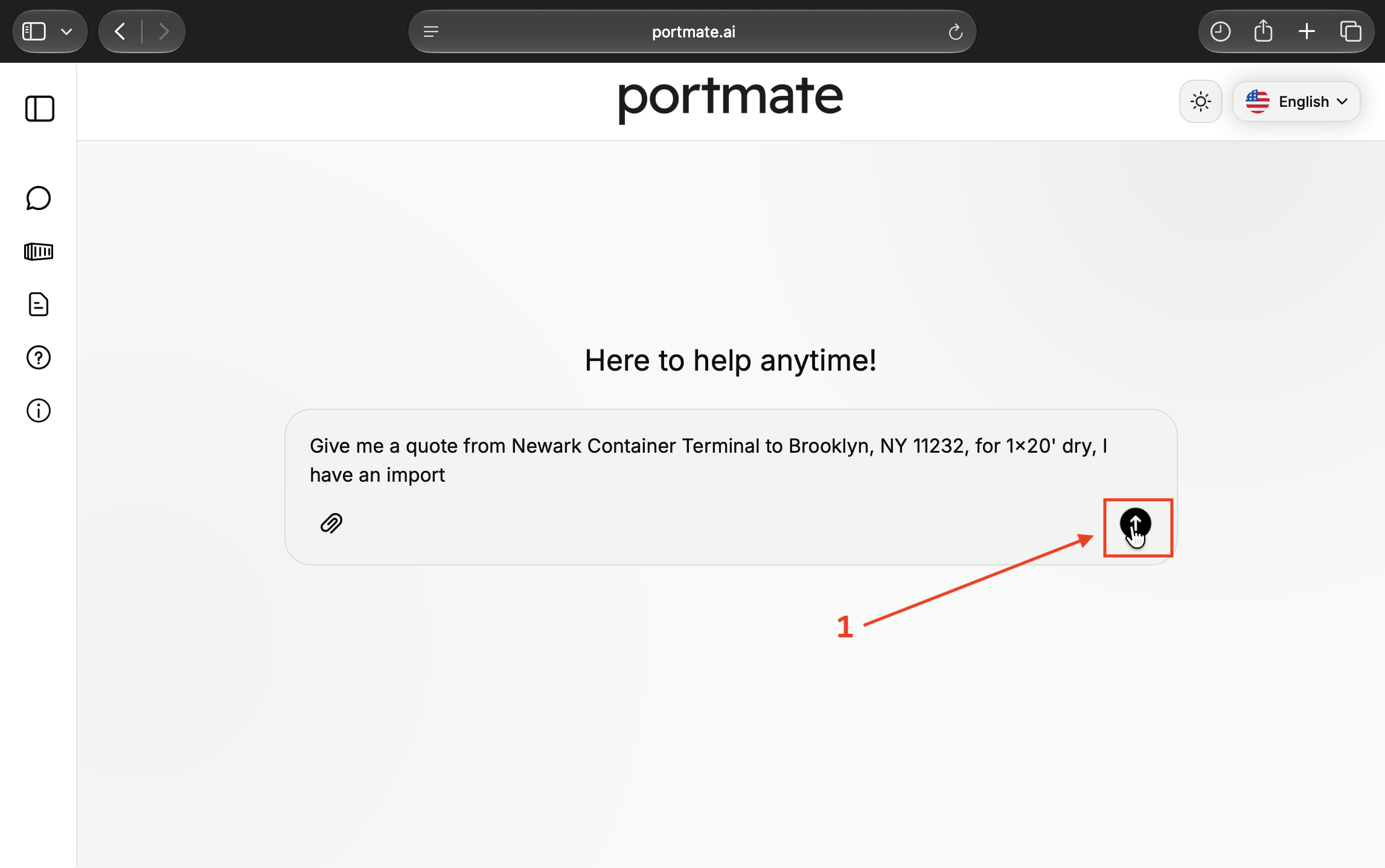
For your own shipment, include the exact terminal, delivery address or ZIP, import/export direction, container size and type, commodity, net cargo weight with units, and any special services you already know. Include live-unload or drop requirements and known empty-return instructions. More complete details reduce the number of assumptions needed for an initial quote.
If the request leaves a detail open, answer follow-up questions and review any disclosed assumptions. The covers the full request process.
Confirm the terminal and route assumptions
Step 5: Review the location being identified. In the example, the Activity panel identifies Port Newark Container Terminal as the candidate pickup location. Check that it is the terminal holding your container.
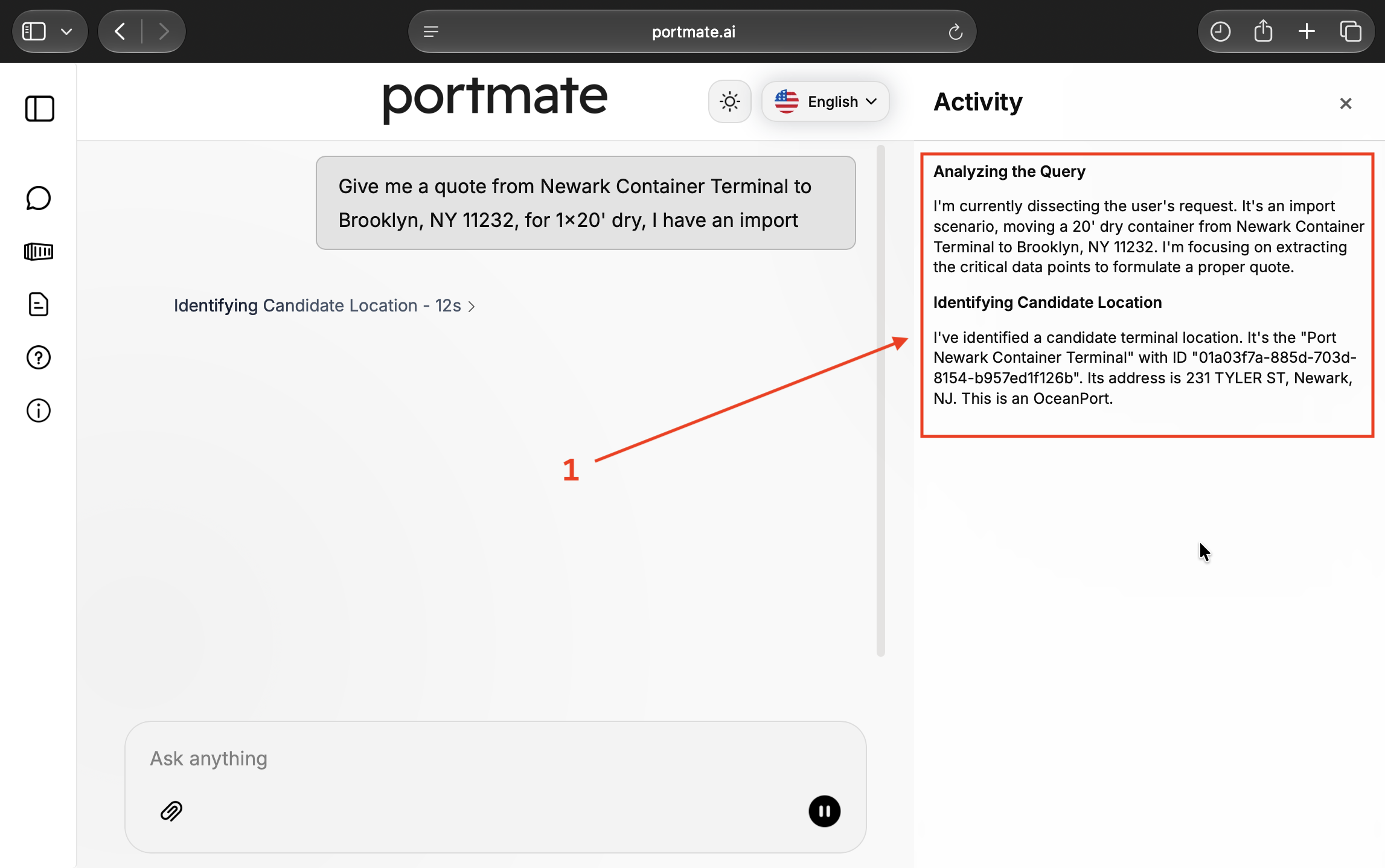
A city or informal terminal name can require a location match. If the selected facility is wrong, correct it before relying on the price. The guide to explains why a terminal assumption needs review.
The returned example includes the loaded pickup, Brooklyn delivery, and an empty-return depot. Its return location is explicitly marked as an assumed default return depot. Confirm the ocean carrier's actual authorized return instructions before dispatch; a pricing assumption does not establish that a depot will accept your container.
For the facilities involved in the pickup area, use the .
Read the fuel line alongside the complete price
Step 6: Inspect the cost breakdown. Find Fuel Surcharge, then review it with line haul, chassis, tolls, and the total.
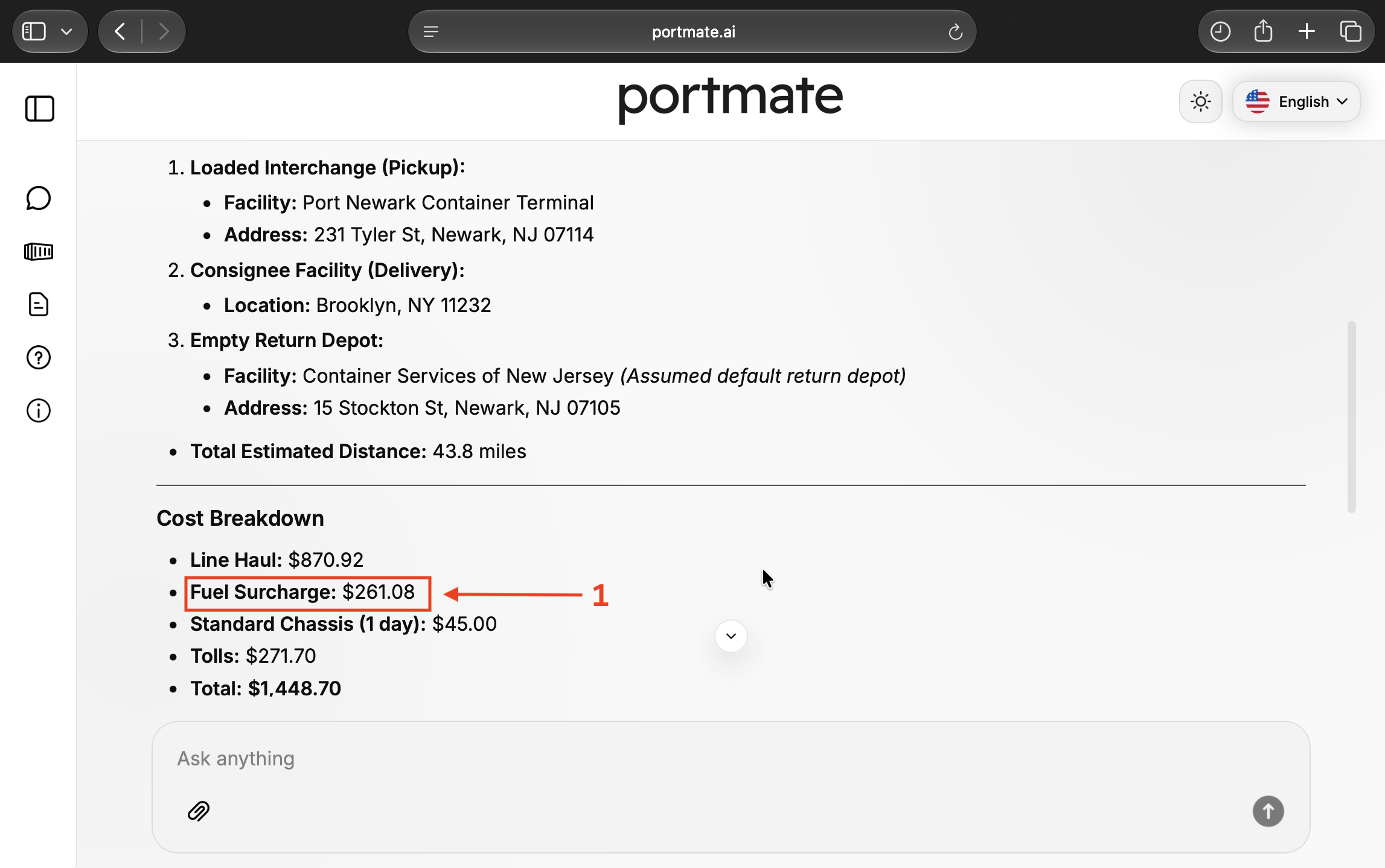
The example shows:
| Charge | Amount |
|---|---|
| Line haul | $870.92 |
| Fuel surcharge | $261.08 |
| Standard chassis, one day | $45.00 |
| Tolls | $271.70 |
| Total | $1,448.70 |
The four charge lines add to the displayed total. Fuel is already included in that $1,448.70, so adding the surcharge again would double-count it.
The displayed fuel amount is approximately 30% of line haul, but that does not establish a fixed 30% Portmate fuel rate. It is the amount in this particular quote. The EIA observations shown earlier are a separate market example and should not be used to reconstruct this screenshot's historical pricing.
Read the quantities as well as the dollar amounts. The chassis line covers one day in this example; a shipment requiring a longer equipment period needs the appropriate scope and pricing. The guide to explains that equipment component.
Check when the quote expires
The EIA observation date identifies the fuel data. The quote's valid-until or expiration date identifies the validity of the offered quote. A new weekly fuel observation and the expiry of an existing quote are separate events.
Review the validity information returned with your quote and keep it with the quote number when sharing the price. Before booking, check:
- The quote number and expiration information.
- Whether the quoted pickup, delivery, equipment, and services still match the shipment.
- Whether any assumptions have been replaced by confirmed instructions.
- Whether the planned operation requires a revised quote.
Use the validity returned for your own quote. If it is unclear in the conversation, ask Portmate to clarify the quote's expiration before proceeding.
A quote's validity can extend beyond the next weekly EIA release. Follow the quote's stated terms rather than substituting that release date as its expiry. A valid date also needs the original shipment scope: check pricing again if the terminal, delivery address, or service requirements change.
Portmate checks quote expiration when a quote is selected for booking. If it has expired, request a new quote. Use the when you are ready to proceed with a valid quote and confirmed shipment details.
Compare quotes without losing the full cost
A lower line-haul figure or a lower fuel percentage does not necessarily mean a lower shipment total. Compare the same operation, eligible charges, equipment quantities, and validity period.
For each quote, reconcile:
- Route: Loaded pickup, delivery, empty return, and any additional stops.
- Transportation and fuel: Whether fuel is separate or included, and what the offered total covers.
- Equipment and services: Chassis type and days, unloading arrangement, and requested accessorials.
- Conditional costs: Waiting, storage, failed trips, or other charges that depend on what happens.
- Validity and assumptions: When the quote expires and which details still need confirmation.
If a quote separates fuel while another includes it in the transportation price, compare the equivalent totals before deciding. If a receiver changes a live unload to an overnight drop, or the carrier changes the authorized empty-return location, obtain pricing for the revised operation. A change in total may have more than one cause.
The guide to explains how shipment details, time allowances, and service assumptions affect the final cost.
Common fuel-cost questions
These distinctions help when a fuel headline, an older quote, and the latest request appear to tell different stories.
Will a falling oil price reduce my drayage total by the same percentage?
No. Crude oil, retail diesel, and a drayage quote measure different things. Fuel is only one part of the move, and the quote also reflects its operating inputs. Compare a new quote for the same shipment scope rather than reducing an old total by the percentage in an oil-market headline.
Should I add fuel to the quoted total myself?
Check the breakdown. In the supplied example, the total already includes fuel. When comparing another provider's offer, establish whether its stated total includes the surcharge before adding anything.
Does Portmate continuously rewrite an older quote when EIA publishes new data?
Treat the returned quote and its validity as the record of that offer. Automatic benchmark tracking supports quote preparation; do not assume that reopening an older conversation has created a newly priced quote. Request a new quote when you need updated pricing, especially after expiration or a change in shipment scope.
What if an instant quote is unavailable?
Check any explanation returned in Chat. Usable fuel data, lane support, and other pricing inputs can affect availability. An unavailable result does not establish a zero fuel charge or justify copying a surcharge from another shipment. Provide requested details or seek help through the .